Unit 2: Skills lab manual for Teachers and students of senior four
2.6.Procedure: Hands Hygiene And Gloving
2.6.1.Technique: Simple Hand Washing
Aims of SIMPLE HAND
• To reduce the risk of infection by maintaining a clean environment
• To prevent infections
• To remove germs from hands
• To cleanse the hands of pathogens (bacteria, viruses, or othermicroorganisms that can cause disease).
Learning outcome• Perform correctly hand washing technique using appropriate steps.
ASSOCIATE NURSE STUDENT/ PREPARATION
• Should appear professional (in full and clean uniform) with student ID
Card
• Hair tied back and put bonnet
• Assemble equipment and arrange on bedside chair in the order the items will
be used
• Remove watch, jewels, and Rings• Wear closed shoes
EQUIPMENT
• Water
• Plain (non-antimicrobial) soap• Disposable towel
Simple hand washing’s steps
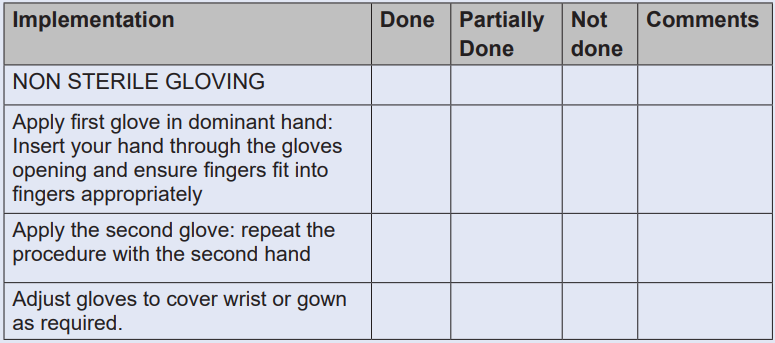
2.6.2.Techinque Non-Sterile And Sterile Gloving
AIMS
• To protect Associate nurses’ hands when handling substances
• To reduce likelihood of transmitting micro-organisms from nurses to the
patient and vice-versa;
• To reduce likelihood of transmitting micro-organisms from one patient tothe other.
ASSOCIATE NURSE PREPARATION
• Should appear professional (in full and clean uniform) with ID Card
• Hair tied back
• Remove watch, jewels, and Rings
• Wear closed shoes
• Ensure nails are cut short• Hand washing
EQUIPMENT
• Clean gloves(for non sterile gloving)• Sterile Gloves(for sterile Gloving)
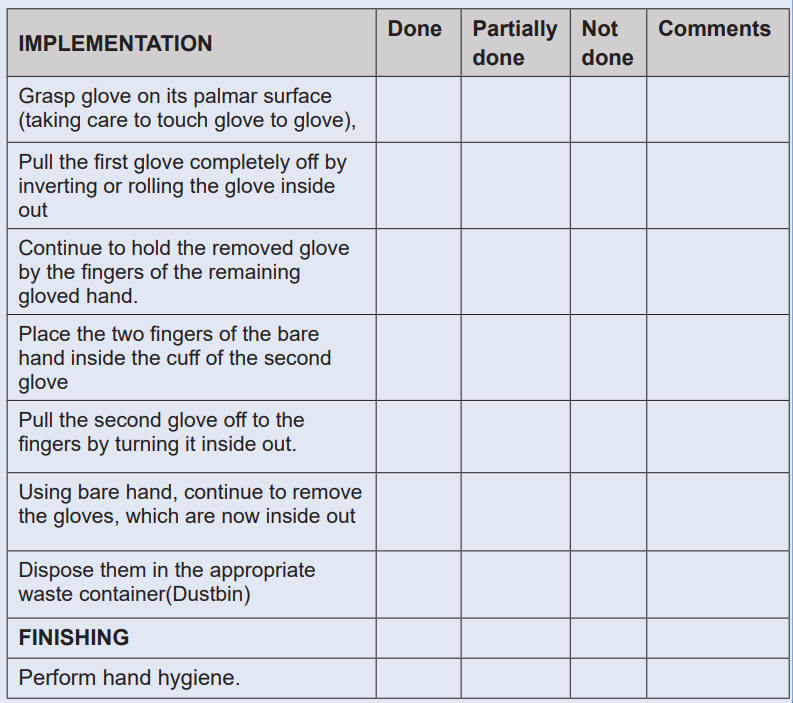
2.6.3.Technique: Removing Non-Sterile And Sterile Gloves
AIMS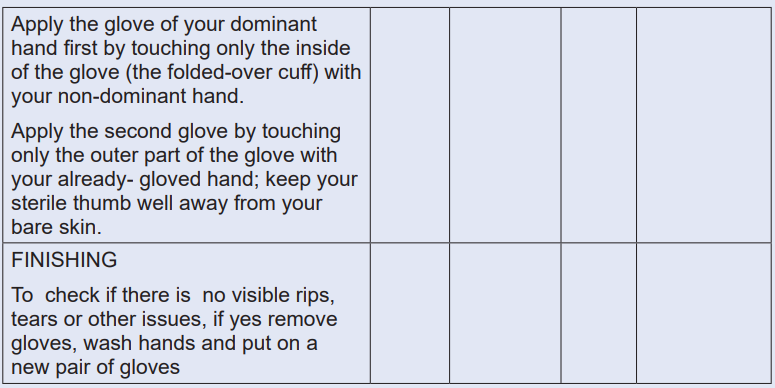
• To reduce likelihood of transmitting micro-organisms from associate nurse
student to the patient and vice-versa;
• To reduce likelihood of transmitting micro-organisms from one patient tothe other.
ASSOCIATE NURSE PREPARATION
• Should appear professional (in full and clean uniform) with ID Card
• Hair tied back
• Remove watch, jewels, and Rings
• Wear closed shoes
• Ensure nails are cut short• Hand washing
EQUIPMENTS• Dustbin
Steps
2.7. Procedure: Bedmaking
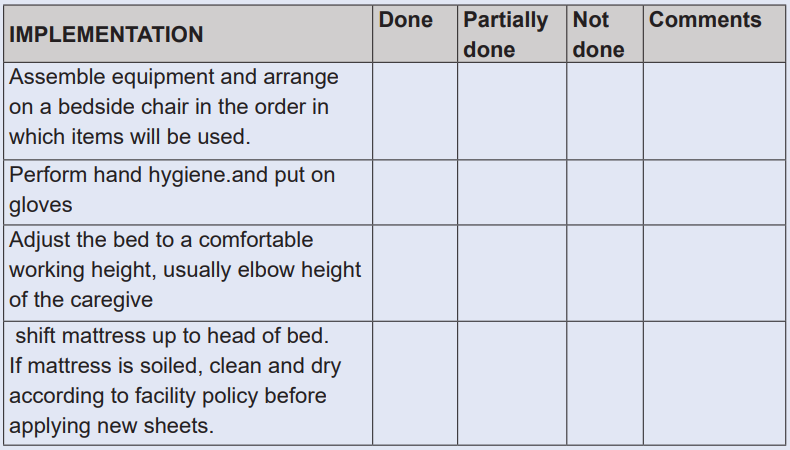
2.7.1.Technique: Unoccupied Bed, With Changing Bed-Sheets: OneNurse
AIMS
• To provide clean and comfortable position of the patient,
• To reduce risk of infection
• To Prevent bed sores
Learning outcomes:
ASSOCIATE NURSE PREPARATION
• Should appear professional (in full and clean uniform) with ID Card
• Hair tied back
• Remove watch, jewels, and Rings
• Wear closed shoes
• Ensure nails are cut short
• Hand washing
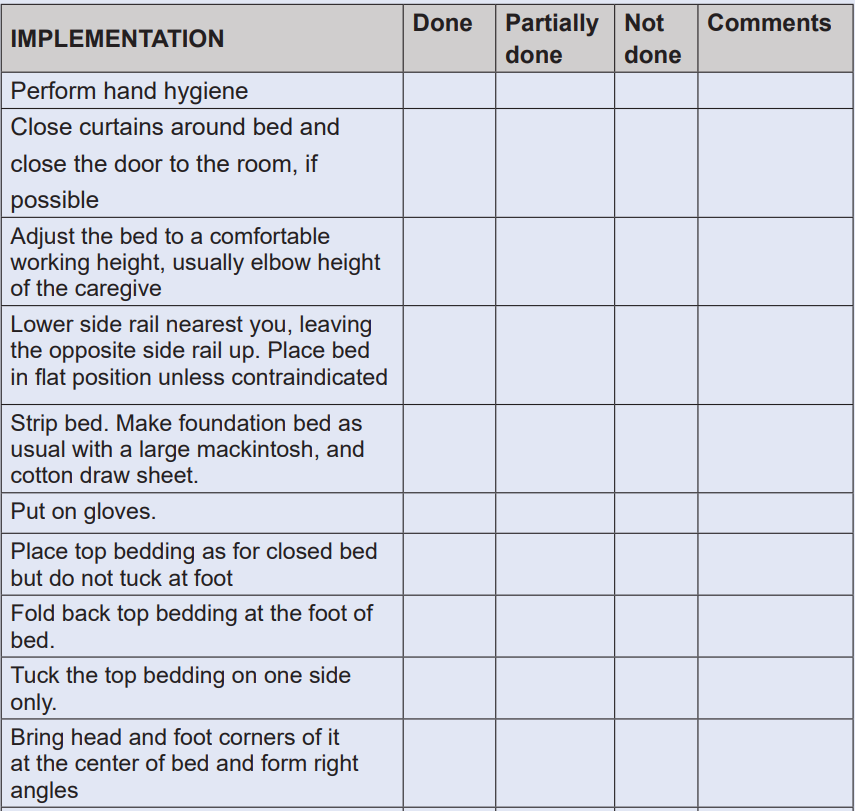
EQUIPMENTS
• Pillow case
• Protective gloves
• Blanket
• Waterproof protective pad• Linen hamper or bag
Steps
2.7.2.Techinque: Unoccupied Bed, With Changing Bed-Sheets :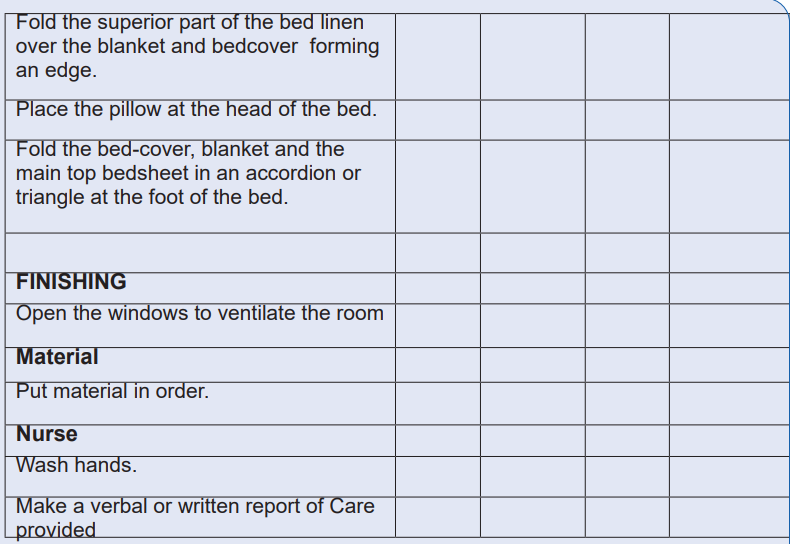
Two Associate Nurses.
AIMS
• To provide clean, safe and comfortable bed for the patient
• To promote rest and sleep
• To reduce the risk of infection by maintaining a clean environment
• To prevent bed sores• To observe patient and to prevent complications
Learning outcomes:
• To provide physical and psychological comfort and security to the patient.• Demonstrate the ability to make an unoccupied bed
ASSOCIATE NURSE STUDENT/ PREPARATION
• Should appear professional (in full and clean uniform) with ID Card
• Hair tied back
• Remove watch, jewels, and Rings
• Wear closed shoes• Hand washing
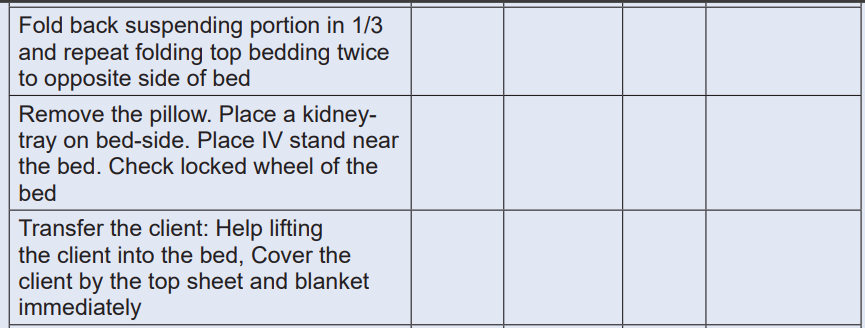
EQUIPMENTS
• Pillow case
• Protective gloves
• Blanket
• cleaning materials
• Linen hamper or bag
• 2 Bed sheet (bottom sheet and top sheet)
• Draw sheet• Mackintosh (if contaminated or needed to change
Steps
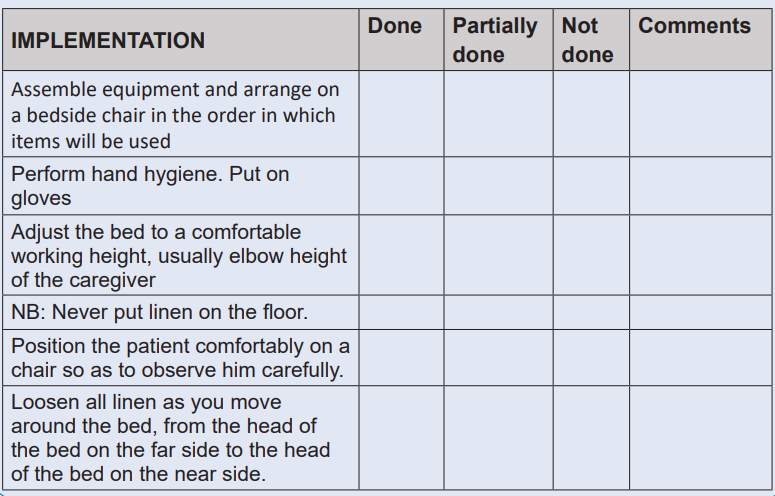
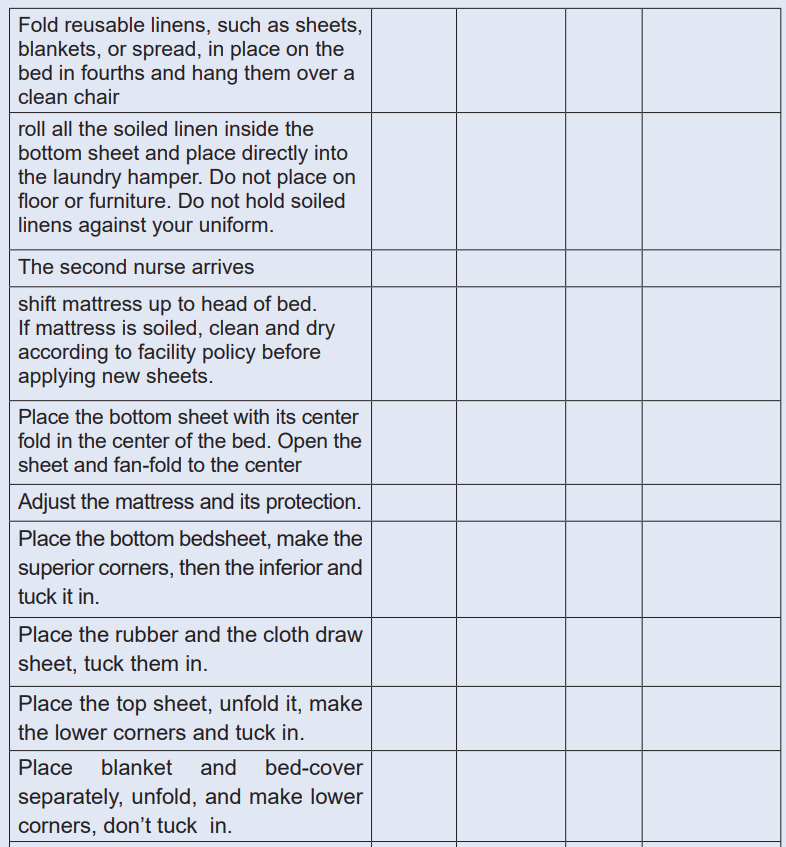
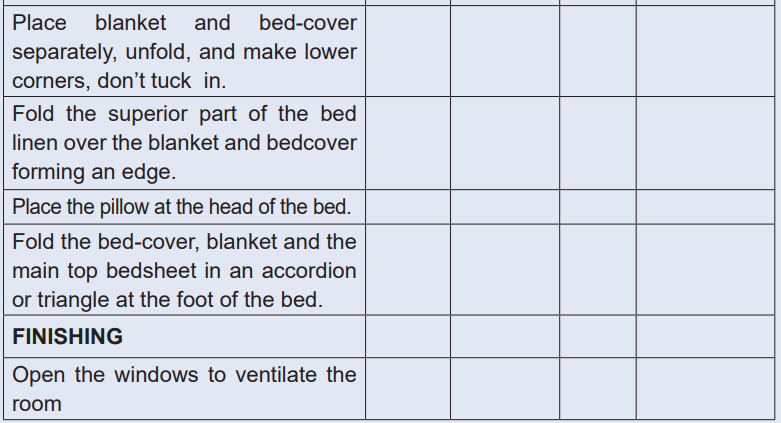
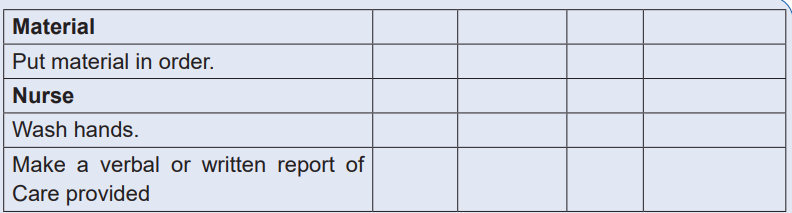
2.7.3.Techinque: Unoccupied Bed Making Without Changing Bed Sheets
AIMS
• To be ready for the next occupant
• To prepare the bed for the client return
• To provide a clean environment
• To provide a good appearance• To minimize sources of infections
earning outcomes:
• To provide physical and psychological comfort and security to the patient.• Demonstrate the ability to make an unoccupied bed
ASSOCIATE NURSE / PREPARATION
• Should appear professional (in full and clean uniform) with ID Card
• Hair tied back
• Remove watch, jewels, and Rings
• Wear closed shoes• Hand washing
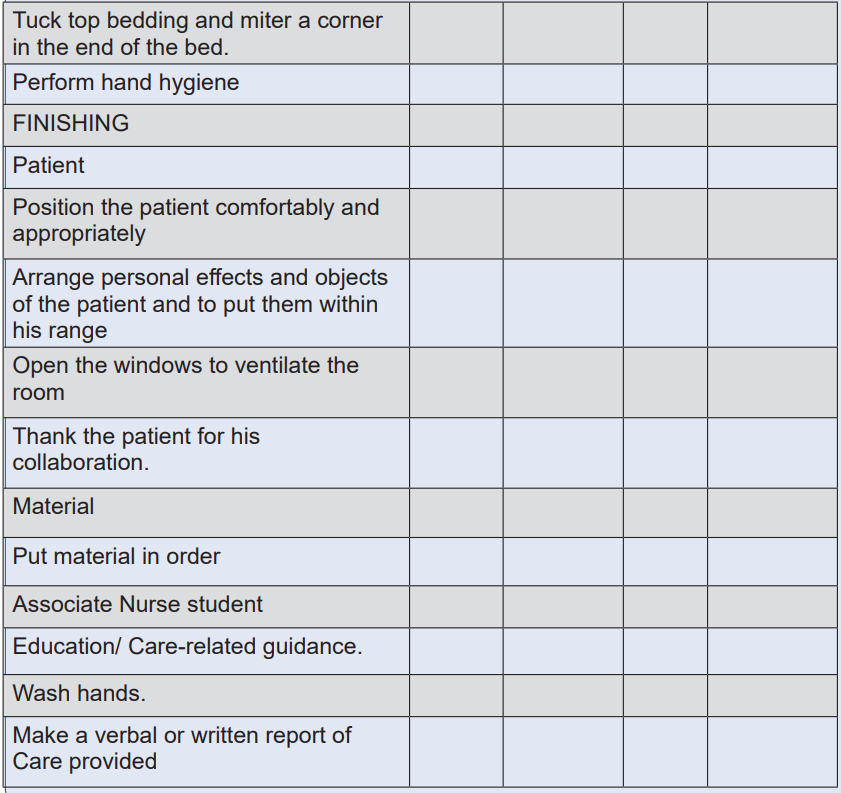
EQUIPMENTS
• Two large cotton sheets
• One water proof draw mackintosh (if necessary)
• One draw sheet (if necessary)
• One or two pillows
• Pillow slips/covers
• One blanket optional• One bed cover or counterpane
Steps
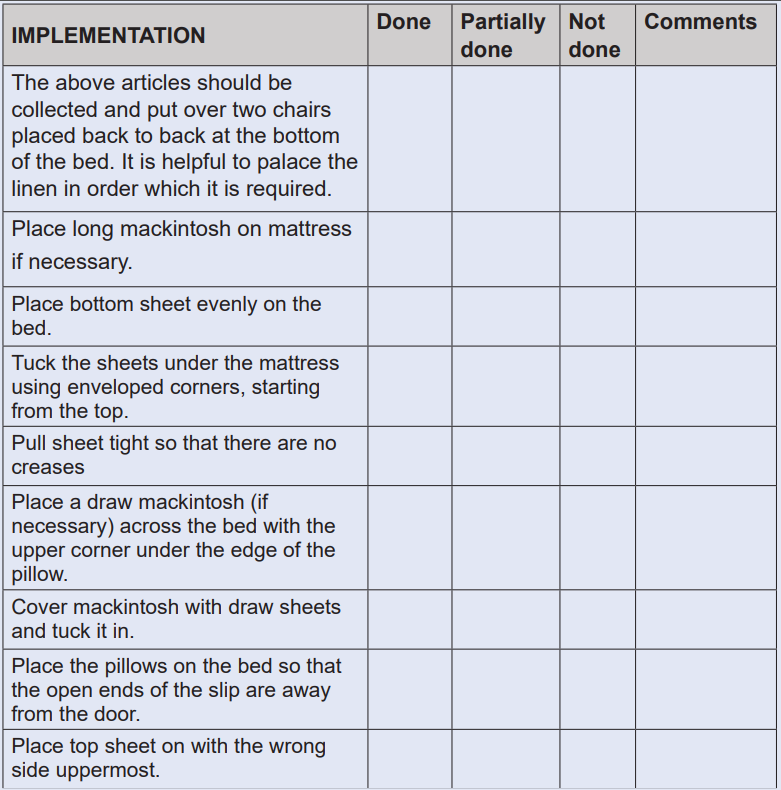
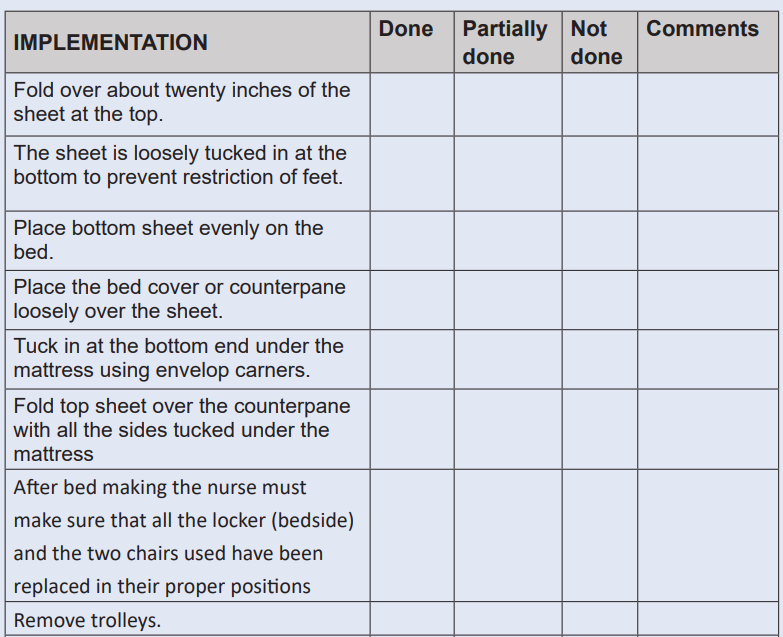
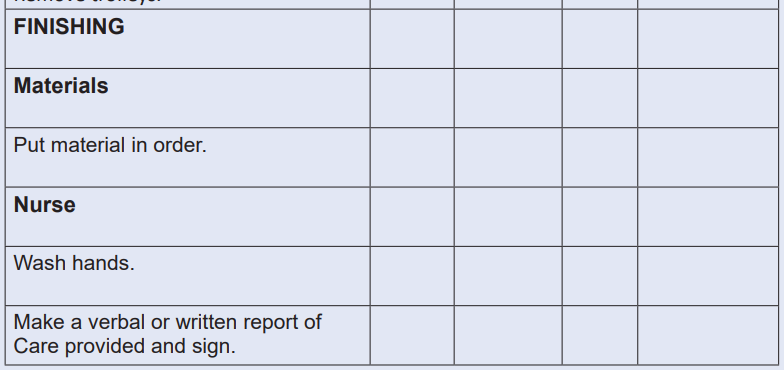
2.7.4.Techinque: Occupied Bed, With Changing Bed-Sheets: Two Nurses Patient Can Turn
ASSOCIATE NURSE STUDENT / PREPARATION
• Should appear professional (in full and clean uniform) with ID Card
• Hair tied back
• Remove watch, jewels, and Rings
• Wear closed shoes• Hand washing
PATIENT PREPARATION
• Identification of the patient
• Self-presentation to the patient
• Physical and psychological patient preparation
• Assess levels of comprehension and collaboration of the patient
• Adjust the environment of the patient as necessary.
• Check chart for limitations on patient’s physical activity.• Cleanliness or condition of the bed and surrounding environment
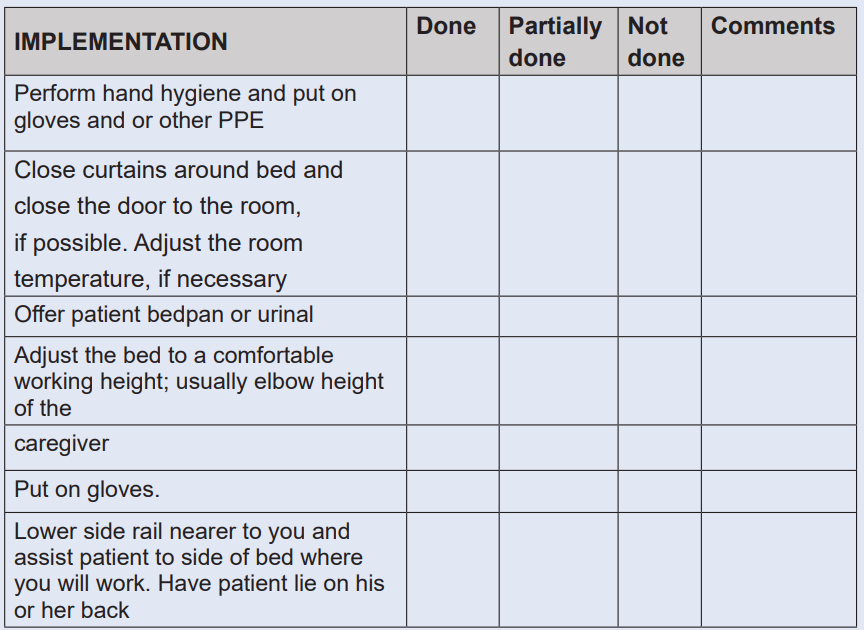
EQUIPMENTS
• Pillow case
• Protective gloves
• Blanket
• cleaning materials ,
• Basin
• Linen hamper or bag
• 2 Bed sheet ( bottom sheet and top sheet)
• Draw sheet
• Mackintosh ( if contaminated or needed to change)• Chair
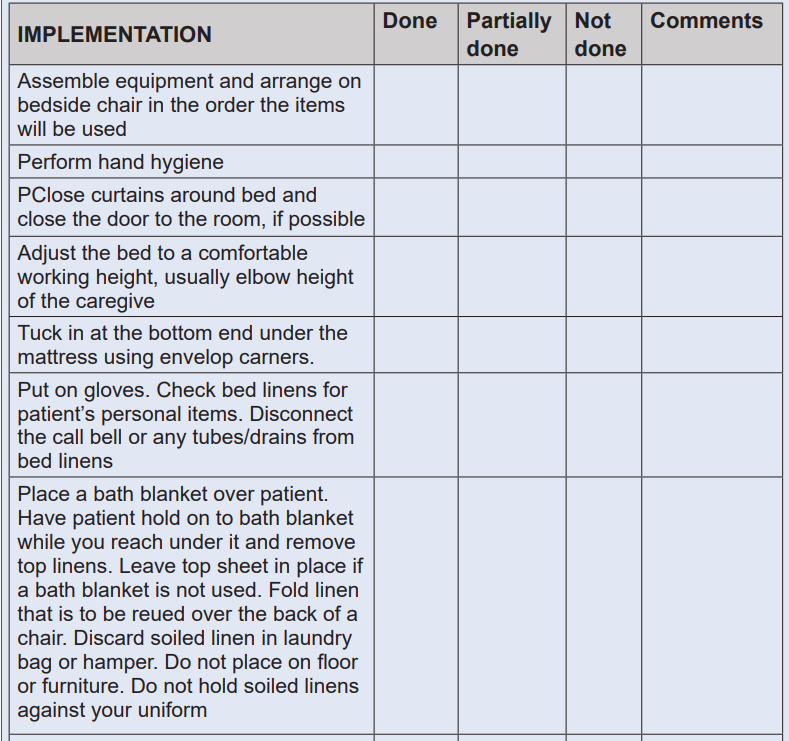
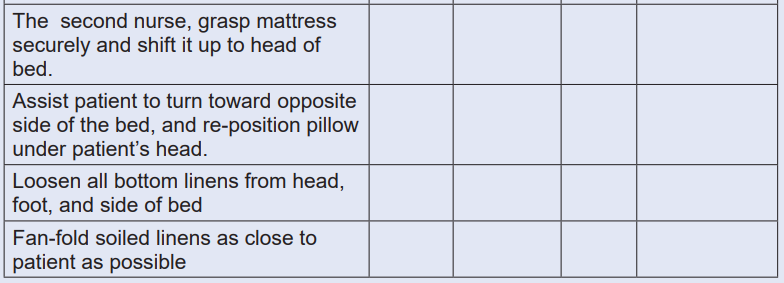
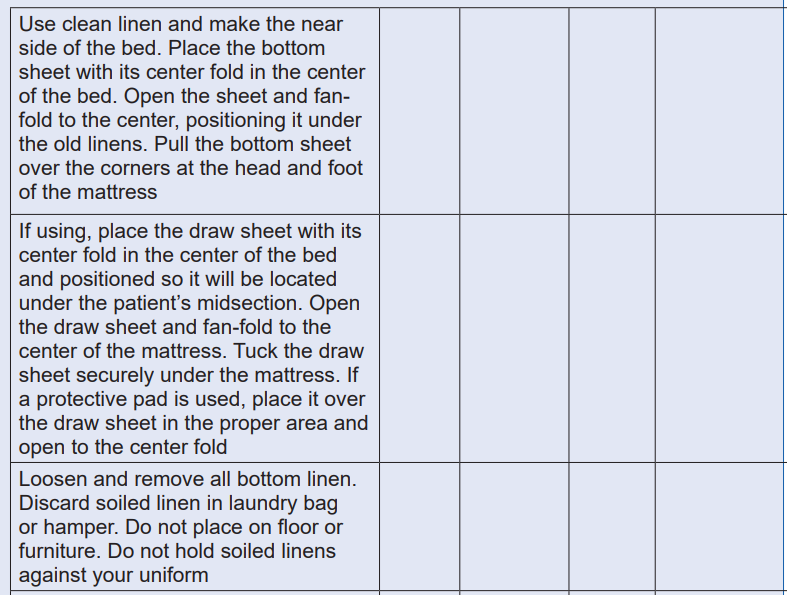
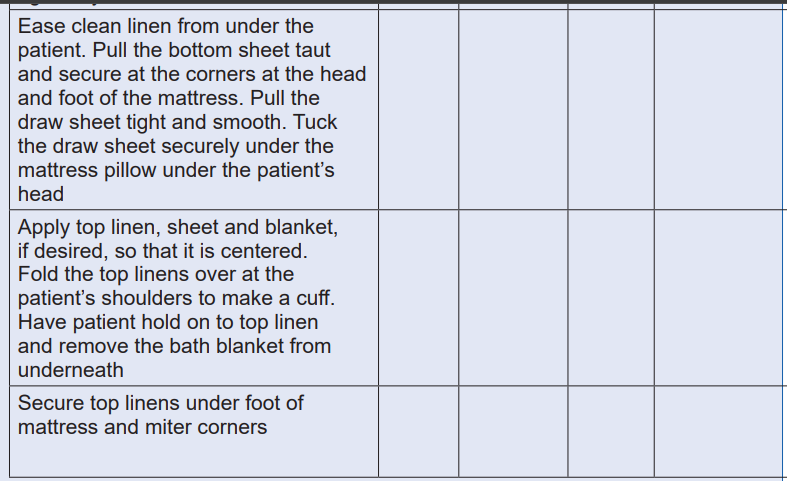
Steps
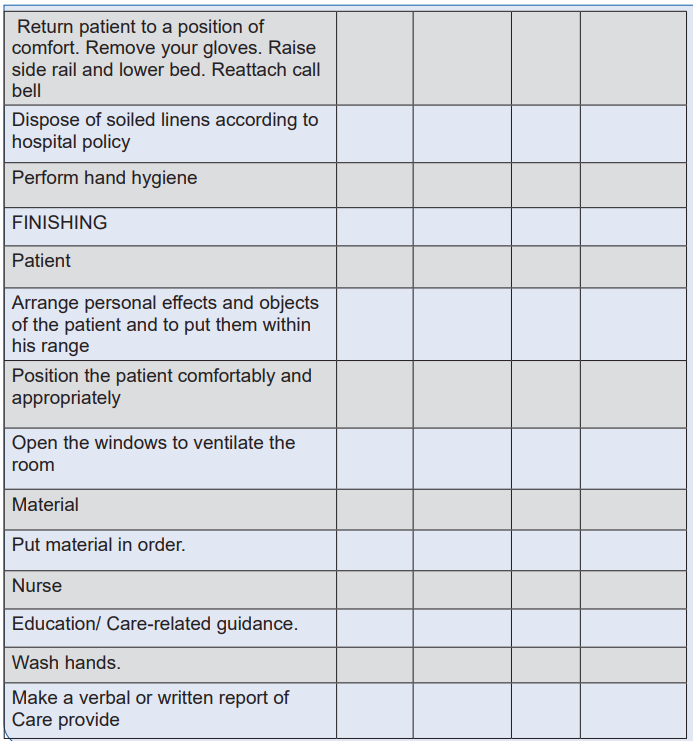
2.7.5.Techinque: Occupied Bed Making, Patient Can Sit
AIMS
• To promote the clients comfort
• To provide a clean environment for the client
• To minimize source of skin irritation
• Provide safety
• These are appliances used in bed making
• Provide comfort of the patient
• For the protection of bed linen
• Prevention of pressure sores• To facilitate putting the patient into bed without delay etc.
Learning outcomes:
• To provide physical and psychological comfort and security to the patient.• Demonstrate the ability to make an occupied bed
ASSOCIATE NURSE STUDENT / PREPARATION
• Should appear professional (in full and clean uniform) with ID Card
• Hair tied back
• Remove watch, jewels, and Rings
• Wear closed shoes• Hand washing
PATIENT PREPARATION
• Identification of the patient
• Self-presentation to the patient
• Physical and psychological patient preparation
• Assess levels of comprehension and collaboration of the patient
• Explain to the patient/ family the rational of BP check up
• Position the patient in a comfortable position• Instruct the patient to have a rest for at least 10 minutes.
EQUIPMENTS
• Gloves
• Mattress Pad
• Bottom draw Sheet
• Cotton draw sheet
• A plastic draw sheet
• Pillowcase
• Top sheet
• Blanket
• Bed Spread
• Linen Hamper or bag• Bed side
Steps
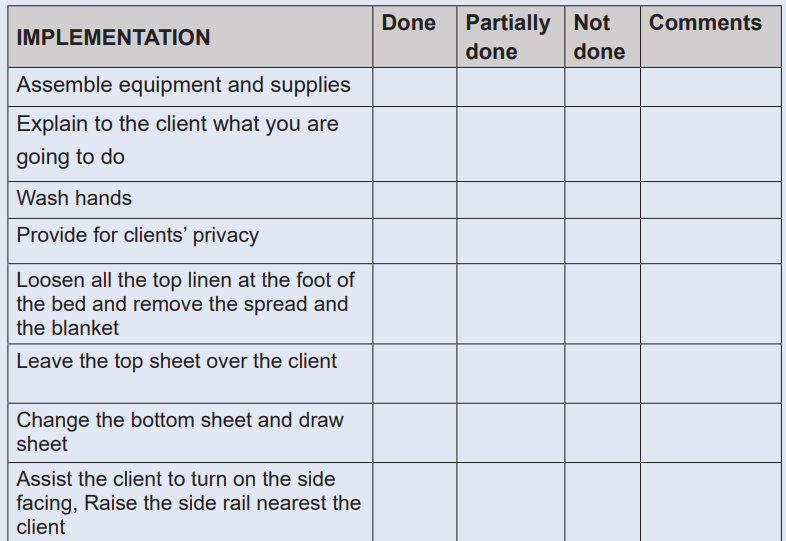
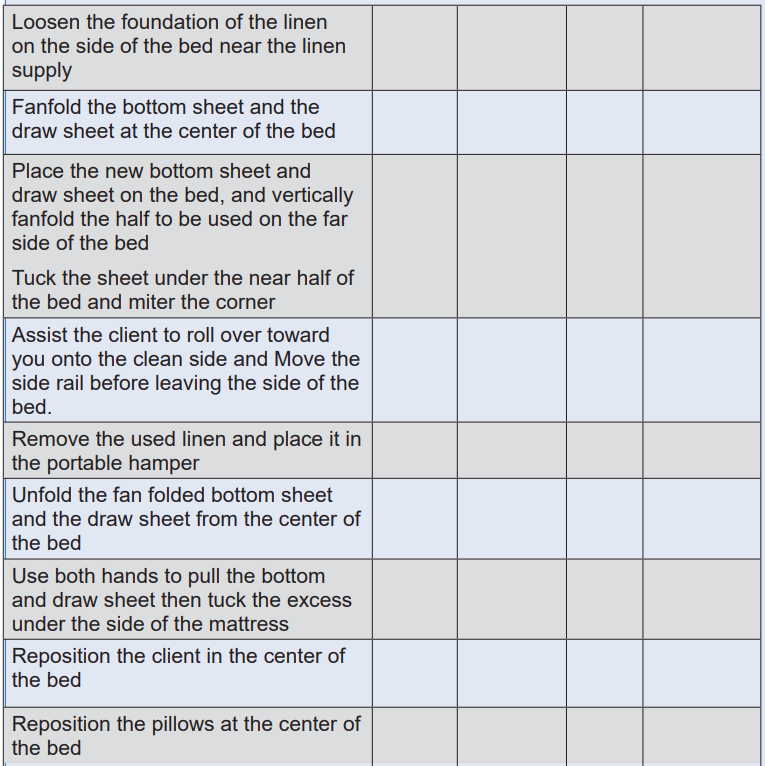
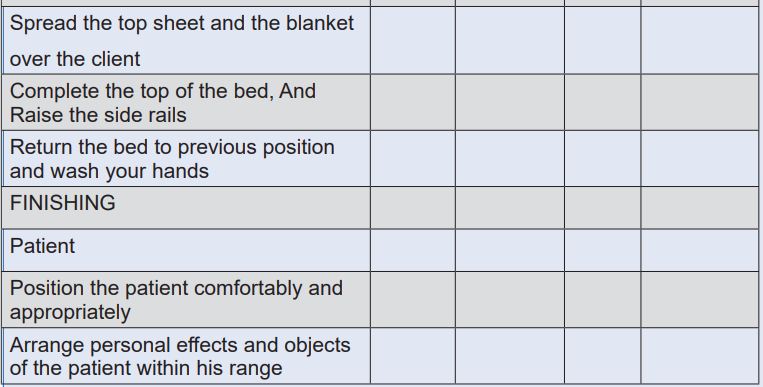
3..2.6. Techinque: Procedure: Occupied Bed Making, Patient Cannot Sit Or Turn
AIMS
• To change the linen with the least possible disturbance to the patient
• To draw or fix the sheets under the patients very firmly so that it would not
wrinkle
• To remove crumbs from the bed.
• To make patient feel comfortable.
• Learning outcomes:
• To provide physical and psychological comfort and security to the patient.• Demonstrate the ability to make an occupied bed
ASSOCIATE NURSE / PREPARATION
• Should appear professional (in full and clean uniform) with ID Card
• Hair tied back
• Remove watch, jewels, and Rings
• Wear closed shoes• Hand washing
PATIENT PREPARATION
• Identification of the patient
• Self-presentation to the patient
• Physical and psychological patient preparation
• Assess levels of comprehension and collaboration of the patient
• Position the patient in a comfortable position
• Make sure that the patient was at least 5-10 min before assessingrespiration
EQUIPMENTS
• Necessary linen.
• Tray for stripping and airing.
• Laundry bag or hamper
• Gloves
• Mattress Pad
• Bottom draw Sheet
• Cotton draw sheet
• A plastic draw sheet
• Pillow Case
• Top bed sheet
• Blanket
• Bed Spread
• Linen Hamper or bag• Bed side
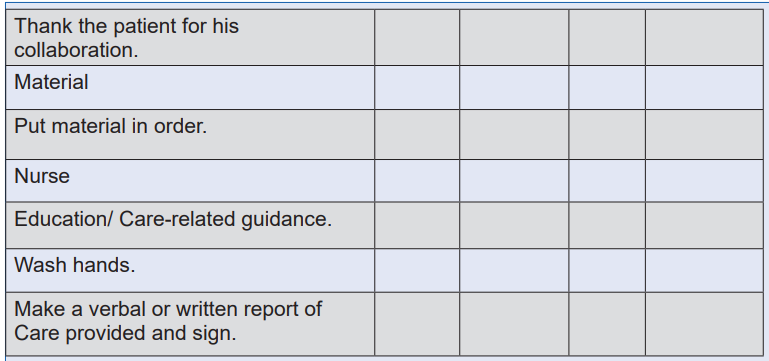
Steps
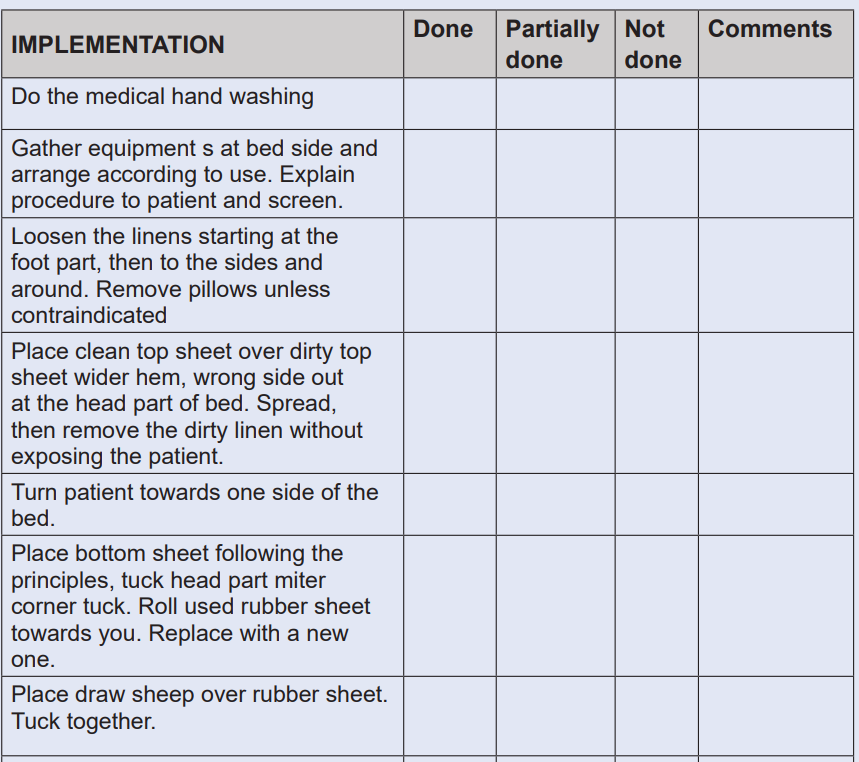
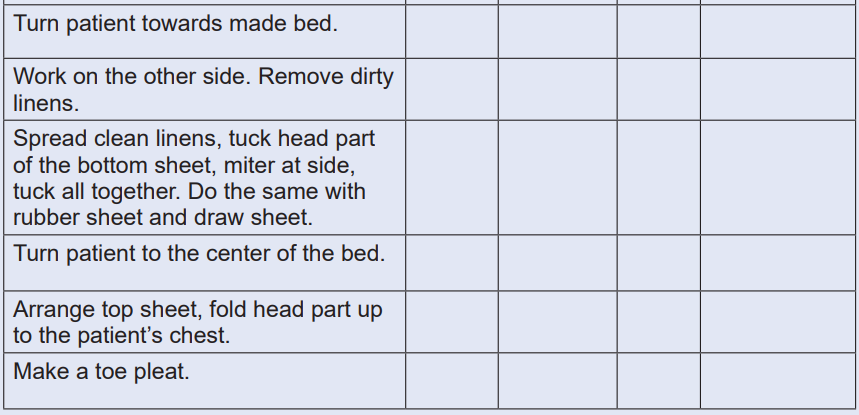
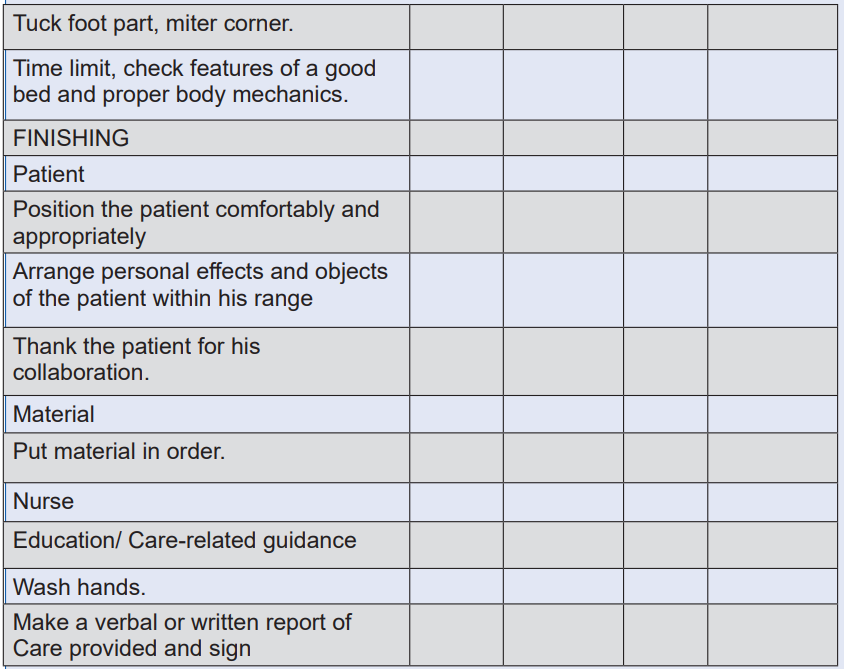
3.2.7. Techinque: Post-Operative Bed Making
AIMS
• To provide clean, safe and comfortable bed for the patient
• To promote rest and sleep
• To reduce the risk of infection by maintaining a clean environment
• To prevent bed sores
• To economize time and energy
• To observe patient and to prevent complications
• Learning outcomes:
• To provide physical and psychological comfort and security to the patient.• Demonstrate the ability to make a postoperative bed
ASSOCIATE NURSE / PREPARATION
• Should appear professional (in full and clean uniform) with ID Card
• Hair tied back
• Remove watch, jewels, and Rings
• Wear closed shoes• Hand washing
EQUIPMENTS
• Pillowcase
• Protective gloves
• Bed sheets: Bottom sheet (1)
• Top sheet (1)
• Draw sheet (1-2)
• Mackintosh
• Draw sheet
• Mackintosh ( if contaminated or needed to change)According to the
type of operation, the
• number required of mackintosh and draw
• sheet is different.
• Blanket (1) Hot water bag with hot water if needed
• Materials for vital signs
• Iv stand• Chair
Steps
2.8. Procedure: Bedbath
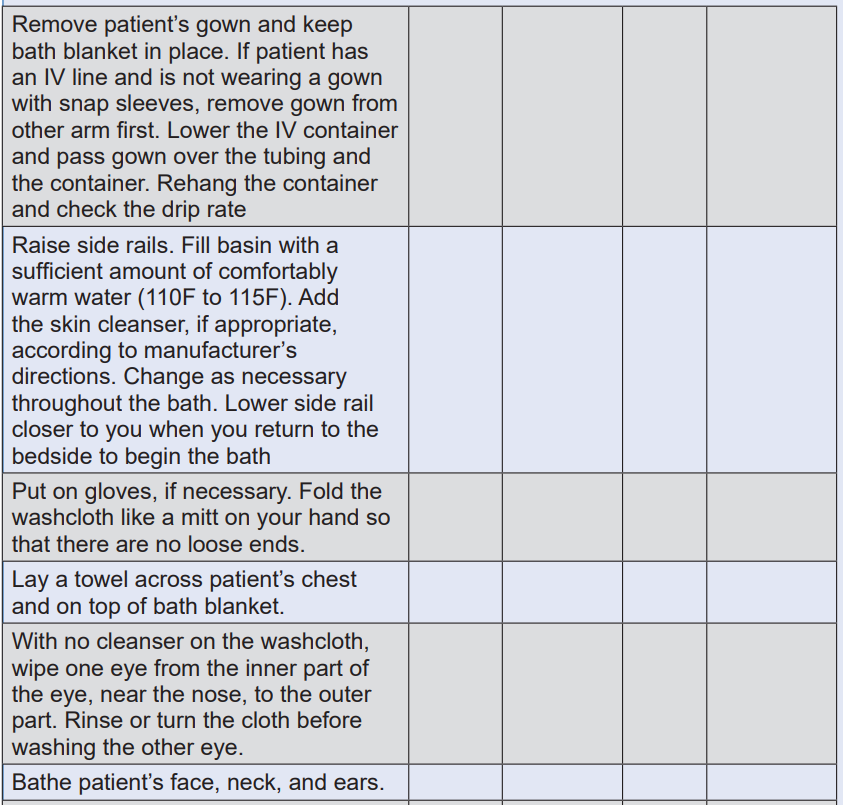
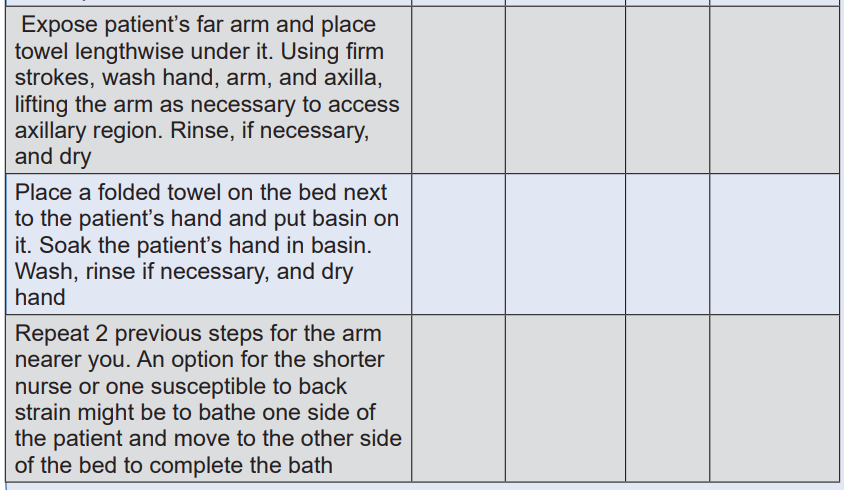
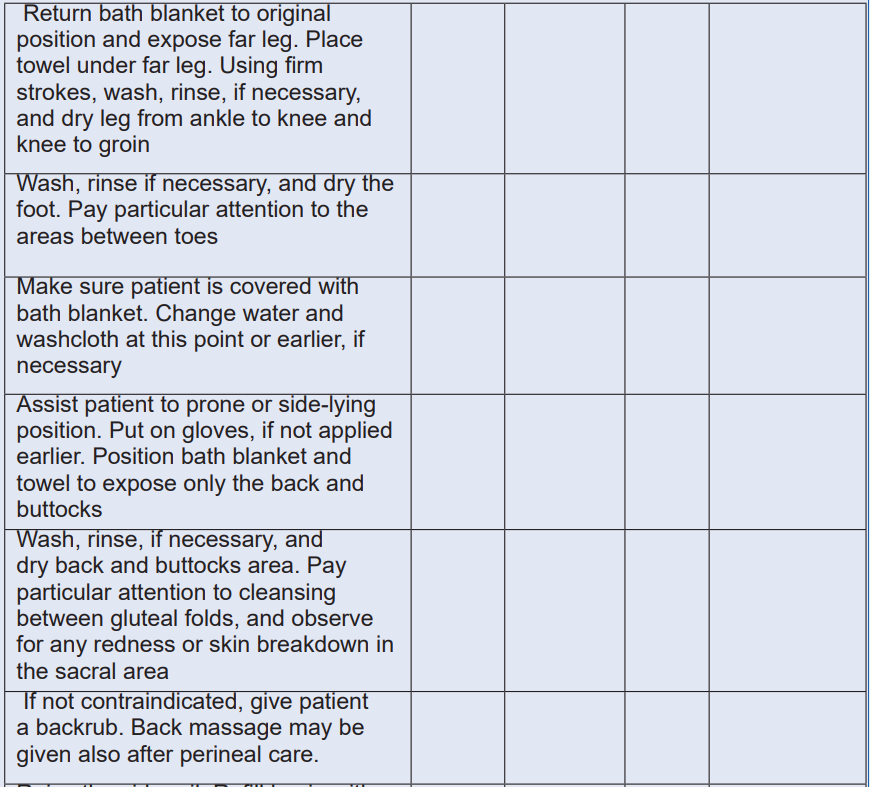
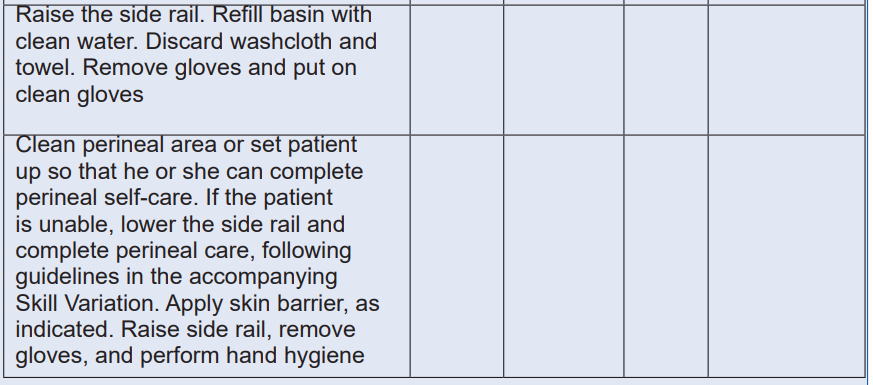
3.3.1. Techinque: Complete Bed Bath Patient Can Not Sit
AIMS
• To promote hygiene
• To prevent bacteria spreading on the skin
• To stimulate circulation
• To promote patient comfort and induce sleep
• To prevent bed sores• To observe the client for any complications
Learning outcomes:
• To perform correctly the technic of bed bath• Apply environmental safety
ASSOCIATE NURSE STUDENT / PREPARATION
• Should appear professional (in full and clean uniform) with ID Card
• Hair tied back
• Remove watch, jewels, and Rings
• Wear closed shoes• Hand washing
PATIENT PREPARATION
• Identification of the patient
• Self-presentation to the patient
• Physical and psychological patient preparation
• Assess levels of comprehension and collaboration of the patient
• Adjust the environment of the patient as necessary.• Check chart for limitations on patient’s physical activity.
EQUIPMENTS
• 2 Basins ( 1 with soap and 1 without soap)
• 2 Bucket: ( 1 for hot clean water, 1 for waste)
• 1 jug
• 1 Soap with soap dish
• 2 Sponge cloth ( 1 for wash another for rinse)
• Face towel
• 2 bath towels ( 1 for covering over mackintosh another for coveringclient body)
• 1 Mackintosh
• 1 trolley
• Thermometer
• Paper bag
• Personal hygiene supplies ( deodorant, lotion, powder, combs, etc)
• Folded screens.
• Bag for dirty linen.• Clean Clothing or hospital gown.
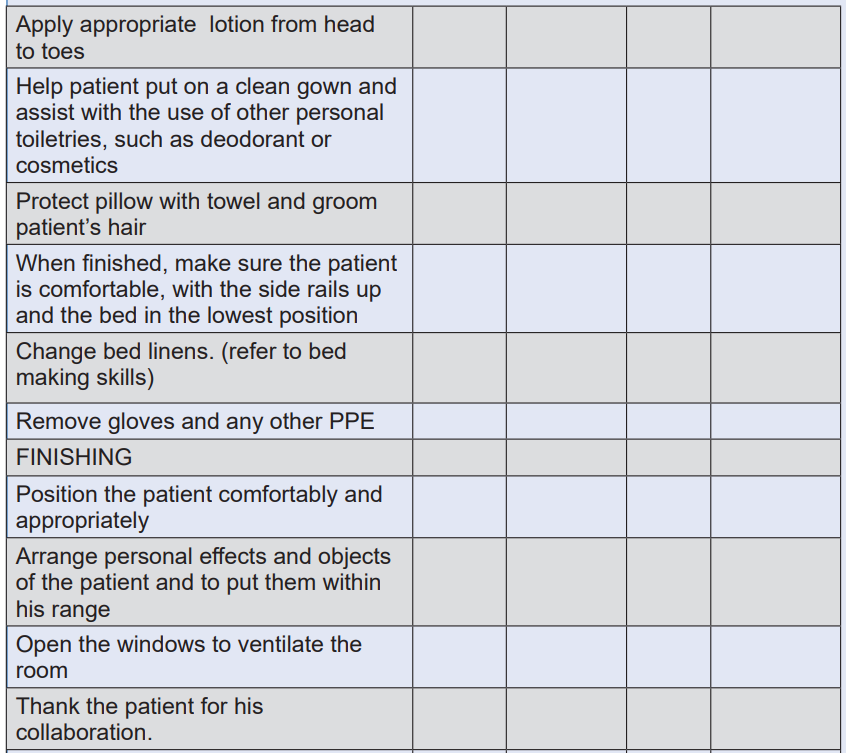
Steps
3.3.2. Techinque: Complete Bed Bath, Patient Can Sit
AIMS
• To Bath is an important part of professional hygiene
• To Bath cleanses the skin and makes the patient more comfortable
• To stimulate the circulation and relax the patient
• To provide the good opportunity to observe the client body and as well ascommunicate with the patient
ASSOCIATE NURSE STUDENT / PREPARATION
• Should appear professional (in full and clean uniform) with ID Card
• Hair tied back
• Remove watch, jewels, and Rings
• Wear closed shoes• Hand washing
PATIENT PREPARATION
• Identification of the patient
• Self-presentation to the patient
• Physical and psychological patient preparation
• Assess levels of comprehension and collaboration of the patient
• Explain to the patient/ family the rational of pulse check up
• Position the patient in a comfortable position• Make sure that the patient has been at rest for at least 10 minutes.
EQUIPMENTS
• Two large cotton sheets
• One water proof draw mackintosh (if necessary)
• One draw sheet (if necessary)
• One or two pillows
• Pillow slips/covers
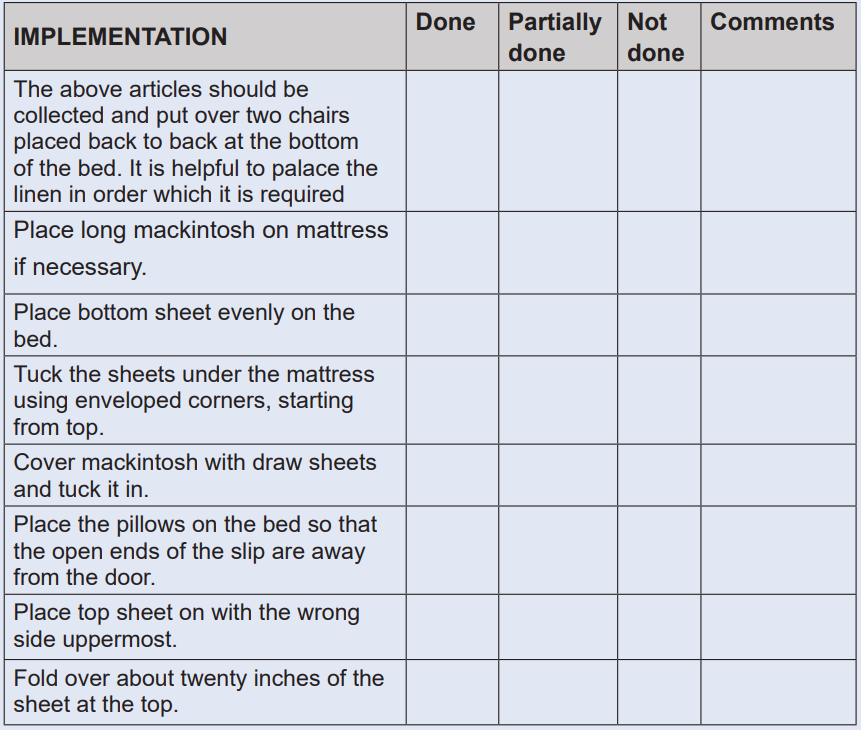
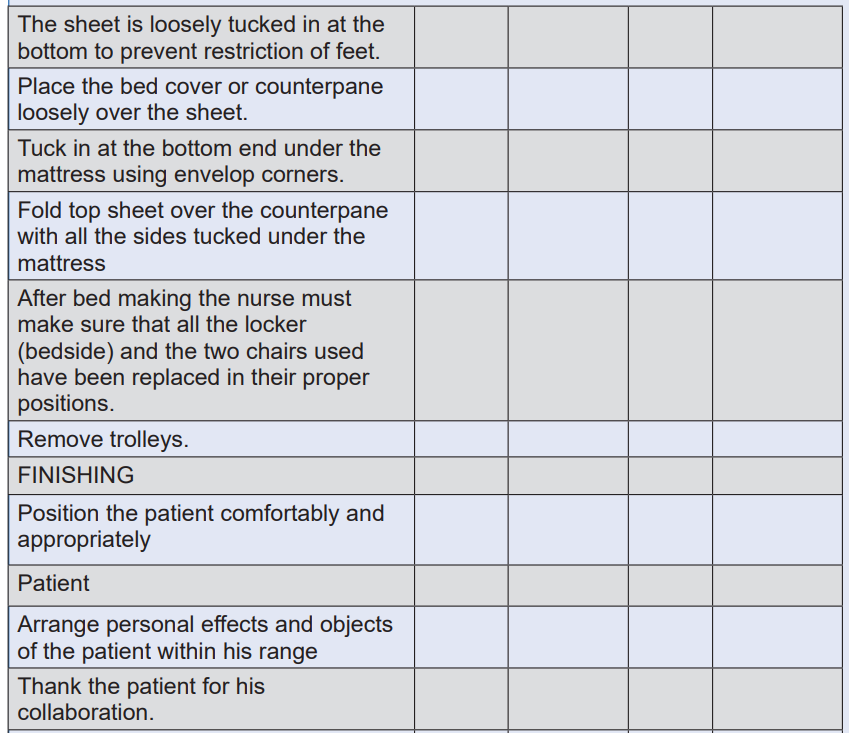
• One blanket (optional)• One bed cover or counterpane
Steps
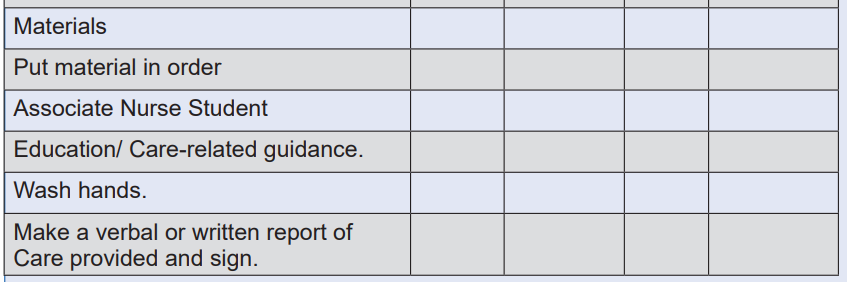
3.3.3. Techinque: Complete Bed Bath, Patient Cannot Sit Or Turn
AIMS
• To keep the skin healthy• To prevent infections
EQUIPMENTS
• Soap
• Wash cloths
• 1 Bath towel
• 2 Wash basins
• Clean gown
• Bath blanket
• Lotion for back rubASSOCIATE NURSE / PREPARATION
• Should appear professional (in full and clean uniform) with ID Card
• Hair tied back
• Remove watch, jewels, and Rings
• Wear closed shoes
• Hand washing
• PATIENT PREPARATION
• Identification of the patient
• Self-presentation to the patient
• Physical and psychological patient preparation
• Assess levels of comprehension and collaboration of the patient
• Explain to the patient/ family the rational of pulse check up
• Position the patient in a comfortable position
• Make sure that the patient was at least 5-10 min before assessingrespiration
Steps
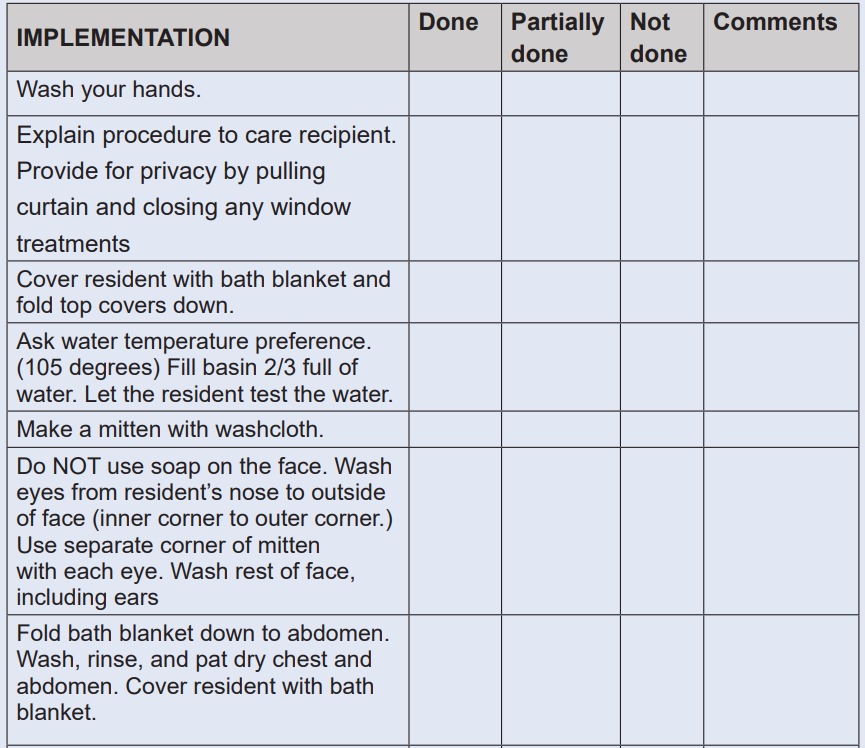
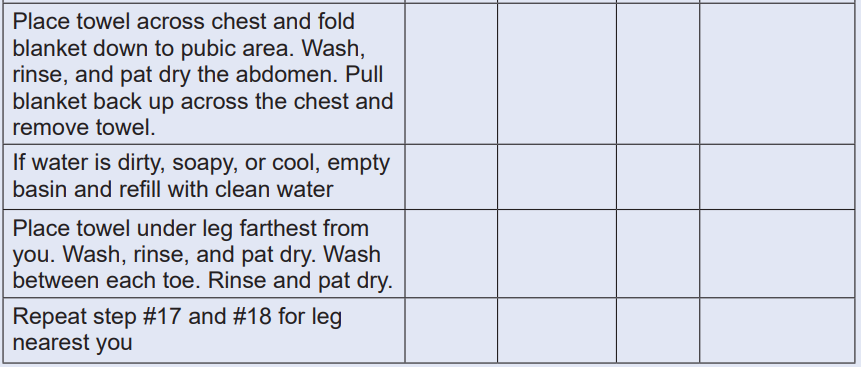
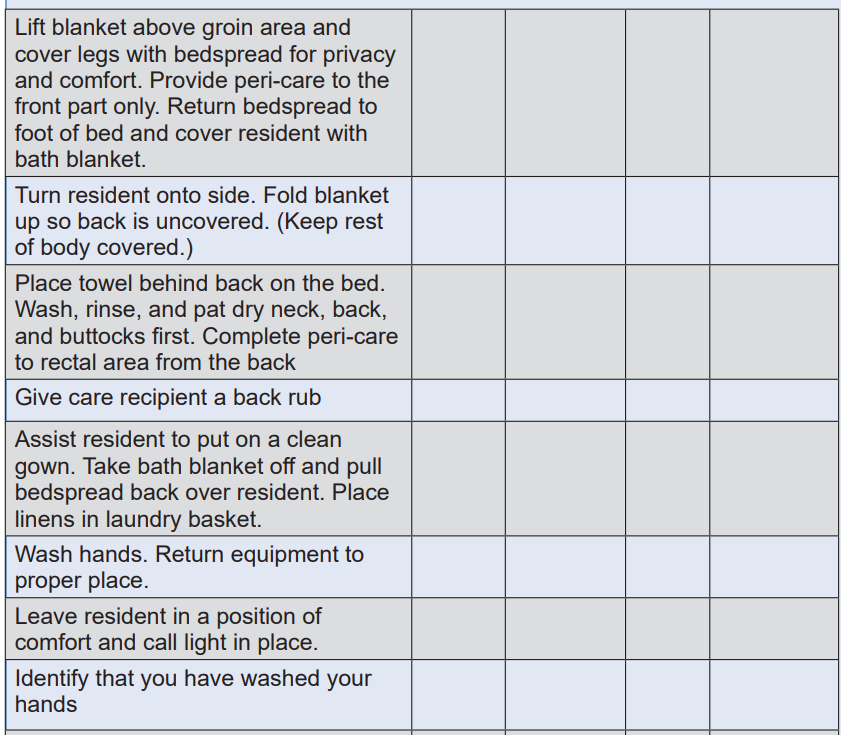
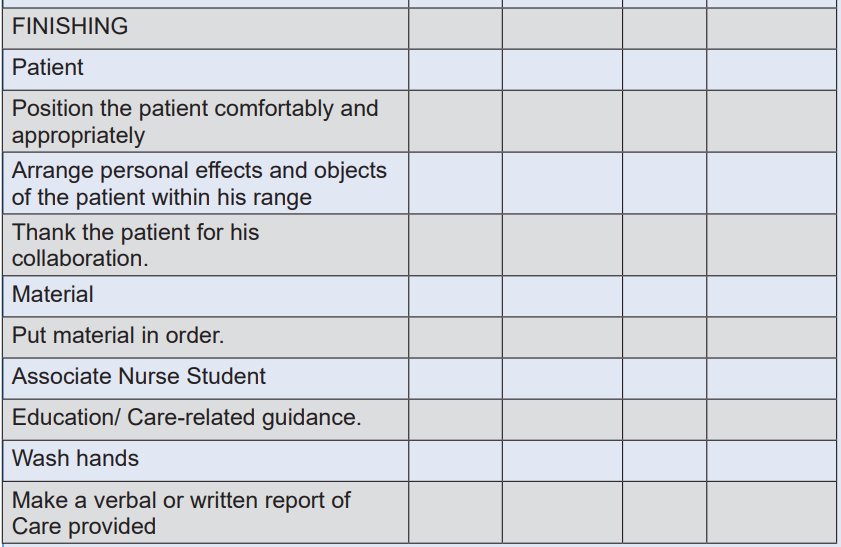
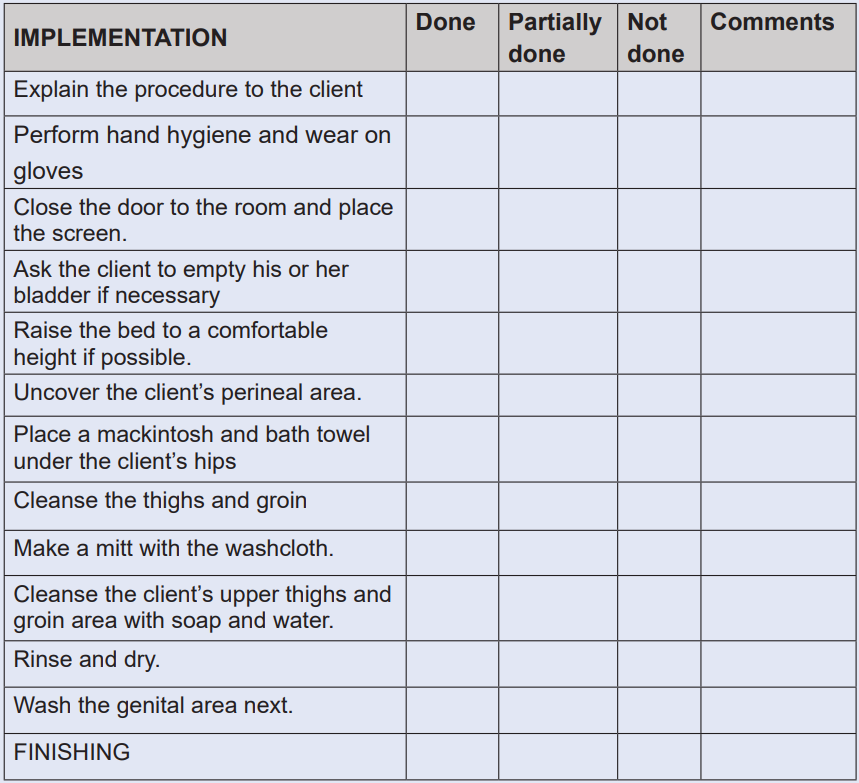
3.3.4. Techinque: Partial Bed Bath, Perineal Care
AIMS
• To Clean the skin
• To stimulate blood circulation
• To improved self-image
• To reduce body odors• To promote range of motion exercises
ASSOCIATE NURSE STUDENT / PREPARATION
• Should appear professional (in full and clean uniform) with ID Card
• Hair tied back
• Remove watch, jewels, and Rings
• Wear closed shoes• Hand washing
PATIENT PREPARATION
• Identification of the patient
• Self-presentation to the patient
• Physical and psychological patient preparation
• Assess levels of comprehension and collaboration of the patient
• Explain to the patient/ family the rational of pulse check up
• Position the patient in a comfortable position• Make sure that the patient has been at rest for at least 10 minutes.
EQUIPMENTS
• Clean gloves (1 pair)
• washcloth (1)
• Basin with warm water (1)
• Bath Towels (1)
• Mackintosh (1)
• Soap with soap dish (1)
• Toilet paper• Bed pan (1): as required
Steps
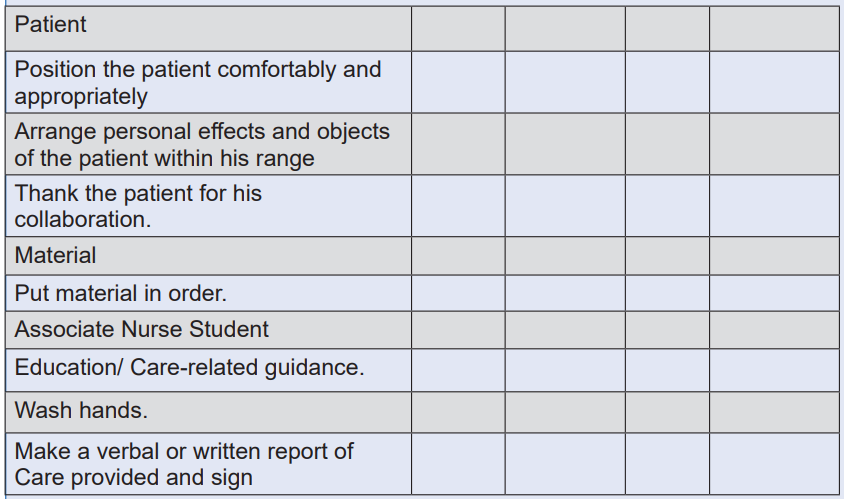
2.9.Procedure: Moving And Positioning Patients In Bed
3.4.1. Techinque: Turning Client To The Lateral Or PronePosition In Bed
Aims of the procedure
To provide comfort
• • To prevent the occurrence of bed sores• • To promote lung and cardiac function
Learning outcomes:
• The students will be able to
• Identify the predilection sites a patient in the: lateral and/or prone position
• Correctly communicate with the patient during positioning
• Put the patient into the basic position as precautionary positioning of thebody
ASSOCIATE NURSE STUDENT / PREPARATION
• Should appear professional (in full and clean uniform) with ID Card
• Hair tied back
• Remove watch, jewels, and Rings
• Wear closed shoes
• Hand washing
• PATIENT PREPARATION
• Identification of the patient
• Self-presentation to the patient
• Physical and psychological patient preparation
• Assess levels of comprehension and collaboration of the patient
• Explain to the patient/ family the rationale of the procedure• Position the client appropriately before moving the client
EQUIPMENTS
• Folded screen
• Protective gloves
• Pillows for positioning• Possibly a draw-sheet.
Steps
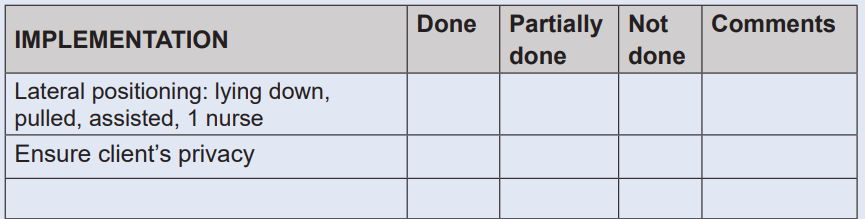
3.4.2. Techinque: Logrolling A Clien
Aims of the procedure
• To turn the client whose body must at all times be kept in a straight alignment• To provide comfort
Learning outcomes:
• The students will be able to
• Identify the predilection sites a patient in Logrolling
• Correctly communicate with the patient during Logrolling
• Put the patient into the basic position as precautionary positioning of thebody
ASSOCIATE NURSE STUDENT / PREPARATION
• Should appear professional (in full and clean uniform) with ID Card
• Hair tied back
• Remove watch, jewels, and Rings
• Wear closed shoes• Hand washing
PATIENT PREPARATION
• Identification of the patient
• Self-presentation to the patient
• Physical and psychological patient preparation
• Assess levels of comprehension and collaboration of the patient
• Explain to the patient/ family the rationale of the procedure• Position the client appropriately before moving the client
EQUIPMENTS
• Folded screen
• Protective gloves
• Pillows for positioning• Possibly a draw-sheet.
Steps
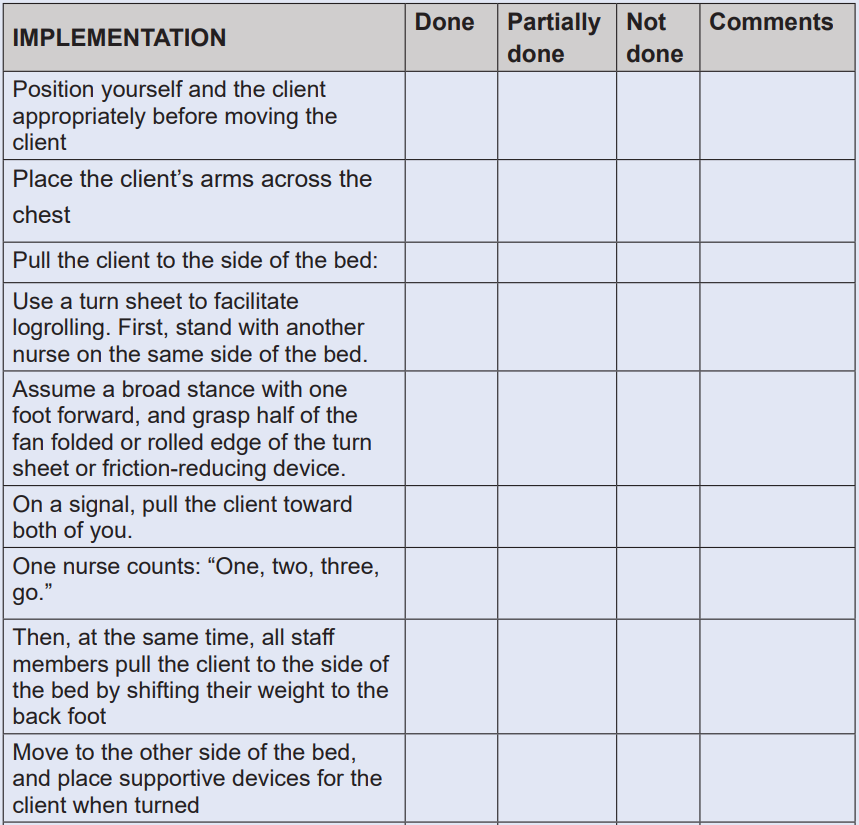
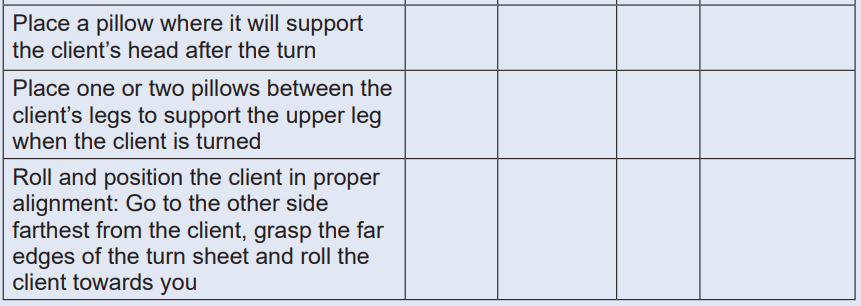
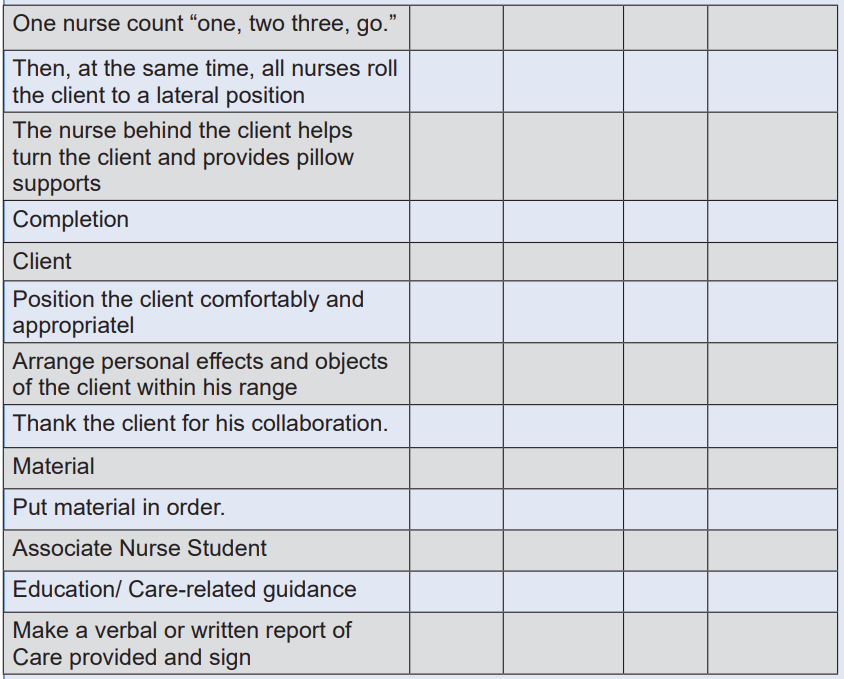
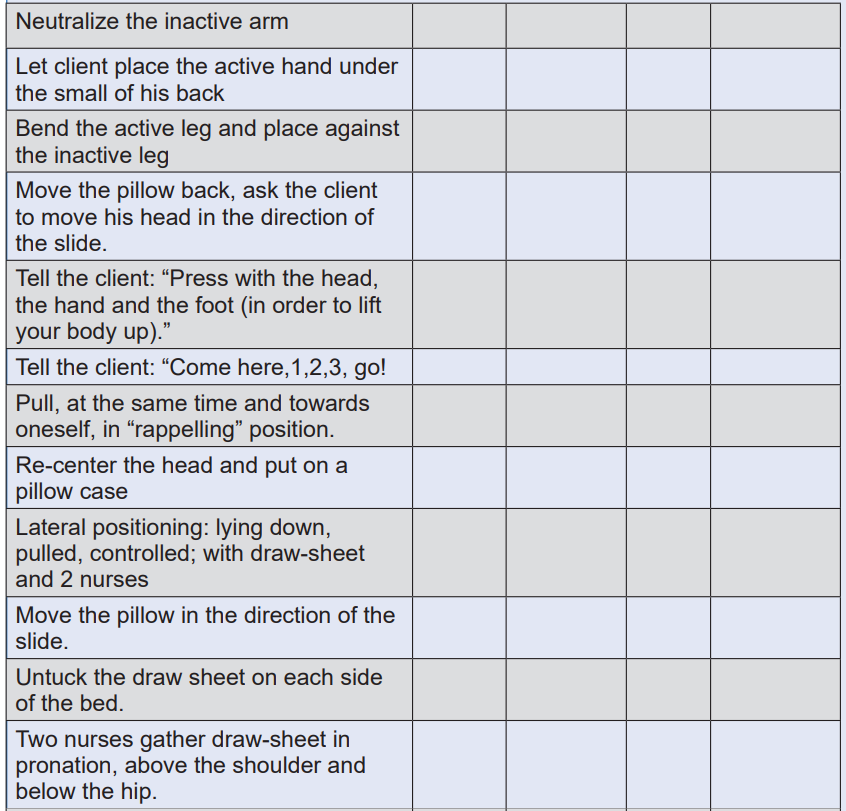
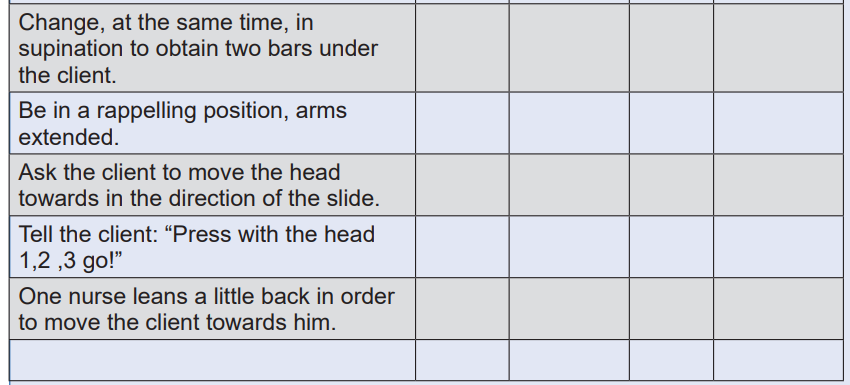
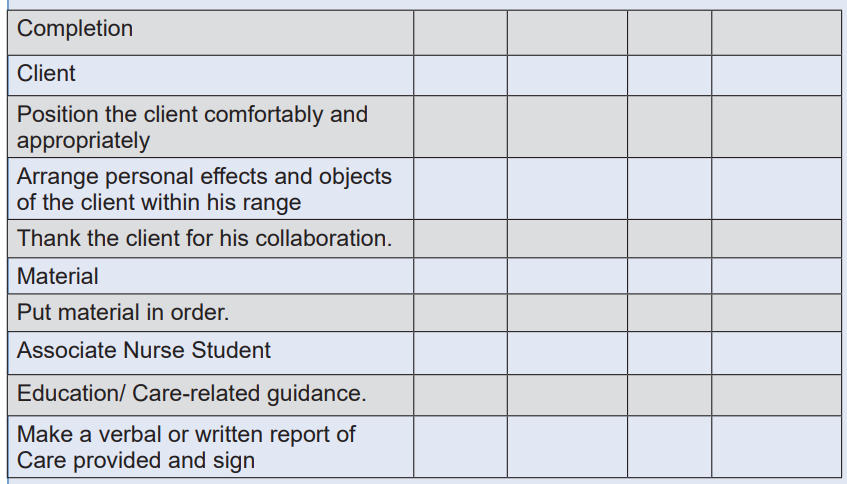
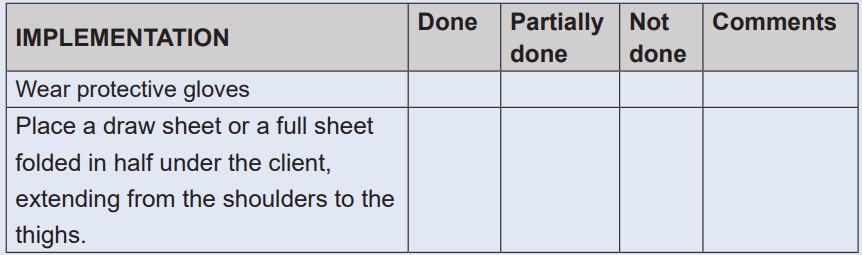
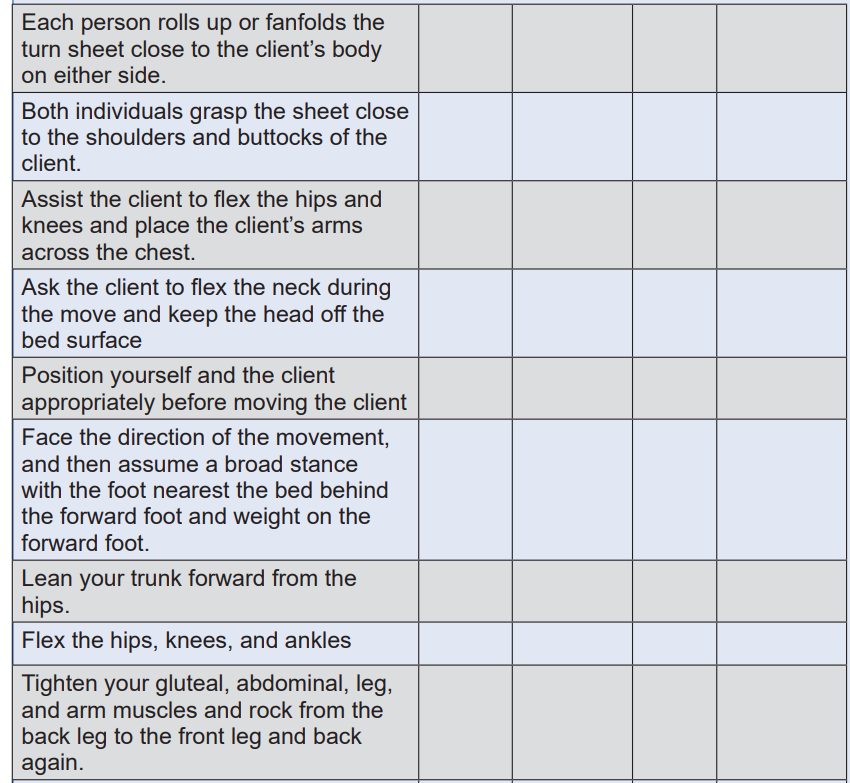
3.4.3. Technique: Moving Patient In Bed (Two Nurses Using Turn Sheet)
Aims of the procedure
• To assist clients who have slid down in bed from the Fowler’s position tomove up in bed
Learning outcomes:
• The students will be able to
• Correctly communicate with the patient during moving the patient• Move the patient correctly
ASSOCIATE NURSE STUDENT / PREPARATION
• Should appear professional (in full and clean uniform) with ID Card
• Hair tied back
• Remove watch, jewels, and Rings
• Wear closed shoes• Hand washing
PATIENT PREPARATION
• Identification of the patient
• Self-presentation to the patient
• Physical and psychological patient preparation
• Assess levels of comprehension and collaboration of the patient
• Explain to the patient/ family the rationale of the procedure• Position the client appropriately before moving the client
EQUIPMENTS
• Folded screen
• Protective gloves
• Pillows for positioning• Draw-sheet or full sheet
Steps
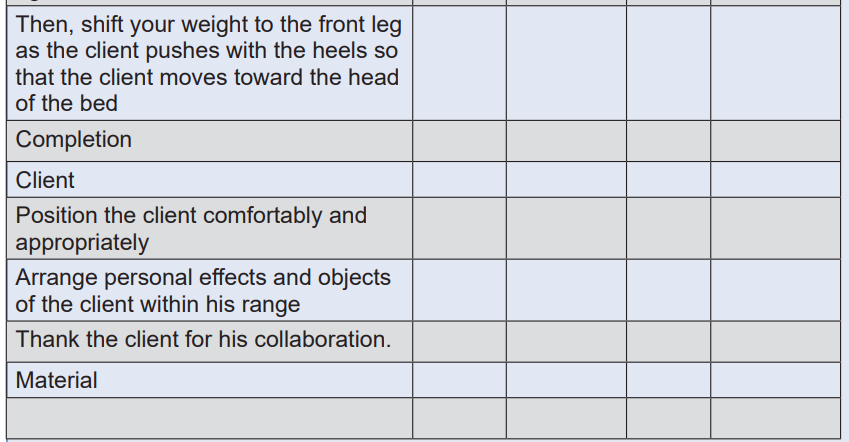
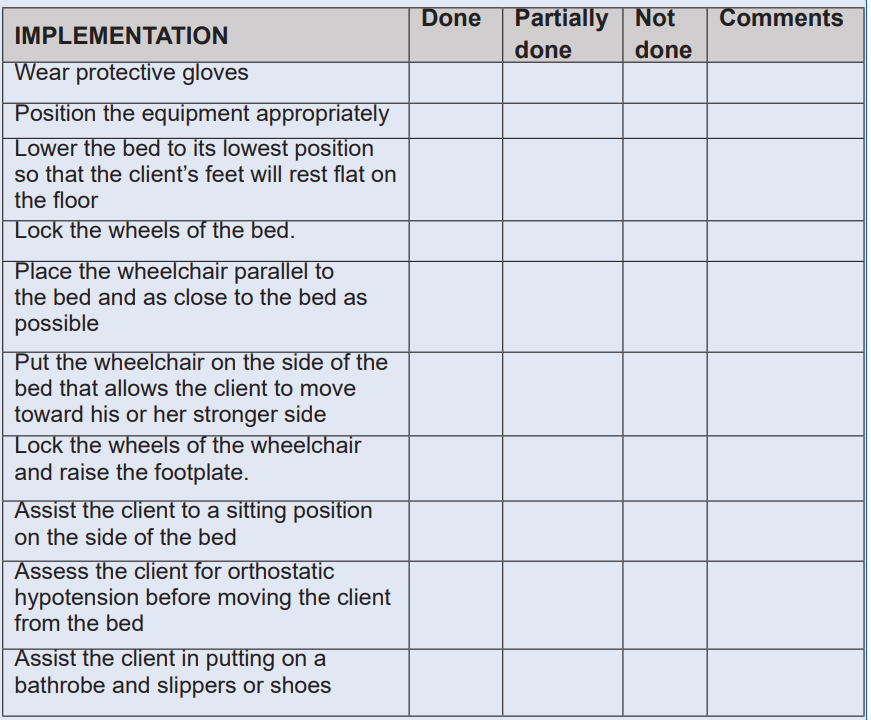
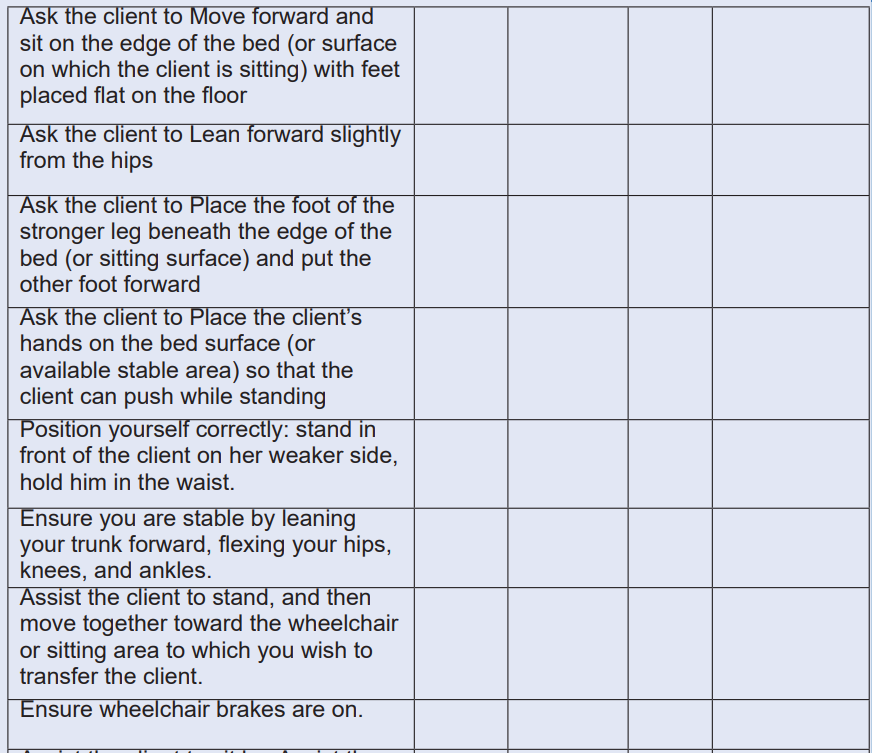
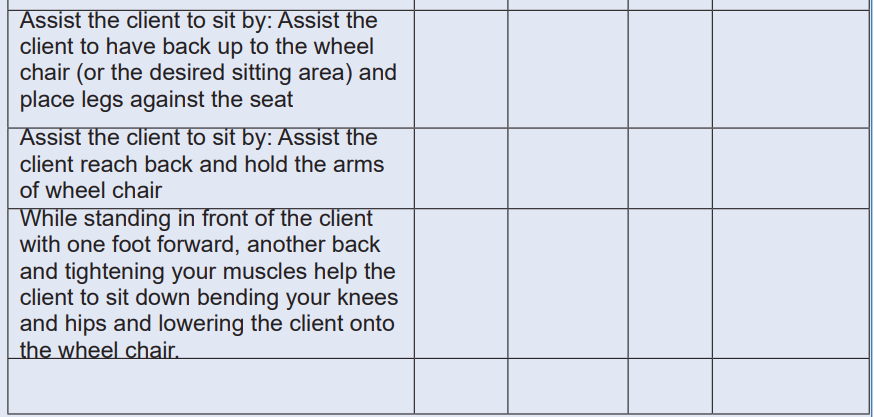
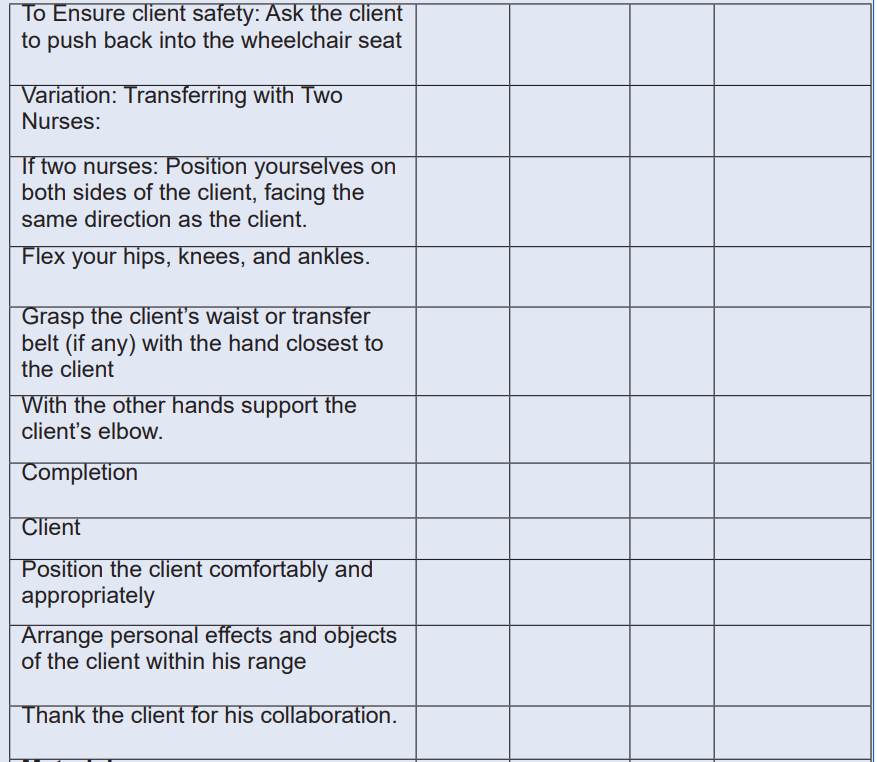
3.4.4. Technique: Moving The Patient From Bed To Chair Or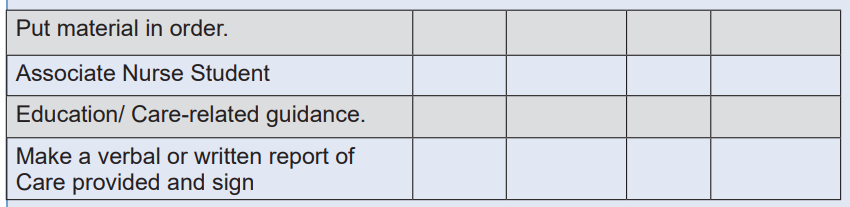
Wheel Chair (One Nurse And Two Nurses)
Aims of the procedure
• Changing position
• Ambulation• Transfer to operating room
Learning outcomes:
The students will be able to
• Implement position changes correctly• Use the appropriate means to facilitate the movement of the patient.
ASSOCIATE NURSE / PREPARATION
• Should appear professional (in full and clean uniform) with ID Card
• Hair tied back
• Remove watch, jewels, and Rings
• Wear closed shoes• Hand washing
PATIENT PREPARATION
• Identification of the patient
• Self-presentation to the patient
• Physical and psychological patient preparation
• Assess Client body size, Activity tolerance, Muscle strength, joint mobility
• , presence of paralysis, degree of comfort, orthostatic hypotension and the
ability of the client
• Explain to the patient/ family the rationale of the procedure• Position the client appropriately before moving the client
EQUIPMENTS
• Protective gloves
• Appropriate clothing
• Slippers or other appropriate open shoes• Chair or wheelchair (depending the purpose)
Steps
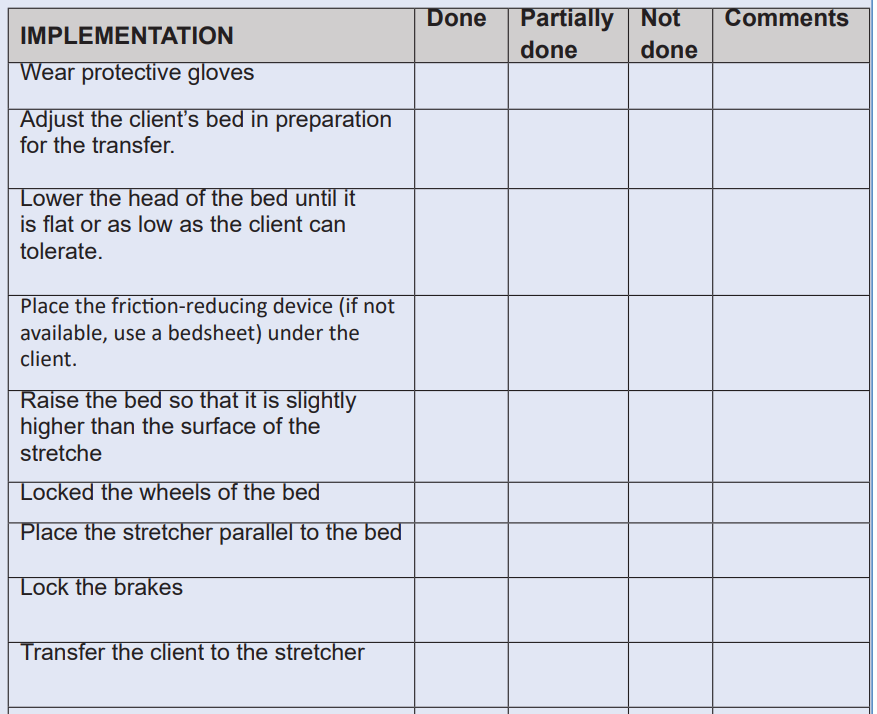
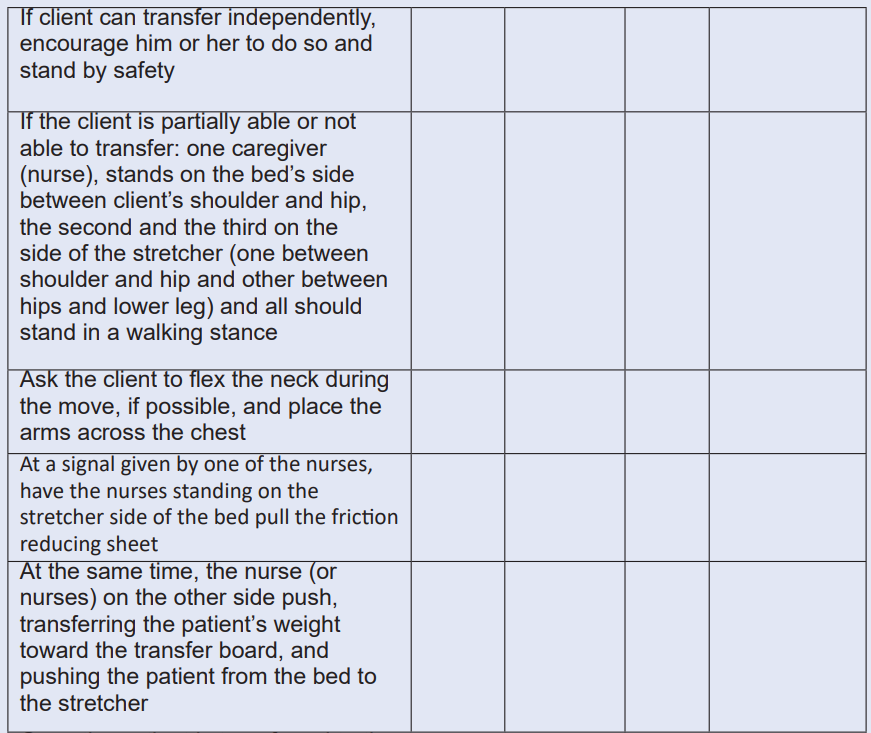
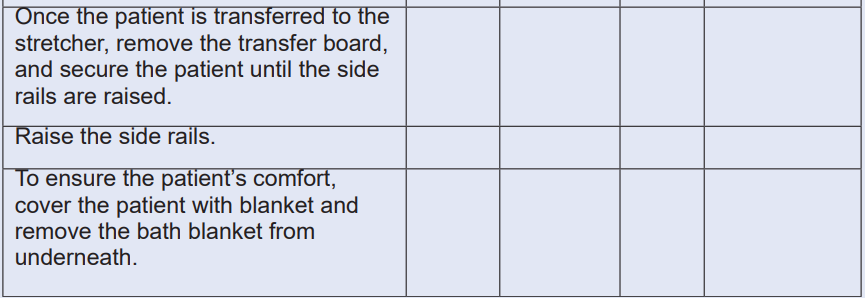
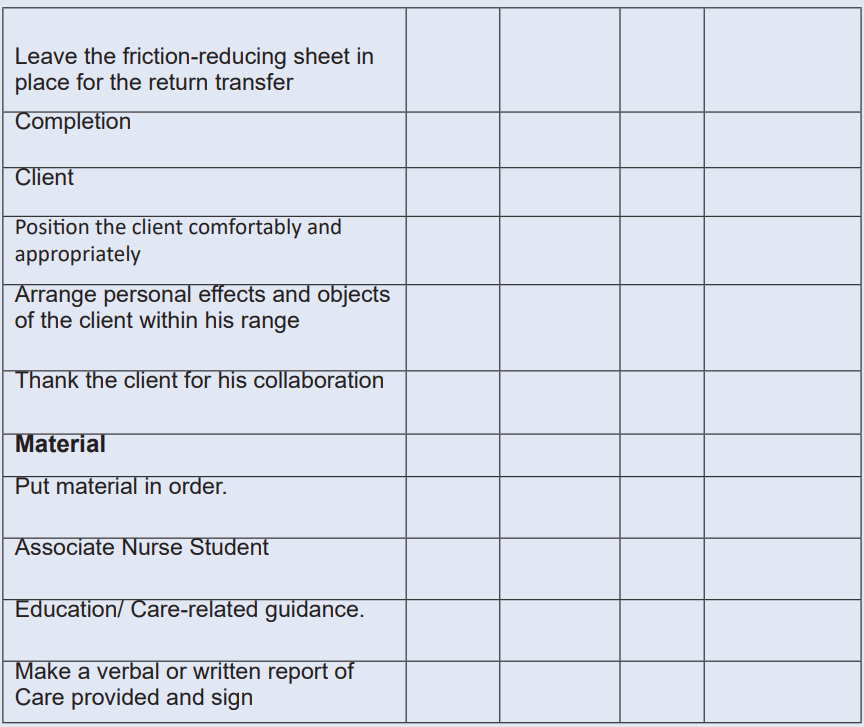
3.4.5. Techinque: Moving The Client From Bed To Stretcher Aims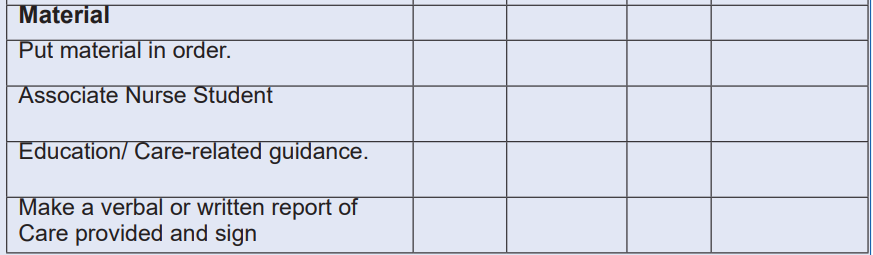
of the procedure
Aims of the procedure
• To transfer the client in supine position from one location to another
Learning outcomes:
The students will be able to
• implement position changes correctly• Use the appropriate means to facilitate the movement of the patient.
ASSOCIATE NURSE STUDENT / PREPARATION
• Should appear professional (in full and clean uniform) with ID Card
• Hair tied back
• Remove watch, jewels, and Rings
• Wear closed shoes• Hand washing
PATIENT PREPARATION
• Identification of the patient
• Self-presentation to the patient
• Physical and psychological patient preparation
• Assess client body size, Activity tolerance, Muscle strength, joint mobility,
presence of paralysis, degree of comfort, orthostatic hypotension and the
ability of the client
• Explain to the patient/ family the rationale of the procedure• Position the client appropriately before moving the client
EQUIPMENTS
• Protective gloves
• Appropriate clothing
• Stretcher• Assistive devices as required or bedsheet
Steps
2.10.Procedure: Application Of Local Heat And Cold
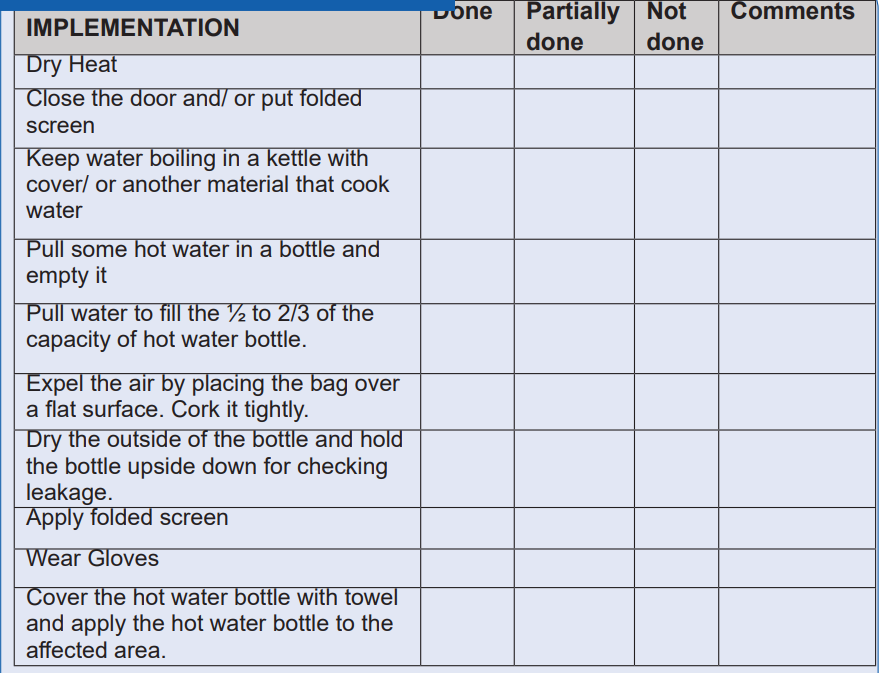
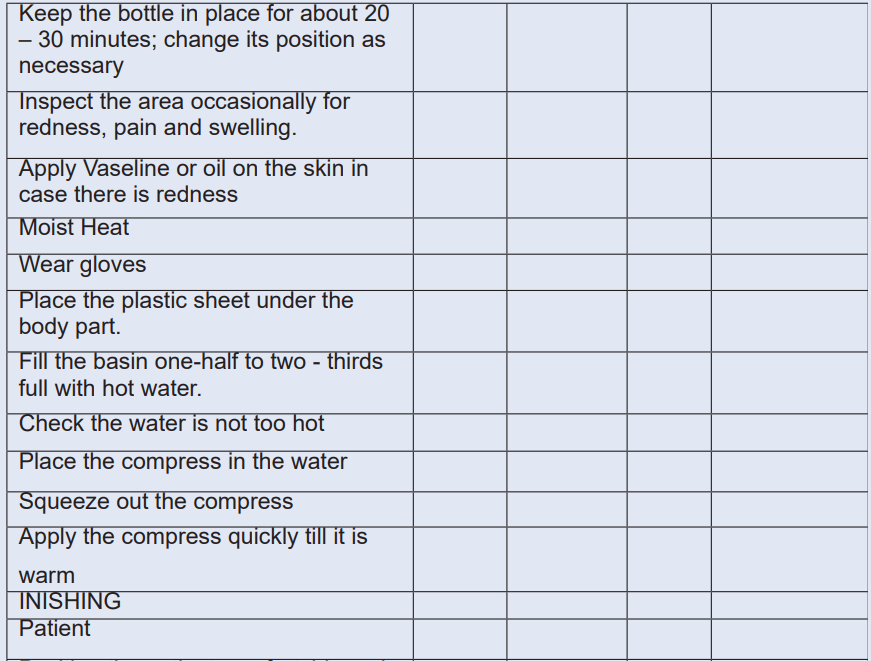
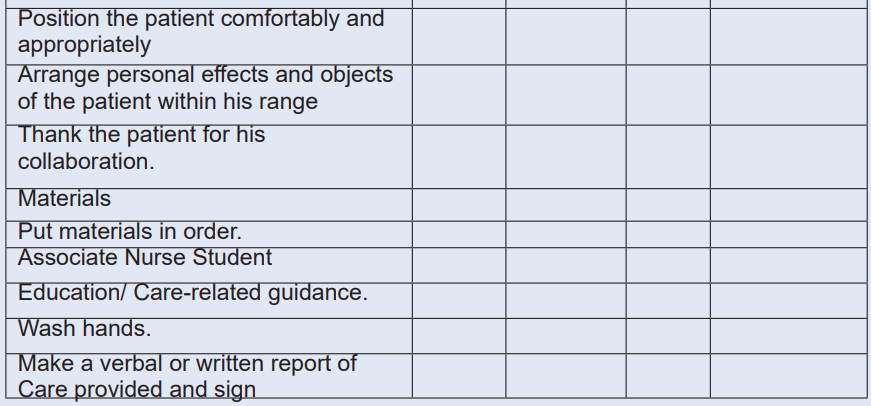
3.5.1. Technique: application dry and moist heat.
AIMS
• To treat sprains muscle pulls• To provide relief of pain
ASSOCIATE NURSE STUDENT / PREPARATION
• Should appear professional (in full and clean uniform) with ID Card
• Hair tied back
• Remove watch, jewels, and Rings
• Wear closed shoes• Hand washing
PATIENT PREPARATION
• Identification of the patient
• Self-presentation to the patient
• Ask for the consent
• Physical and psychological patient preparation
• Assess levels of comprehension and collaboration of the patient
• Adjust the environment of the patient as necessary.
• Explain the procedure and purpose to the patient
• Check chart for limitations on patient’s physical activity.• Cleanliness or condition of the bed and surrounding environment
EQUIPMENTS
• Tray,
• Folded screen• Non sterile Gloves
Dry heat
• Hot water bag• Kettle with cover/ or any other material that can kook the water.
EQUIPMENTS
• Water container.
• Hot water bag cover / small towel to cover.• Vaseline or oil for applying on the skin in case there is redness
Moist Heat
• Basin or tub.
• Small towel.
• Bath towel
• Ties, tape, or rolled gauze.• Mackintosh
Steps
3.5.2. Technique: application dry and moist cold.
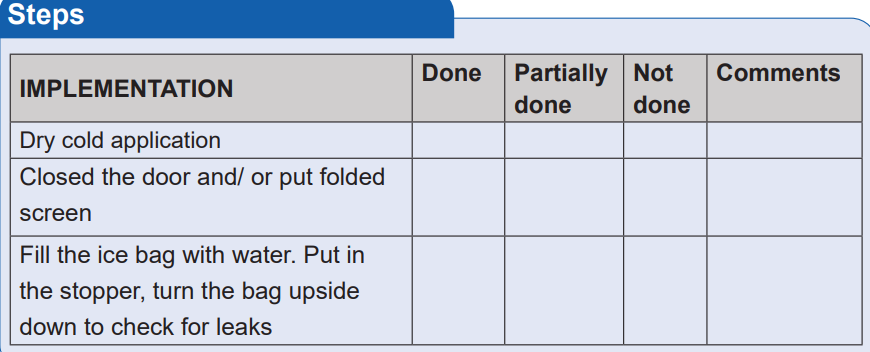
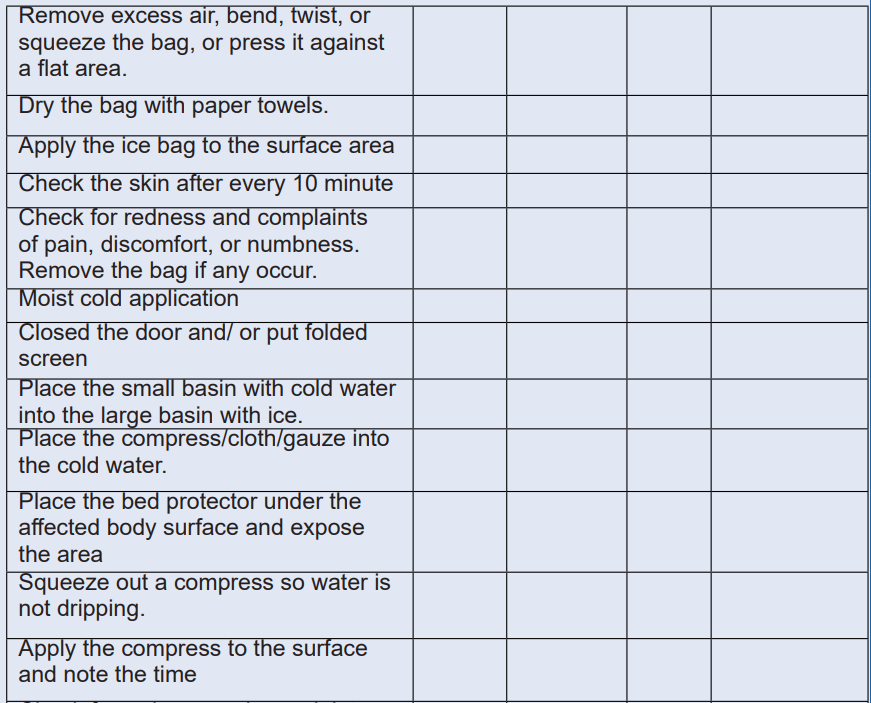
AIMS
• To treat sprains muscle pulls
• To provide relief of pain
ASSOCIATE NURSE STUDENT / PREPARATION
• Should appear professional (in full and clean uniform) with ID Card
• Hair tied back
• Remove watch, jewels, and Rings
• Wear closed shoes
• Clean and short nails
• Remove watch, jewels, and Rings• Wear closed shoes
PATIENT PREPARATION
• Identification of the patient
• Self-presentation to the patient
• Ask for the consent
• Physical and psychological patient preparation
• Assess levels of comprehension and collaboration of the patient
• Adjust the environment of the patient as necessary.
• Explain the procedure and purpose to the patient
• Check chart for limitations on patient’s physical activity.• Cleanliness or condition of the bed and surrounding environment
EQUIPMENTS
• Tray,
• Folded screen
• Non sterile Gloves
• Dry heat
• Hot water bag
• Kettle with cover/ or any other material that can kook the water.
• Water container.
• Hot water bag cover / small towel to cover.
• Vaseline or oil for applying on the skin in case there is redness
• Moist cold
• Large basin Contains of ice.
• Small basin Contain with cold water.
• Gauze squares, wash cloth, or small towels.
• Waterproof pad/ Plastic sheet.
• A towel• Mackintosh
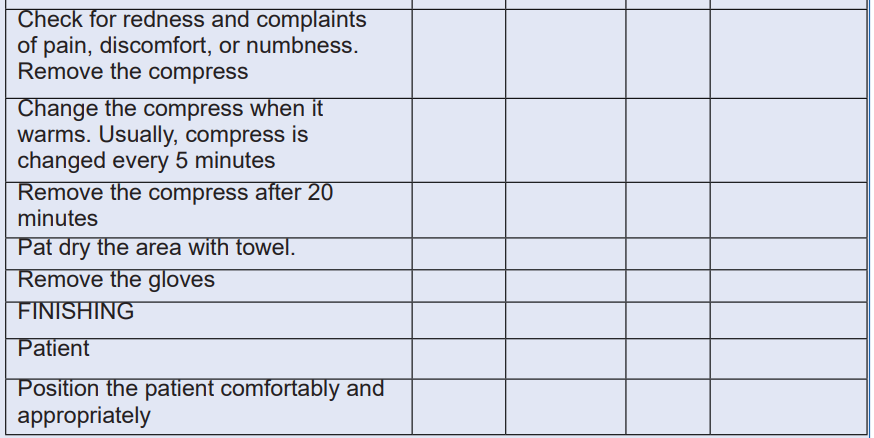
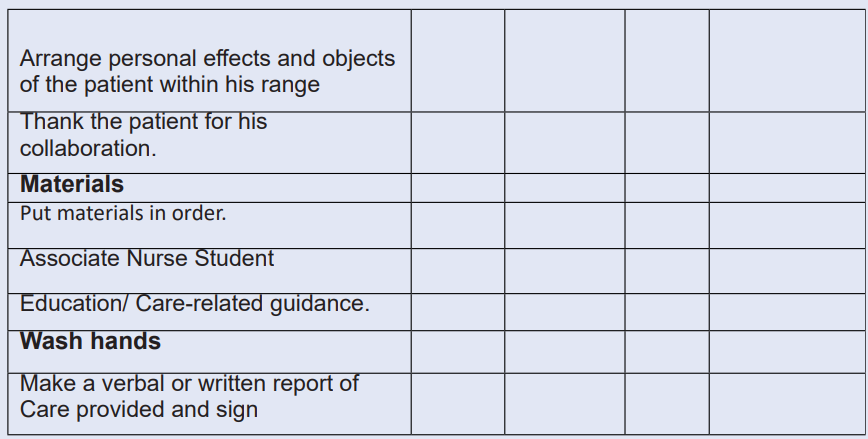
2.11.Procedure: Assisting The Patient To Eliminate
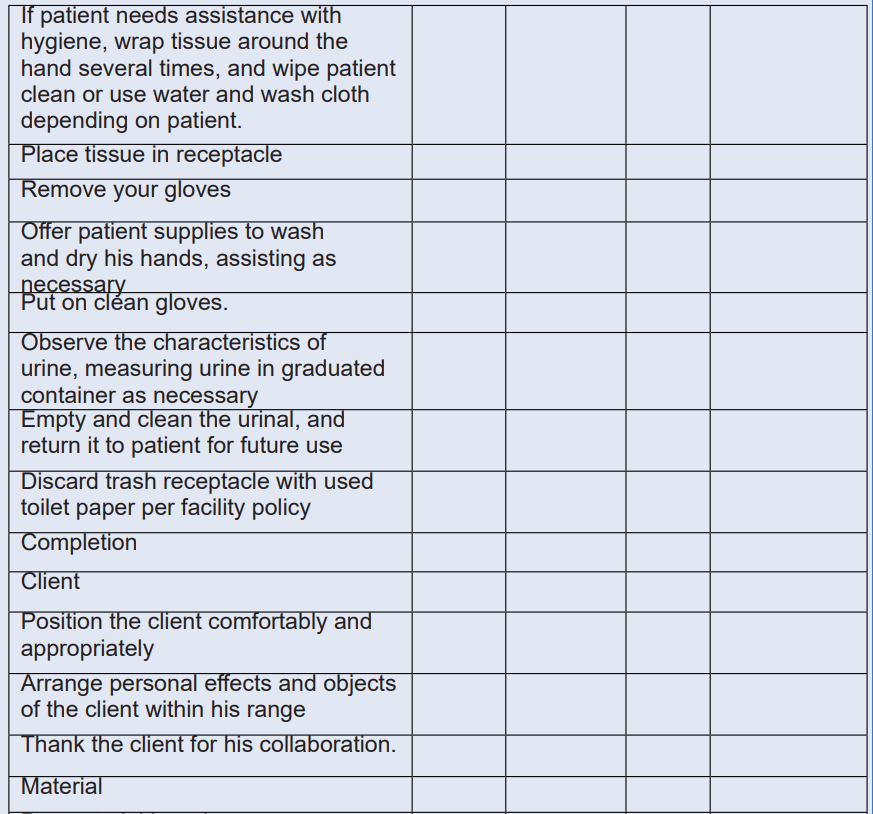
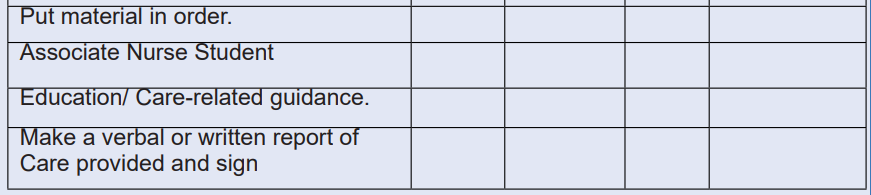
3.6.1. Technique: Use Of Urinal
Aims of the procedure
• To assist in urination when the client is unable to get out of bed• To take urine sample
Learning outcomes:
The students will be able to
• Assist in urination when the client is unable to get out of bed• Take urine sample correctly
ASSOCIATE NURSE STUDENT / PREPARATION
• Should appear professional (in full and clean uniform) with ID Card
• Hair tied back
• Remove watch, jewels, and Rings
• Wear closed shoes
• Clean and short nails
• Remove watch, jewels, and Rings• Wear closed shoes
PATIENT PREPARATION
• Identification of the patient
• Self-presentation to the patient
• Physical and psychological patient preparation
• Assess levels of comprehension and collaboration of the patient• Position the patient in a comfortable position
EQUIPMENTS
• nal
• Protective Clean gloves
• Toilet paper
• Material for personal hygiene if necessary
• Receptacle for waste disposal
• Screen
• Linens such as privacy blankets• Water proof protector/Macintosh
Steps
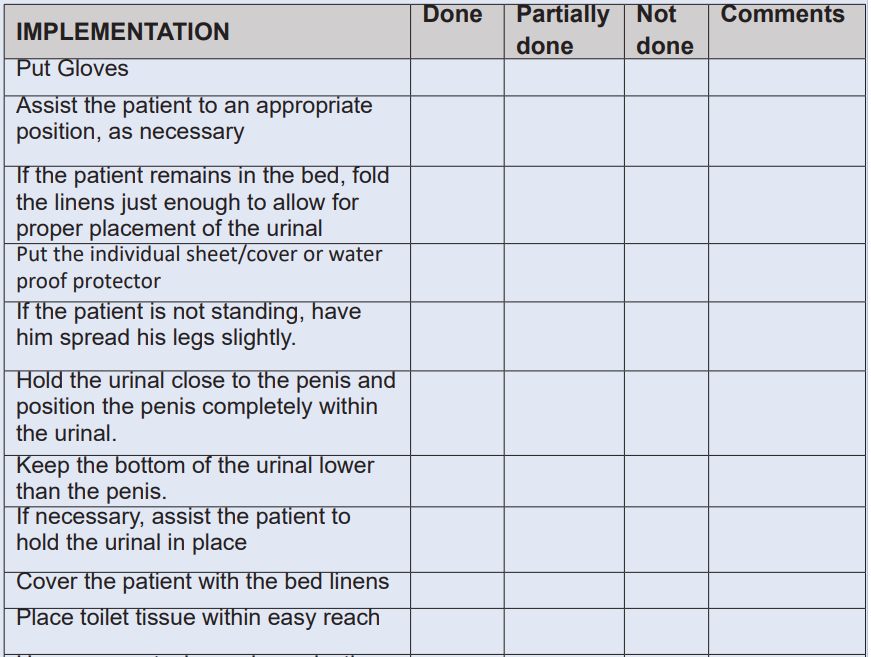
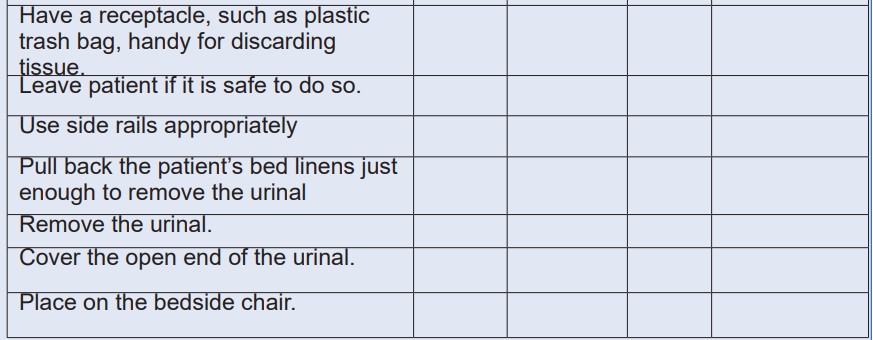
3.6.2. Technique: Use Of Bed Pan
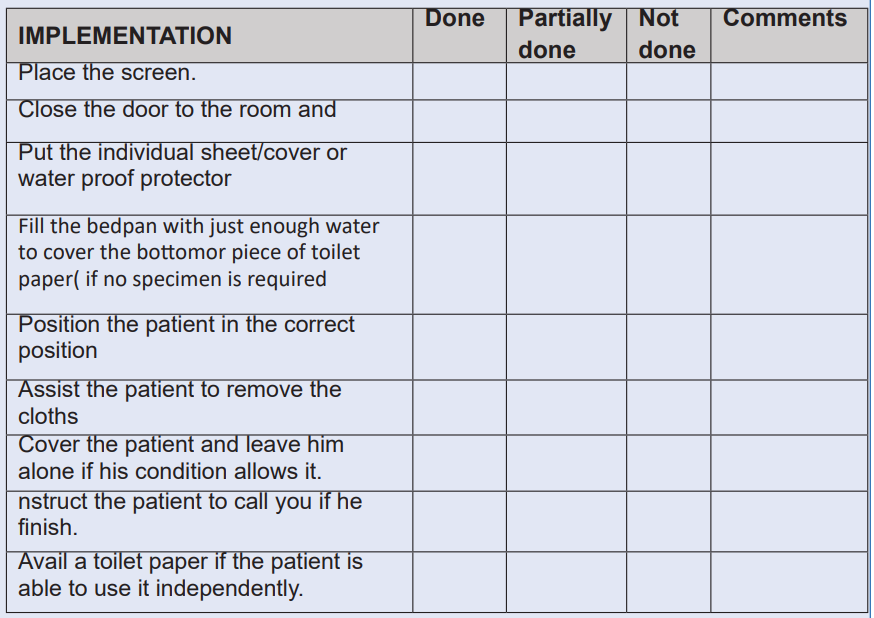
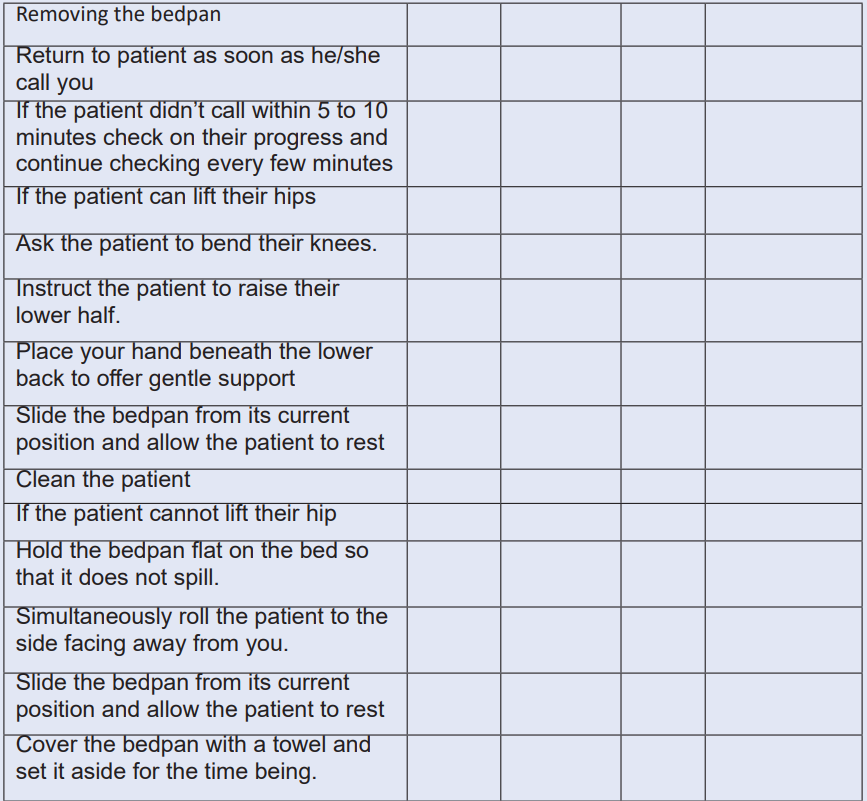
Aims of the procedure
• To assist in voiding when the client is unable to get out of bed• To take stool sample
Learning outcomes:
The students will be able to
• Assist in voiding when the client is unable to get out of bed• Take stool sample correctly
ASSOCIATE NURSE STUDENT / PREPARATION
• Should appear professional (in full and clean uniform) with student ID Card
• Hair tied back
• Remove watch, jewelries, and Rings
• Wear closed and short shoes• Wash hand
PATIENT PREPARATION
• Identification of the patient
• Self-presentation to the patient
• Physical and psychological patient preparation
• Assess levels of comprehension and collaboration of the patient• Position the patient in a comfortable position
EQUIPMENTS
• Bed pan
• Protective Clean gloves
• Toilet paper
• Material for personal hygiene if necessary
• Receptacle for waste disposal
• Screen
• Linens such as privacy blankets• Water proof protector/Macintosh
Steps
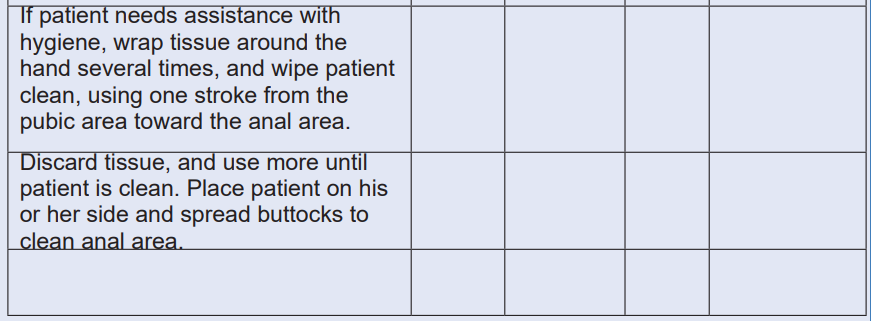
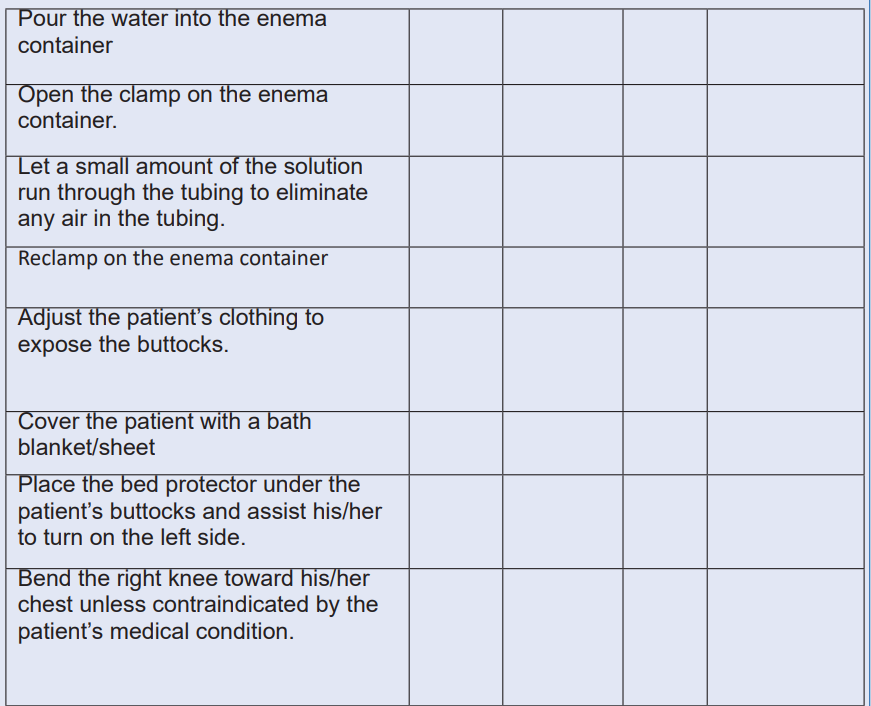
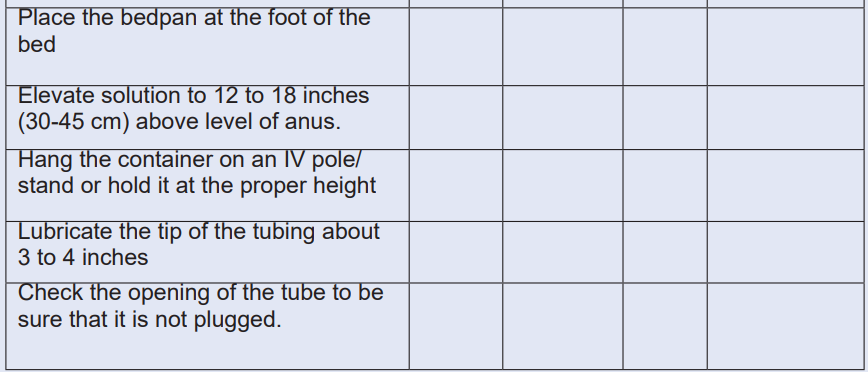
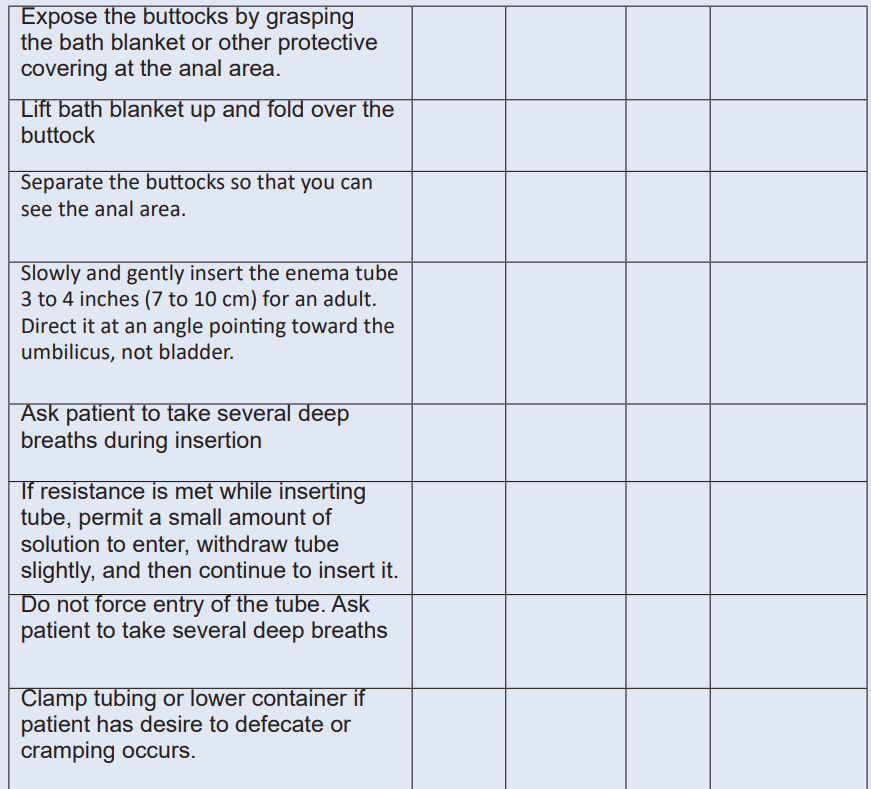
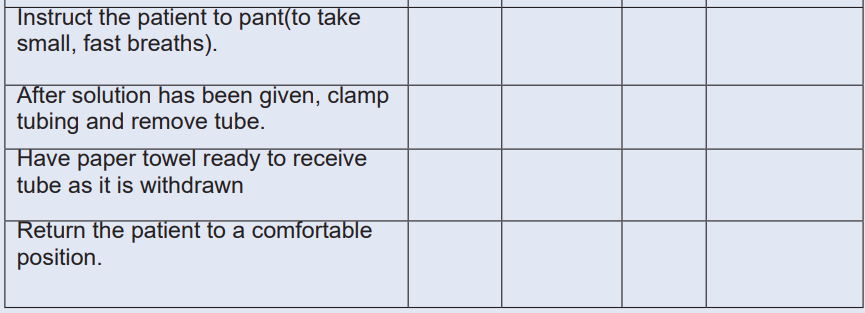
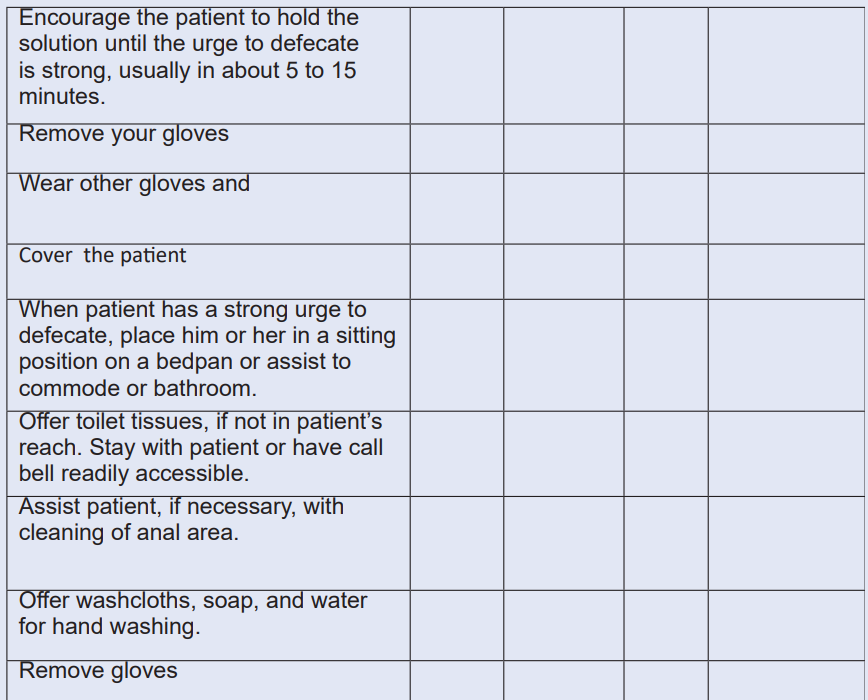
3.6.3. Technique: Administering Enema (Evacuating Enema/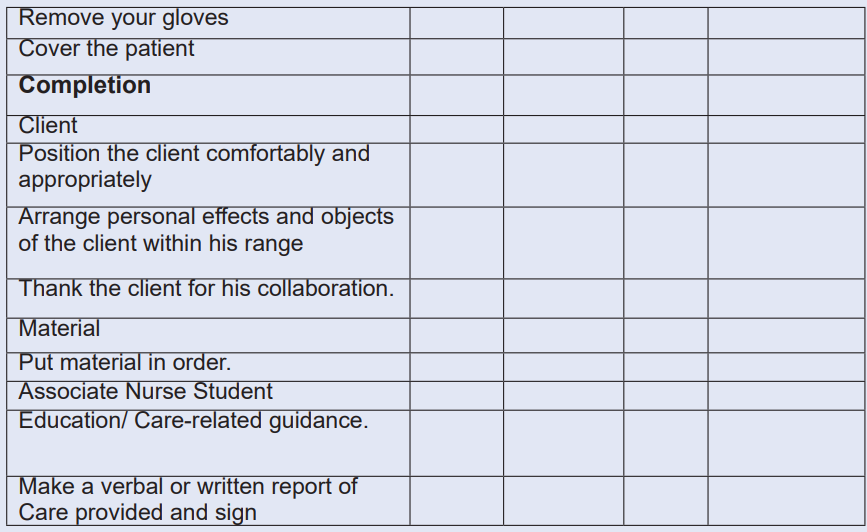
Return Flow Enema)
Aims of the procedure
• To relieve constipation
• To clean bowel before endoscopic examination or procedure
• To clean bowel before surgical operation• To reduce inflammation of intestine
Learning outcomes:
The students will be able to
• Perform enema
• Prepare the patient for enema administration• Prepare the aids for enema administration
ASSOCIATE NURSE STUDENT / PREPARATION
Should appear professional (in full and clean uniform) with student ID Card
• Hair tied back
• Remove watch, jewelries, and Rings
• Wear closed and short shoes• Wash hand
PATIENT PREPARATION
• Identification of the patient
• Self-presentation to the patient
• Physical and psychological patient preparation
• Ensure client privacy
• Assess levels of comprehension and collaboration of the patient• Position the patient in a comfortable position
EQUIPMENTS
• Folding screens.
• Tray, Trolley.
• Bracket
• Impermeable protection and cotton cloth.
• Appropriate rectal tube.
• Kidney dish.
• Lubricant.
• Protective gloves.
• Clean compress and toilet paper.
• Enema cannula with connection tube.
• Grip for clamping or tap.
• Water or other solution at the temperature prescribed.
• Bed pan• Material for personal hygiene, if necessary.
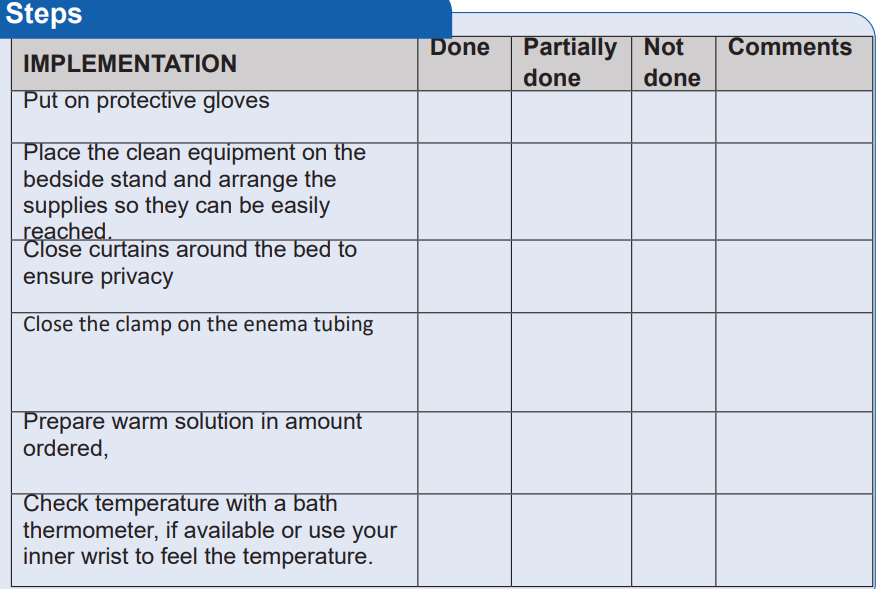

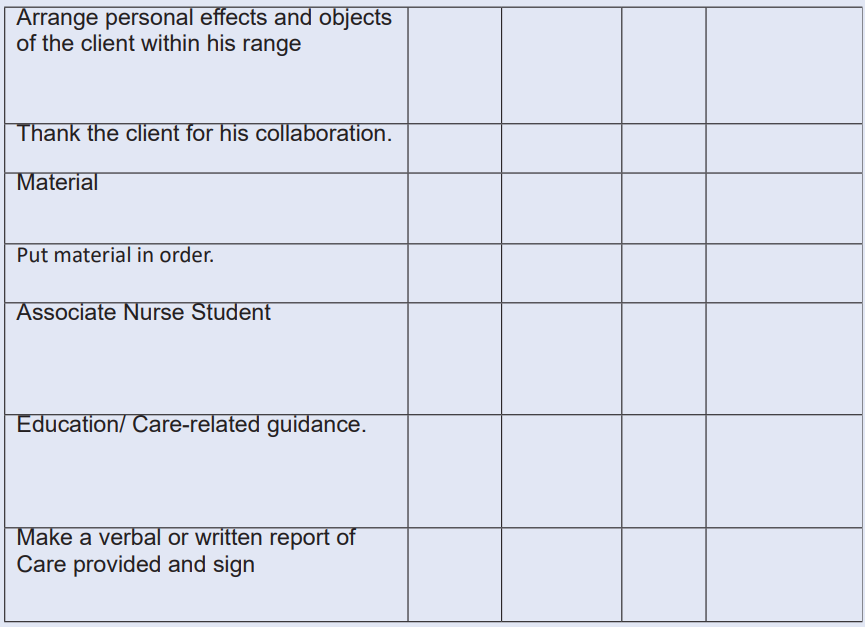
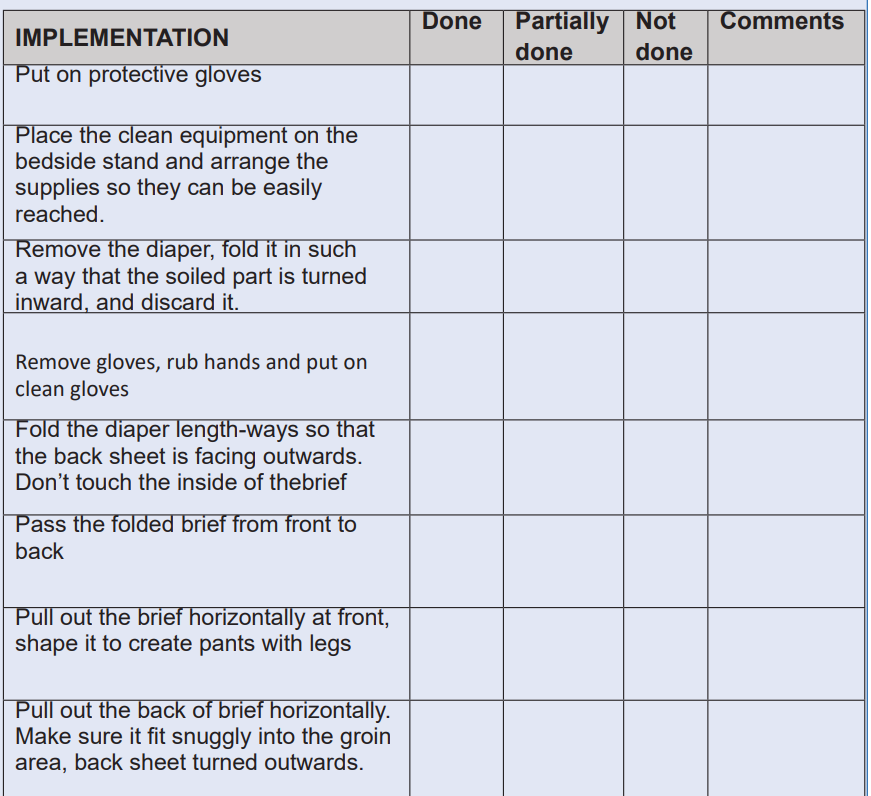
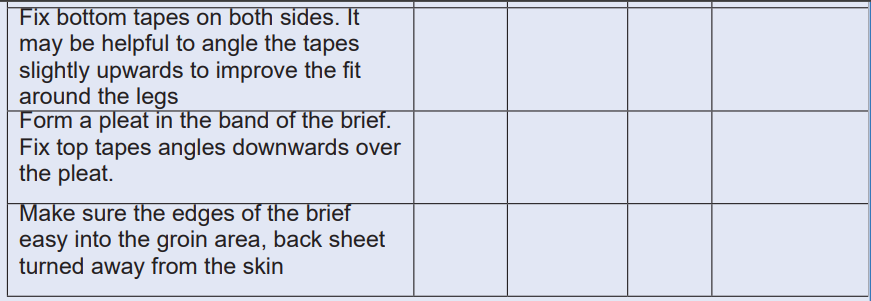
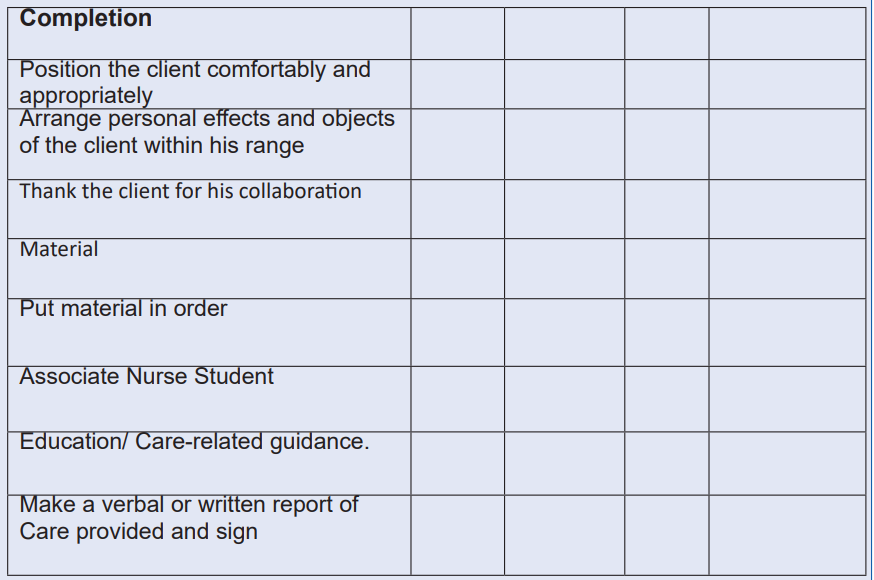
3.6.4. Technique: Assisting Patients In Using Diapers
Aims of the procedure
• To promote cleanliness to the client• To prevent infection and bed sores
Learning outcomes:
The students will be able to
• Perform enema
• Prepare the patient for diapers change• Prepare the aids for diapers change
ASSOCIATE NURSE STUDENT / PREPARATION
Should appear professional (in full and clean uniform) with student ID Card
• Hair tied back
• Remove watch, jewelries, and Rings
• Wear closed and short shoes• Wash hand
PATIENT PREPARATION
• Identification of the patient
• Self-presentation to the patient
• Physical and psychological patient preparation
• Ensure client privacy
• Assess levels of comprehension and collaboration of the patient• Position the patient in a comfortable position
EQUIPMENTS
• Tray or trolley
• Proper Gloves
• A clean diaper (consider the size of the patient)
• Dust bin or bucket to receive soiled diaper
• Bucket with a lid and filled with water for non-disposable diapers.
• Skin protection barrier cream• Bed linens, if necessary.
Steps
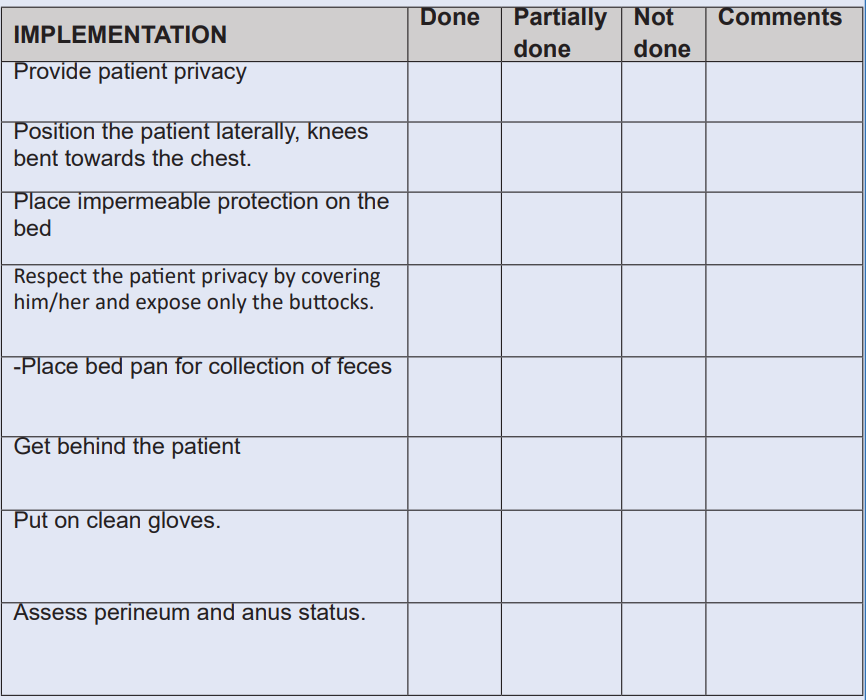
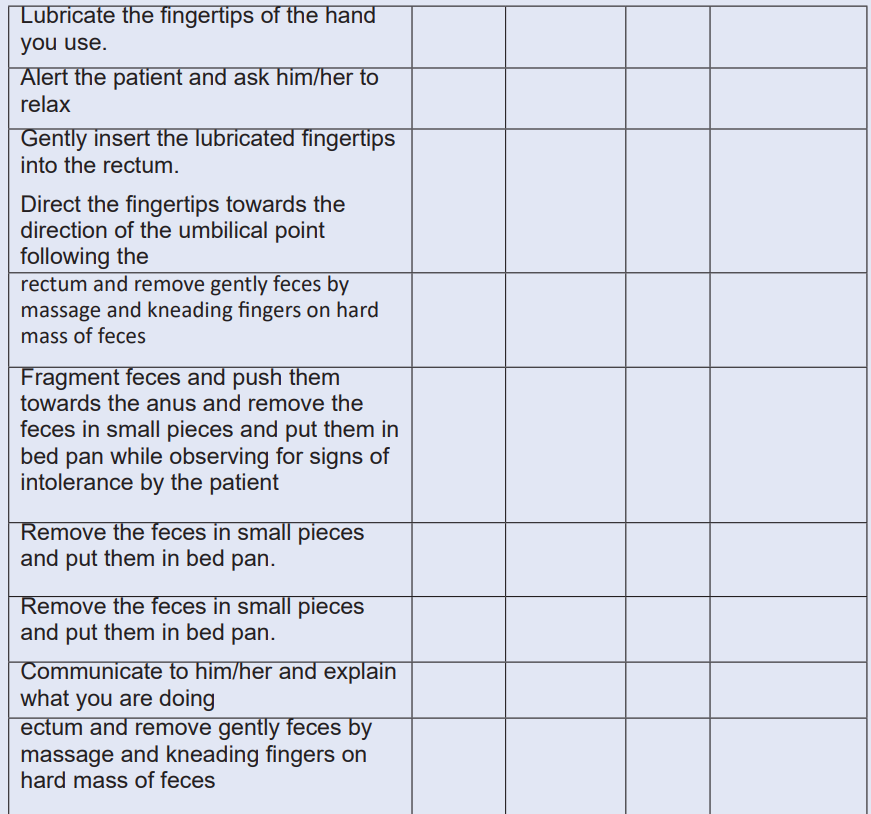
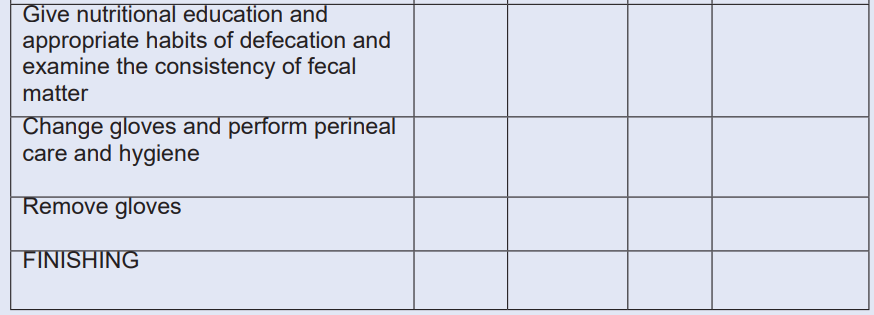
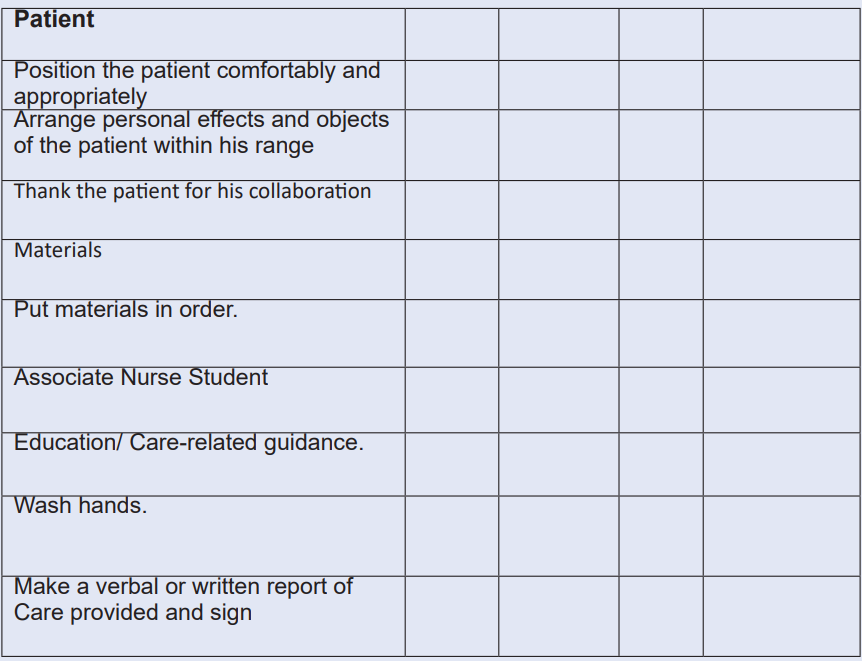
2.12.Technique: Manual Removal Of Fecaloma
AIMS
• To remove impacted feces
ASSOCIATE NURSE STUDENT / PREPARATION
• Should appear professional (in full and clean uniform) with ID Card
• Hair tied back
• Remove watch, jewels, and Rings
• Wear closed shoes
• Clean and short nails
• Remove watch, jewels, and Rings
• Wear closed shoes• Hand washing
PATIENT PREPARATION
• Identification of the patient
• Self-presentation to the patient
• Ask for the consent
• Physical and psychological patient preparation
• Assess levels of comprehension and collaboration of the patient
• Adjust the environment of the patient as necessary.
• Explain the procedure and purpose to the patient
• Check chart for limitations on patient’s physical activity.• Cleanliness or condition of the bed and surrounding environment
EQUIPMENTS
• The trolley.
• Serving forceps in its container.
• Disinfectant solution (for hands).
• Bed pan with cover.
• Impermeable protection and cotton protection.
• Lubricant.
• Toilet paper.
• Kidney dish for wastes.
• Individual blanket or towel.
• Protective gloves.• Plastic apron if available
Steps
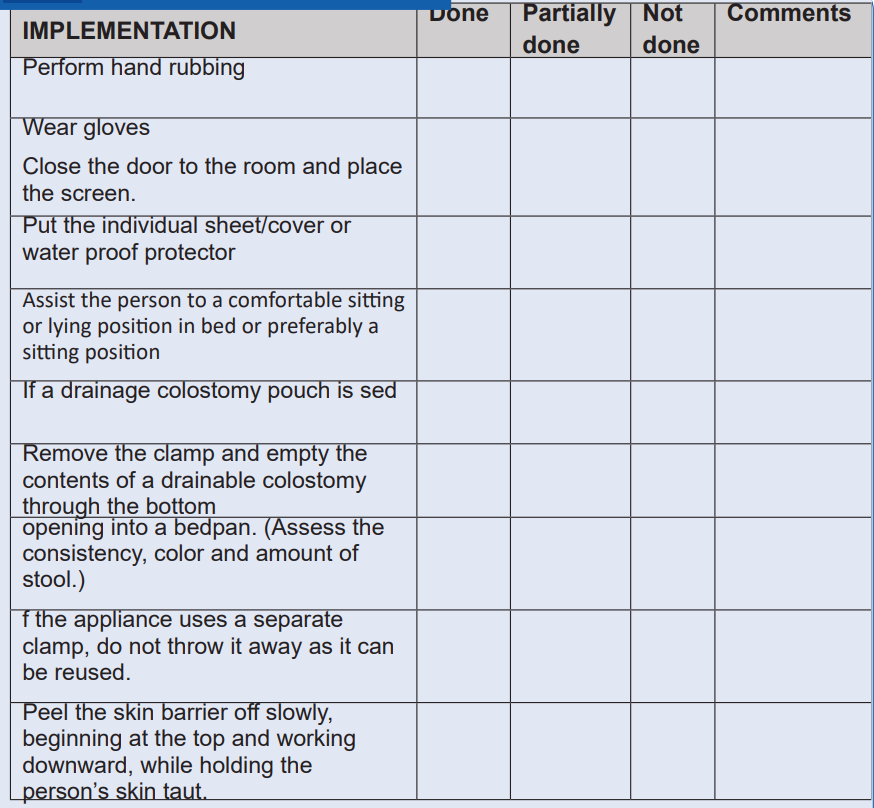
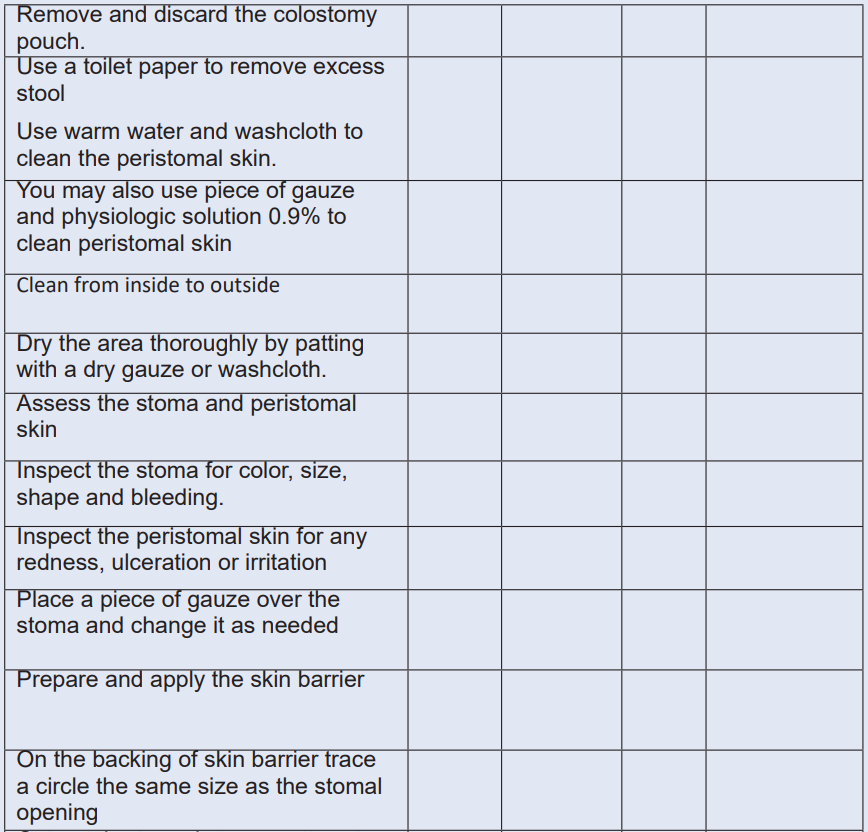
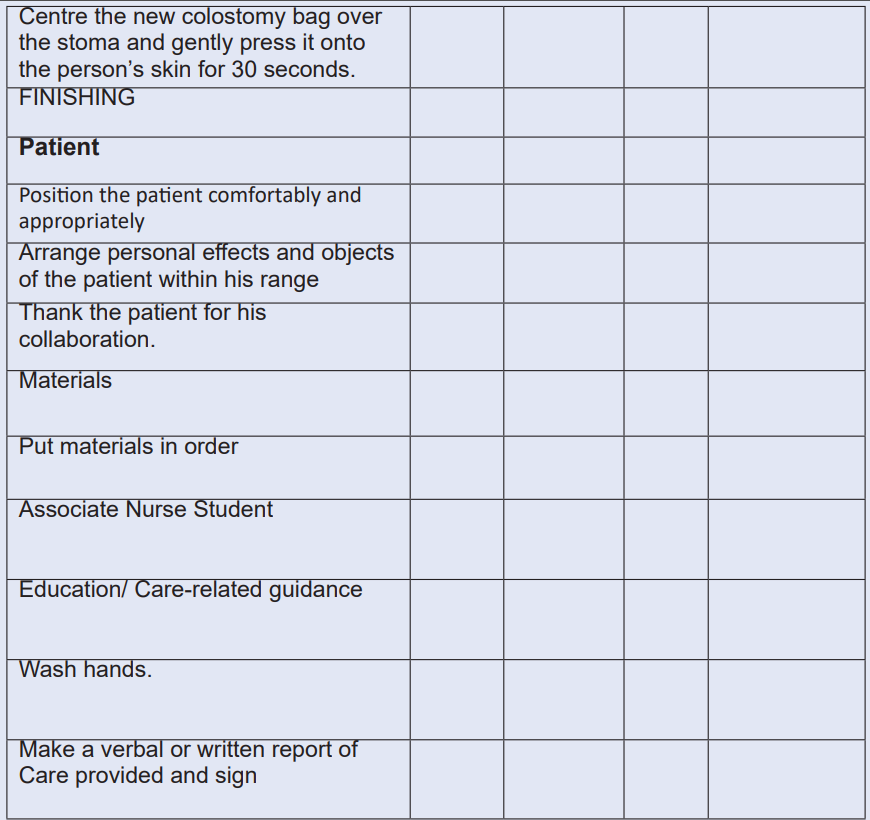
2.13.Hygiene Care of Ileostomy Or Colostomy
AIMS
• To prevent infection• To prevent irritation of the skin
ASSOCIATE NURSE STUDENT / PREPARATION
• Should appear professional (in full and clean uniform) with ID Card
• Hair tied back
• Remove watch, jewels, and Rings
• Wear closed shoes
• Clean and short nails
• Remove watch, jewels, and Rings
• Wear closed shoes• Hand washing
PATIENT PREPARATION
• Identification of the patient
• Self-presentation to the patient
• Ask for the consent
• Physical and psychological patient preparation
• Assess levels of comprehension and collaboration of the patient
• Adjust the environment of the patient as necessary.
• Explain the procedure and purpose to the patient
• Check chart for limitations on patient’s physical activity.
• Check Cleanliness or condition of the bed and surrounding environment• Position the patient in a comfortable position
EQUIPMENTS
• Bed pan
• Protective Clean gloves
• Toilet paper
• Material for personal hygiene if necessary
• Receptacle for waste disposal
• Screen
• Linens such as privacy blankets
• Water proof protector/Macintosh
• Pieces of gauzes• Physiologic 0.9% solution The trolley.
Steps

2.14. Vital signs And Parameters
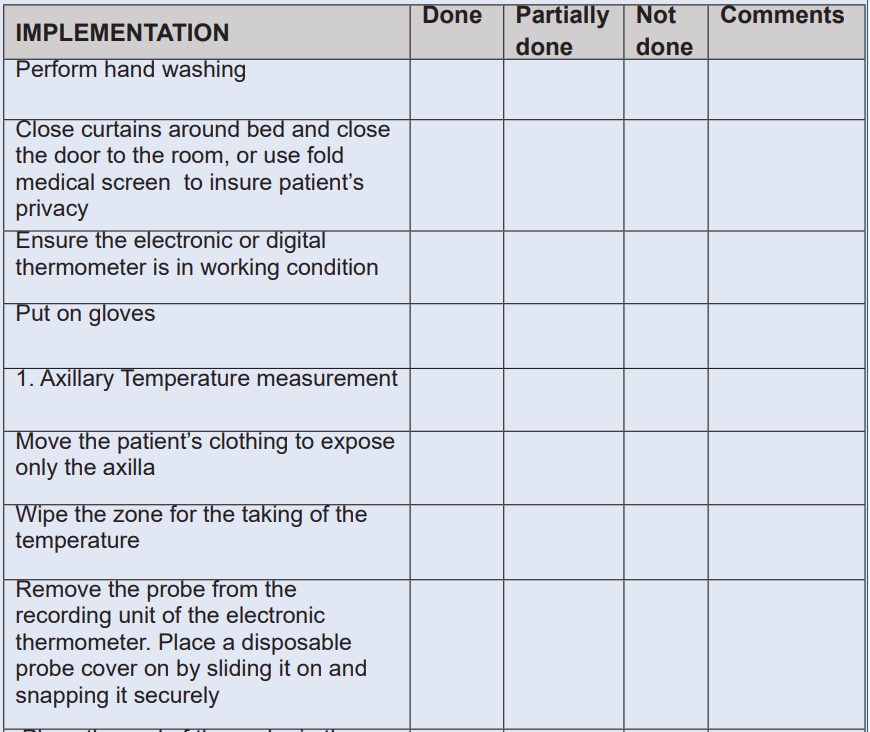
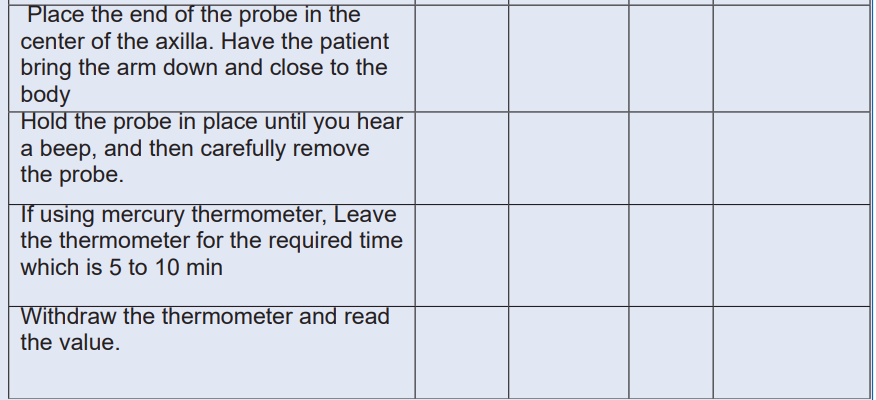
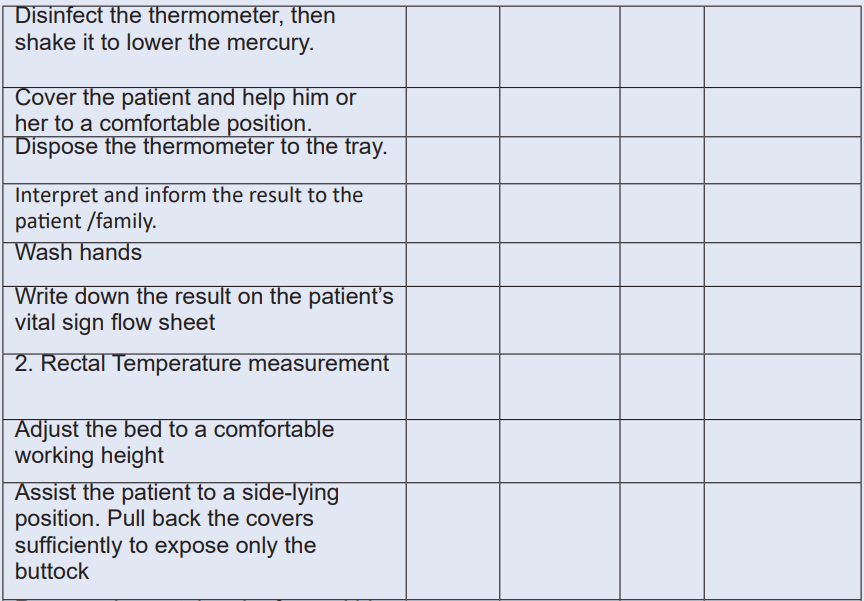
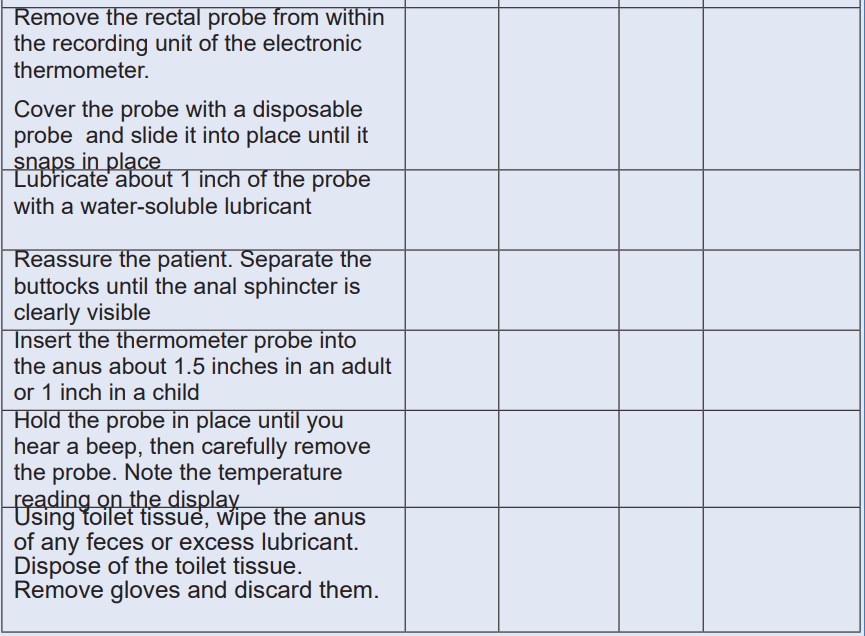
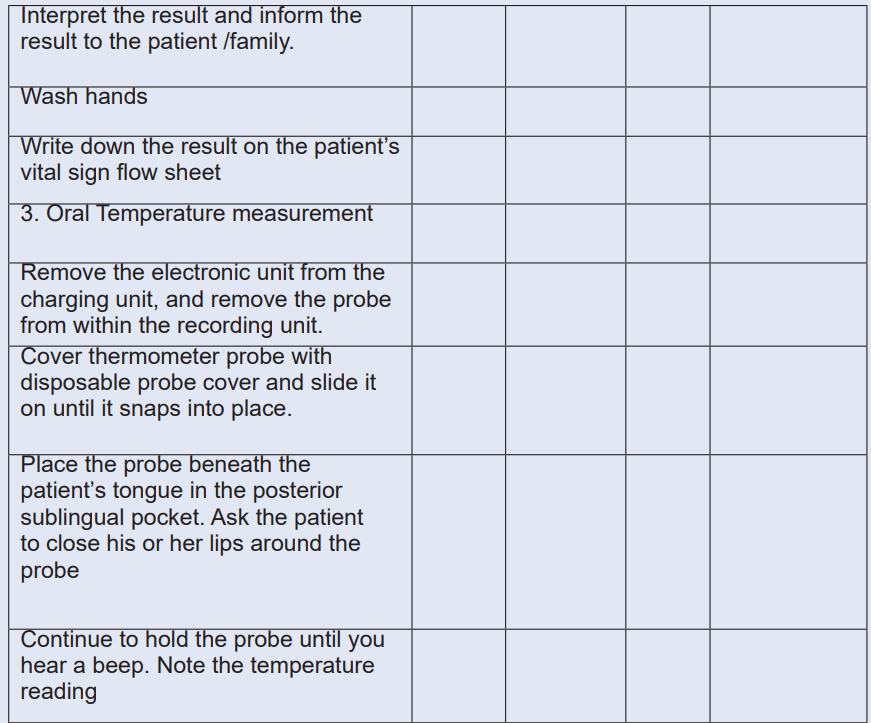
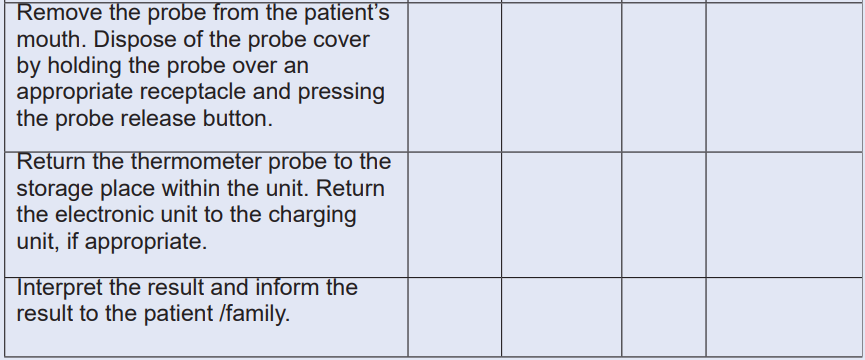
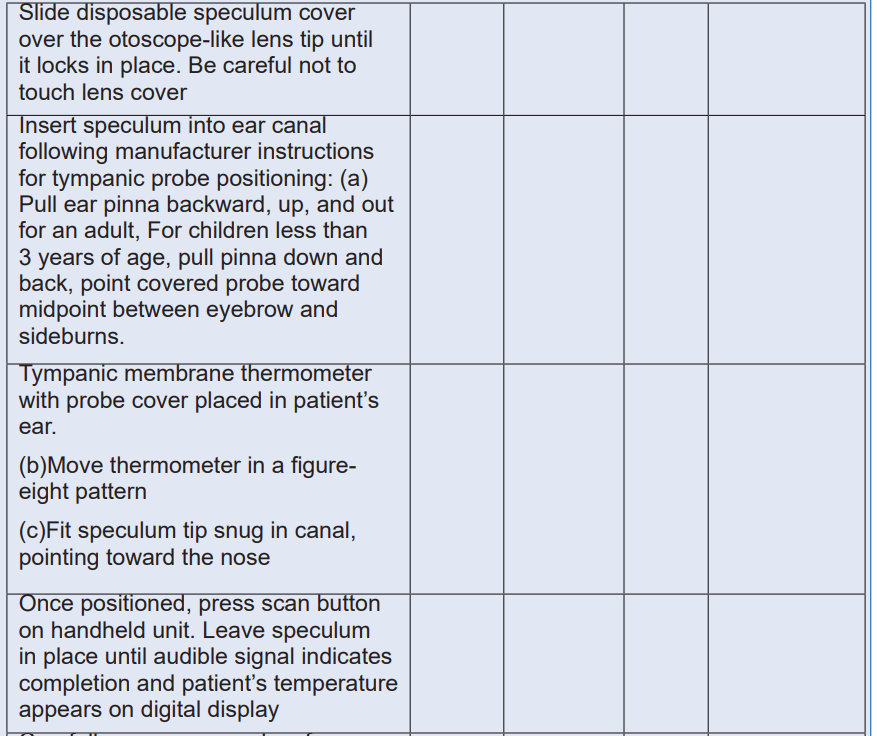
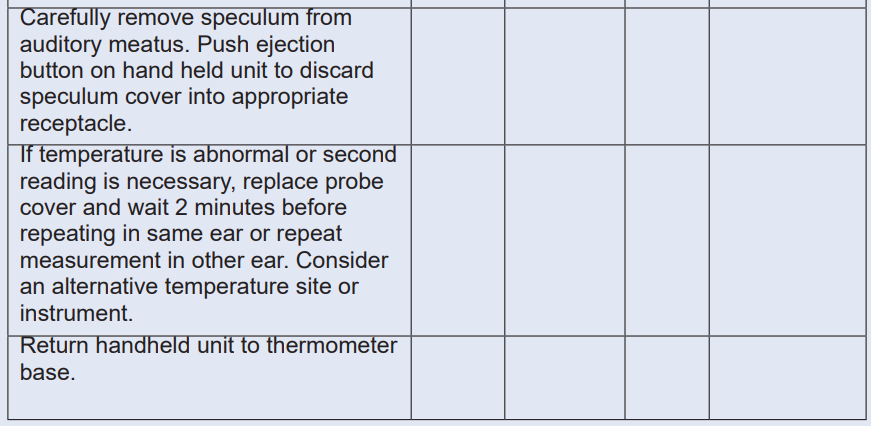
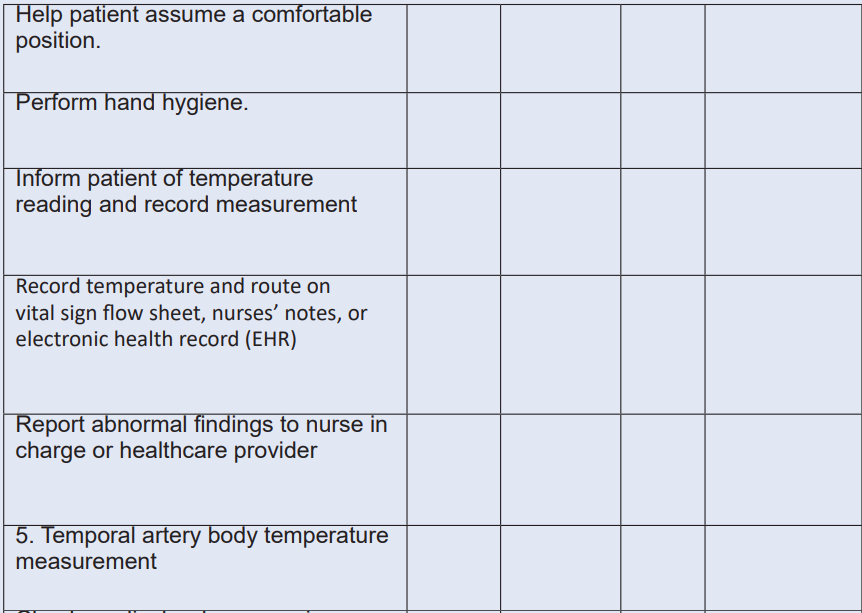
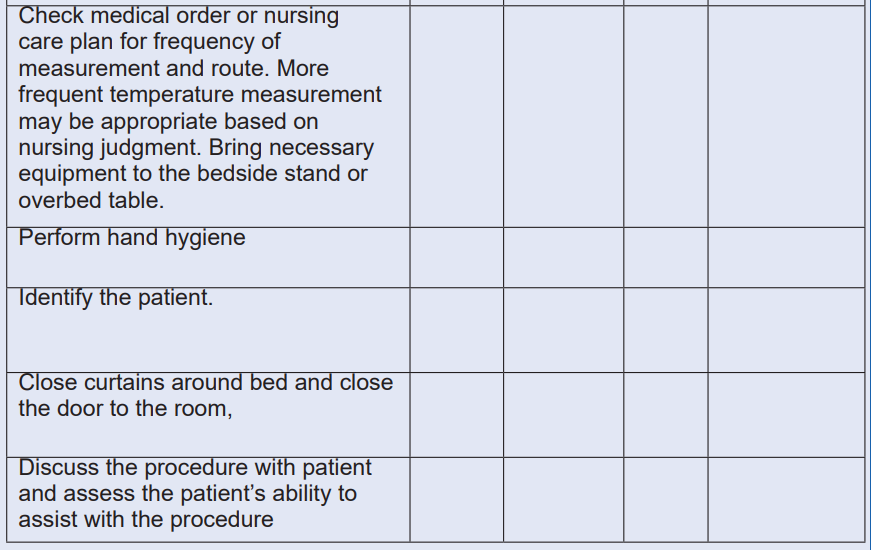
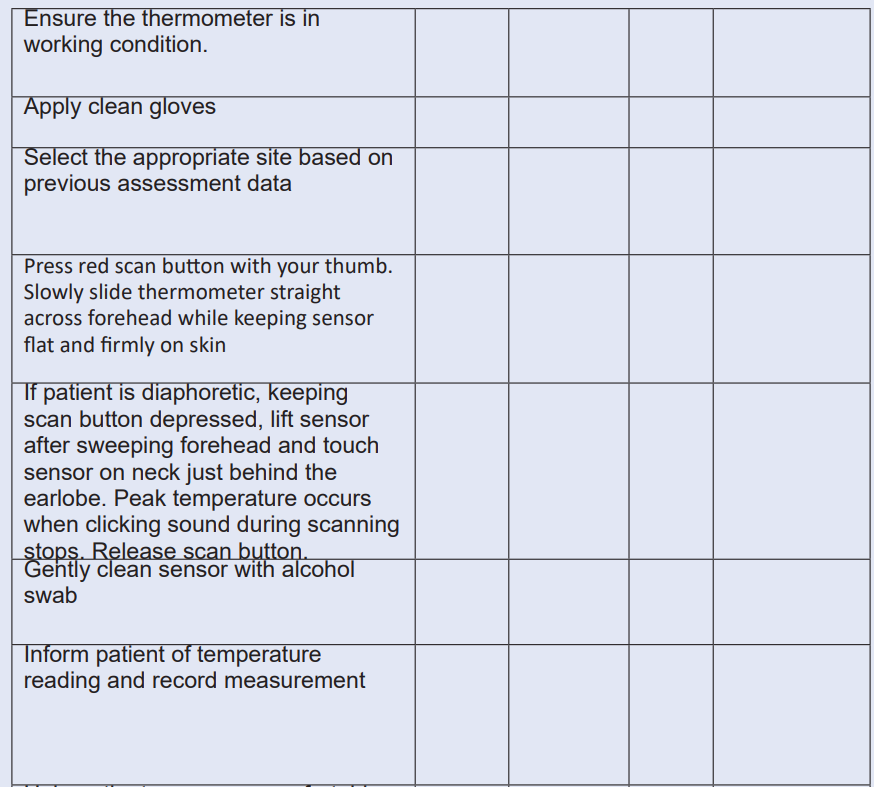
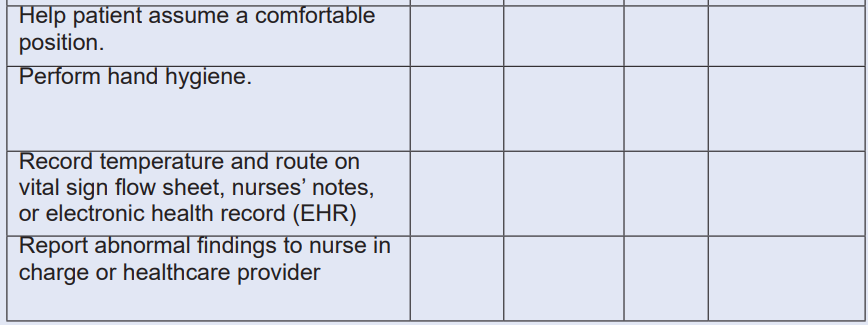
2.14.1.Technique: Body Temperature Mesurement
Aims of the procedure
• To assist in diagnosis
• To evaluate patient recovery from illness,
• To determine if immediate measure is needed to any abnormal bodytemperature
Learning outcomes:
• To measure the body temperature (axillary, oral, tympanic membrane andtemporal artery)
• To write down the results , interpret them and communicate the results
ASSOCIATE NURSE STUDENT / PREPARATION
• Should appear professional (in full and clean uniform) with student ID
Card
• Hair tied back
• Remove watch, jewelries, and Rings
• Wear closed shoes• Hand washing
PATIENT PREPARATION
• Identification of the patient
• Self-presentation to the patient
• Physical and psychological patient preparation
• Assess levels of comprehension and collaboration of the patient
• Explain to the patient/ family the rational of body temperature measurement• Position the patient in a comfortable position
EQUIPMENTS
EQUIPMENTS (axillary body temperature)
• Appropriate and functional thermometer.
• Cleaned and disinfected tray.
• Swabs and disinfectant.
• Pen and vital sign flow sheet or electronic health record
• Functional watch on the second hand• Kidney dish and bowl
EQUIPMENTS(tympanic body temperature)z
• Infrared (tympanic) thermometer, appropriate for site to be used
• Disposable probe covers
• Non sterile gloves, if appropriate
• Cleaned and disinfected tray.
• Swabs and disinfectant
• Kidney dish and bowl
• Additional Personal Protective Equipment (PPE),as indicated
• Toilet tissue, if needed• Pencil or pen, paper or flow sheet, computerized record
EQUIPMENTS(temporal body temperature)
• Infrared temporal artery thermometer, appropriate for site to be used
• Disposable probe covers
• Non sterile gloves, if appropriate
• Cleaned and disinfected tray.
• Swabs and disinfectant
• Kidney dish and bowl
• Additional Personal Protective Equipment (PPE),as indicated
• Toilet tissue, if needed• Pencil or pen, paper or flow sheet, computerized record
Steps
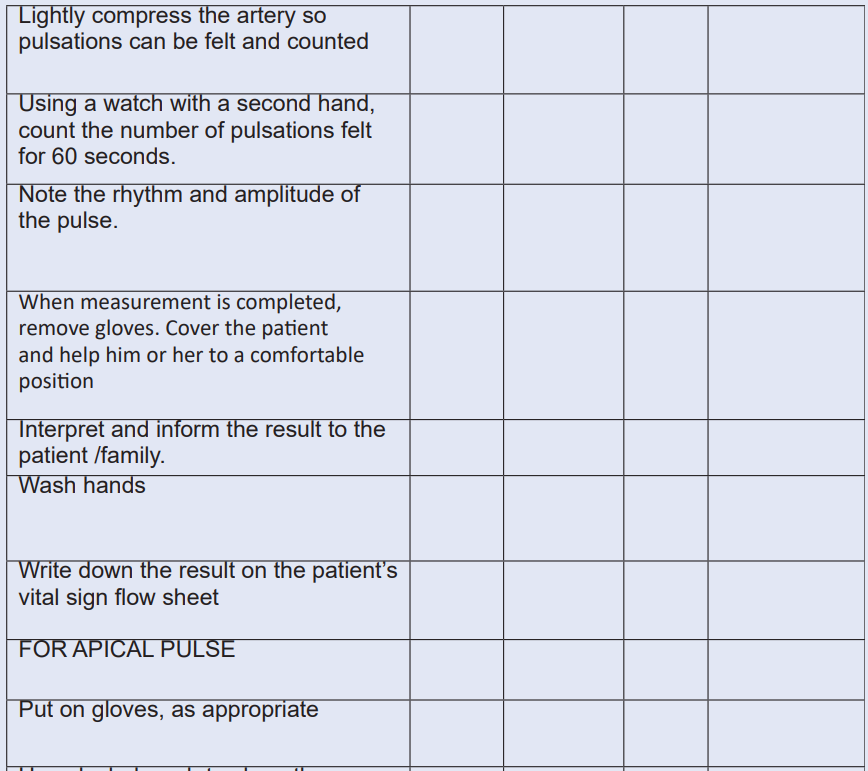
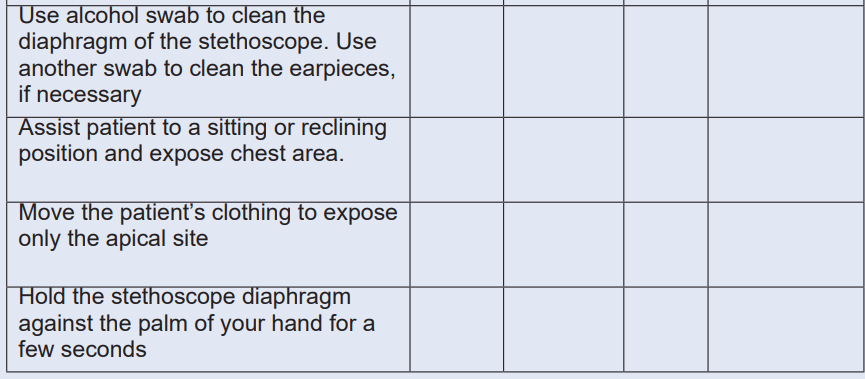
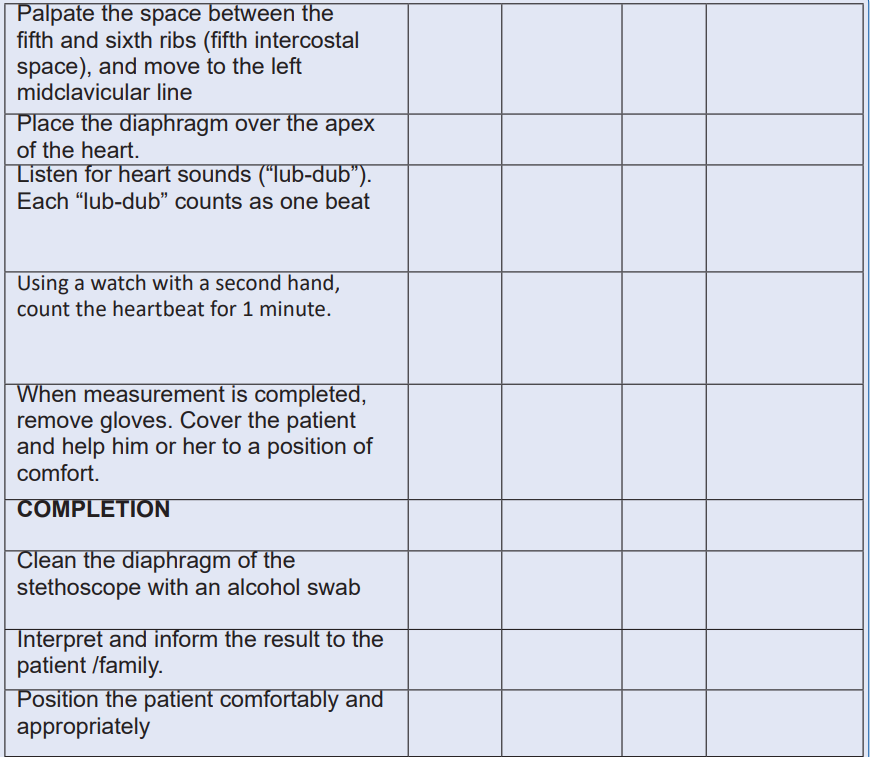
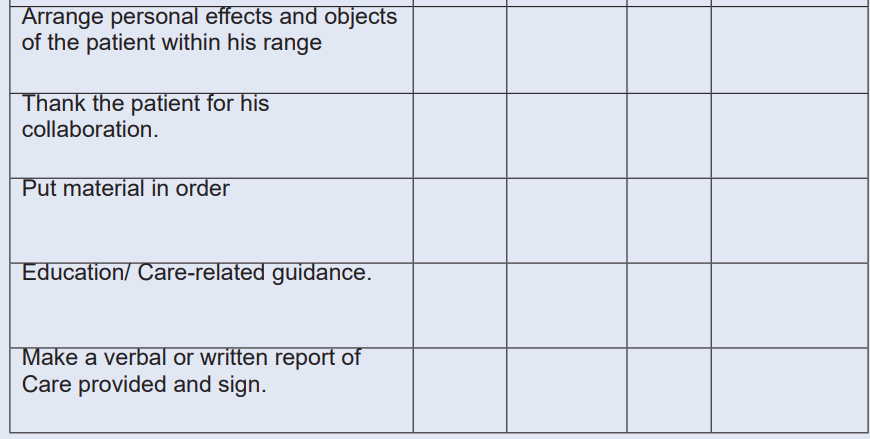
2.14.2.Technique: Pulse Measurement
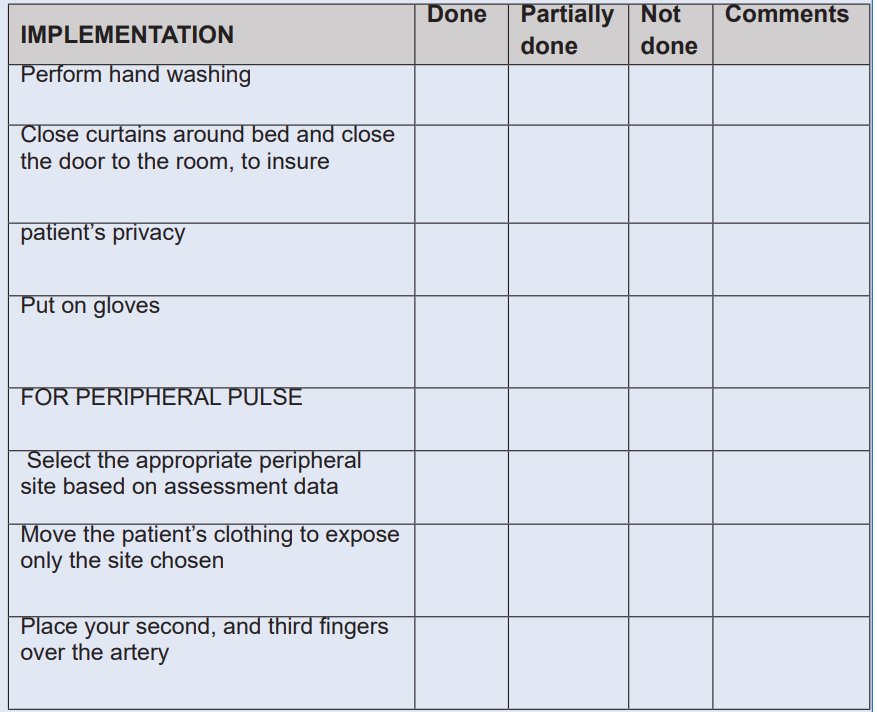
AIMS
• To gather information about heart rhythm and pattern of beat
• To assess heart ability to deliver blood to distant areas
• To evaluate heart effect to cardiac medication, activity, blood volume andgas exchange
Learning outcomes:
• Take correctly the pulse rate
• Record the results and interpret them.• Communicate results
ASSOCIATE NURSE STUDENT / PREPARATION
• Should appear professional (in full and clean uniform) with student ID Card
• Hair tied back
• Remove watch, jewelries, and Rings
• Wear closed shoes• Hand washing
PATIENT PREPARATION
• Identification of the patient
• Self-presentation to the patient
• Physical and psychological patient preparation
• Assess levels of comprehension and collaboration of the patient
• Explain to the patient/ family the rational of pulse check up
• Position the patient in a comfortable position• Make sure that the patient has been at rest for at least 10 minutes.
EQUIPMENTS
• Watch with second hand.
• Stethoscope (for taking the apical pulse only).
• Non-sterile gloves
• Pen and vital sign flow sheet or electronic health record• Swabs with disinfectant in kidney dish in the event of the apical pulse.
Steps
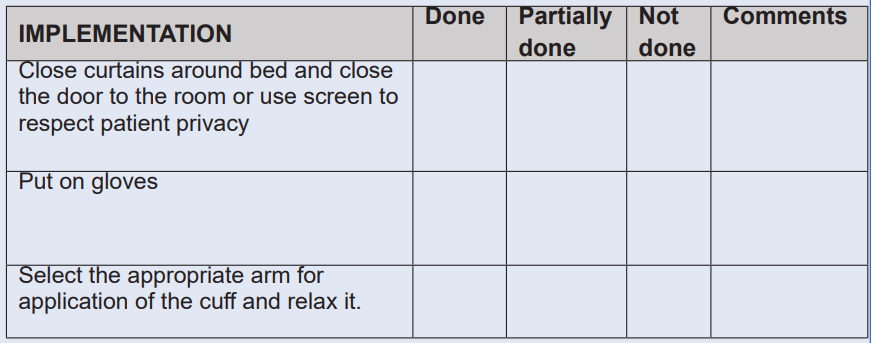
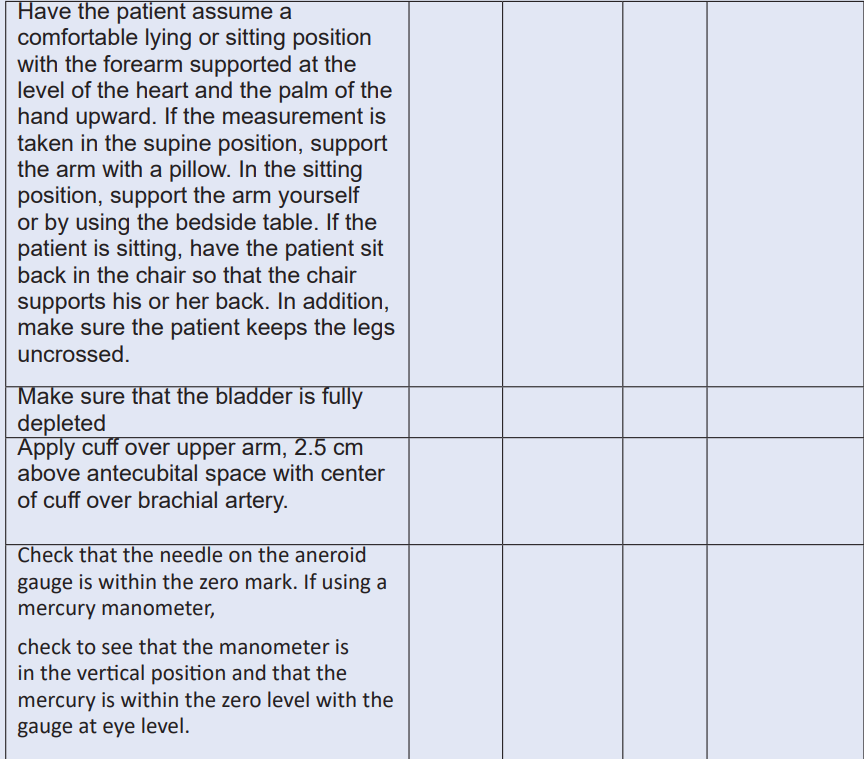
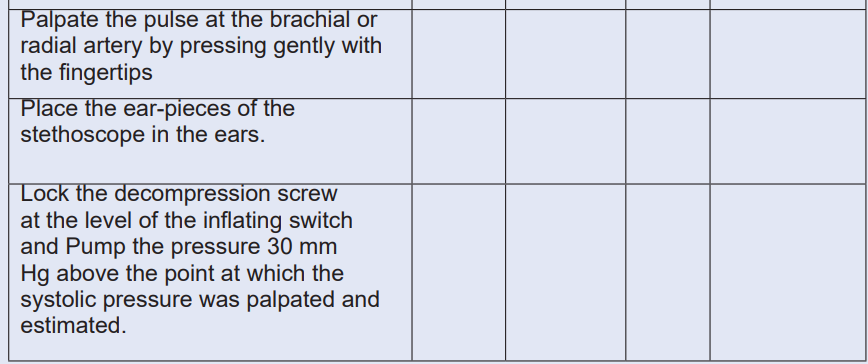
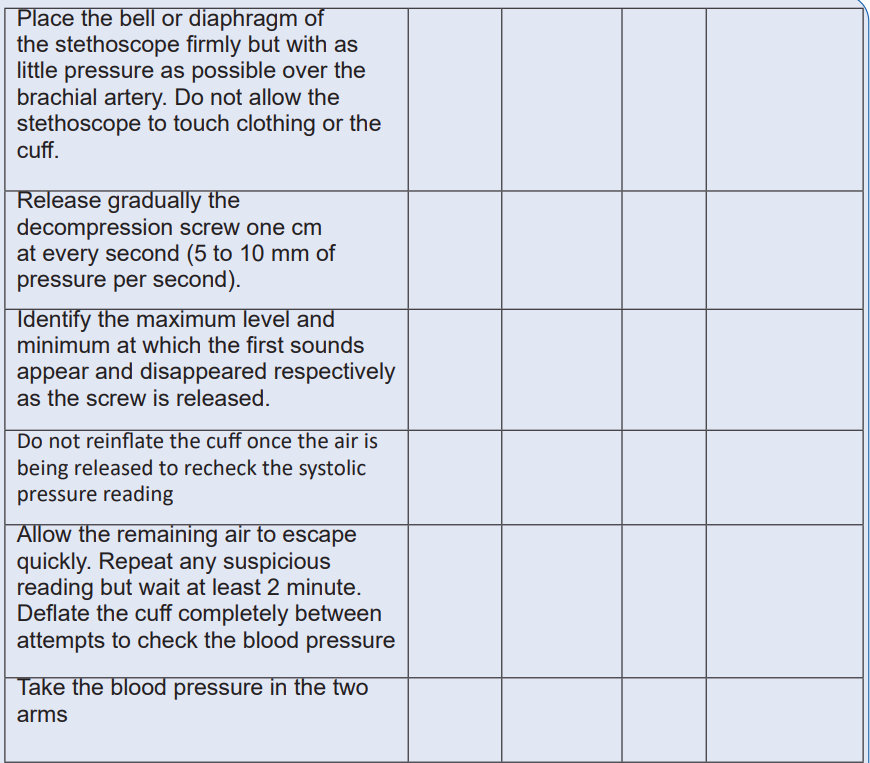
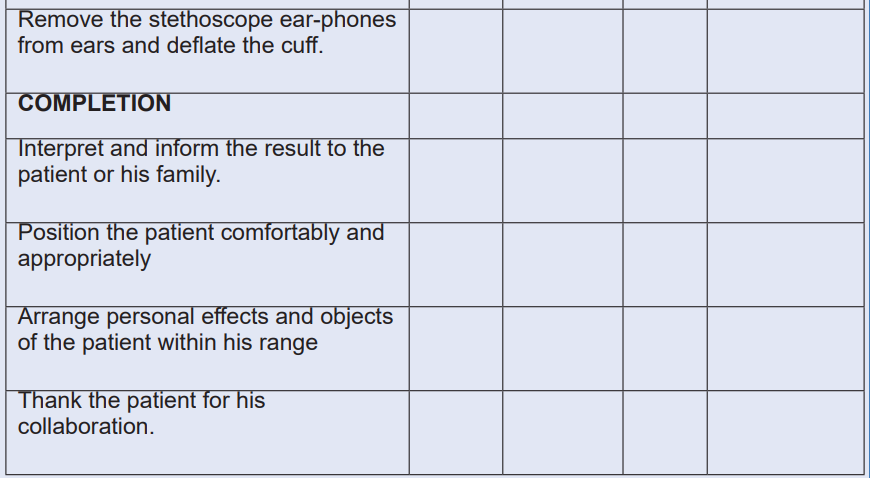
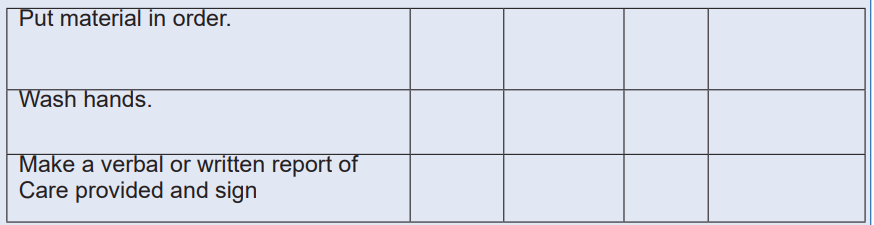
2.14.3. Technique: Blood Pressure Measurement
Aims of the procedure
• To obtain baseline data for diagnosis and treatment
• To compare and evaluate subsequent change occurred during care.
Learning outcomes:
• The students will be able to demonstrate how to use the equipment for
taking a blood pressure, organize their technique, and produce an accurate
reading according to what they hear or see.• The student will be able to interpret the findings
ASSOCIATE NURSE STUDENT / PREPARATION
• Should appear professional (in full and clean uniform) with student ID Card
• Hair tied back
• Remove watch, jewelries, and Rings
• Wear closed shoes• Hand washing
PATIENT PREPARATION
• Identification of the patient
• Self-presentation to the patient
• Physical and psychological patient preparation(Make sure that the skin is
dry and injury-free. Do not take BP on an arm with perfusion, paralyzed, or
on the side of a former mastectomy)
• Assess levels of comprehension and collaboration of the patient
• Explain to the patient/ family the rationale of BP check up
• Position the patient in a comfortable position• Instruct the patient to have a rest for at least 10 minutes.
EQUIPMENTS
• Hand washing
• Disinfected Tray/Trolley
• Disposable pressure cuff of appropriate size for patient
• Functional sphygmomanometer
• Non sterile Gloves
• Alcohol swabs(concentrated at 70%)
• Functional stethoscope.
• Kidney dish• Pen and vital sign flow sheet or electronic health record
Steps
2.14.4.Technique: Respiratory Rate Measurement
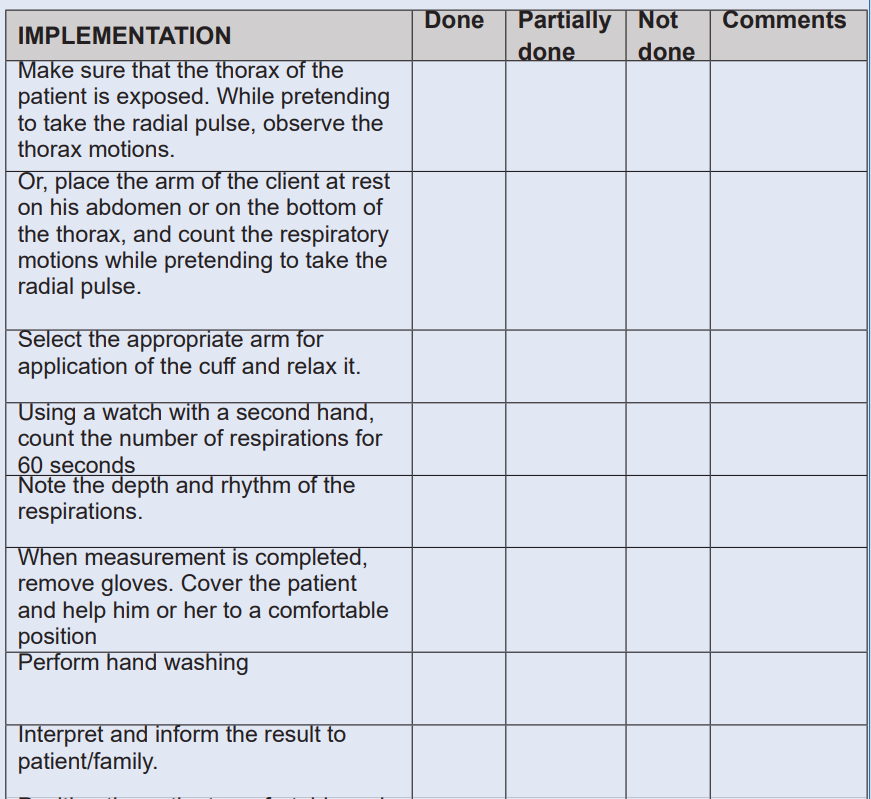
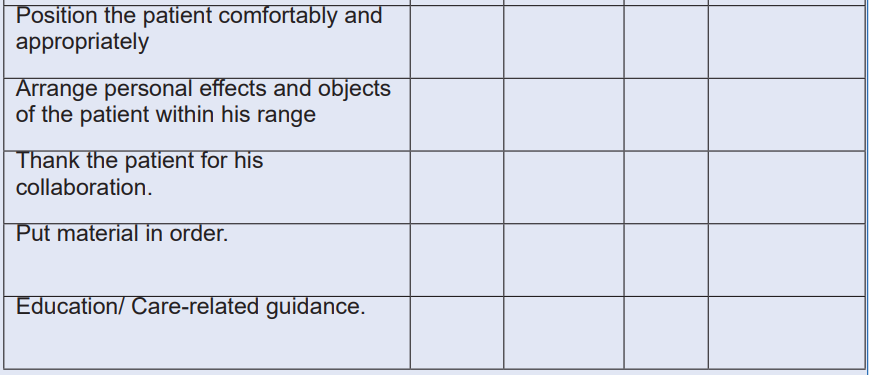
AIMS
• To gather information about rhythm and depth
• To determine number of respiration occurring per minutes
Learning outcomes:
• Take correctly the Respiration rate
• Record the results and interpret them.• Communicate results
ASSOCIATE NURSE STUDENT / PREPARATION
• Should appear professional (in full and clean uniform) with student ID Card
• Hair tied back
• Remove watch, jewelries, and Rings
• Wear closed shoes• Hand washing
PATIENT PREPARATION
• Identification of the patient
• Self-presentation to the patient
• Physical and psychological patient preparation(Make sure that the skin is
dry and injury-free. Do not take BP on an arm with perfusion, paralyzed, or
on the side of a former mastectomy)
• Assess levels of comprehension and collaboration of the patient
• Explain to the patient/ family the rationale of BP check up
• Position the patient in a comfortable position• Instruct the patient to have a rest for at least 10 minutes.
EQUIPMENTS
• Functional watch
• Pen and vital sign flow sheet• Nonsterile glove
Steps

2.14.5. Technique: Pulse Oximetry Measurement (Oxygen Saturation)
AIMS
• To review basics of the hemodynamics of cardiovascular system
• To recognize various mechanisms for control of vascular disorders
• To incorporate hemodynamic concepts in treatment decision-making
process, including when selecting pharmacologic agents for management
of cardiovascular diseases.
• To assess the effectiveness of treatment
• To monitor the health of individuals with any type of condition that canaffect blood oxygen levels
Learning outcomes:
• Take correctly the pulse oximetry
• Record the results and interpret them.• Communicate results
ASSOCIATE NURSE STUDENT / PREPARATION
• Should appear professional (in full and clean uniform) with student ID Card
• Hair tied back
• Remove watch, jewelries, and Rings
• Wear closed shoes• Hand washing
PATIENT PREPARATION
• dentification of the patient
• Self-presentation to the patient
• Physical and psychological patient preparation
• Assess levels of comprehension and collaboration of the patient• Position the patient in a comfortable position
EQUIPMENTS
• Pulse oximeter
• Pen• Vital signs monitoring chart
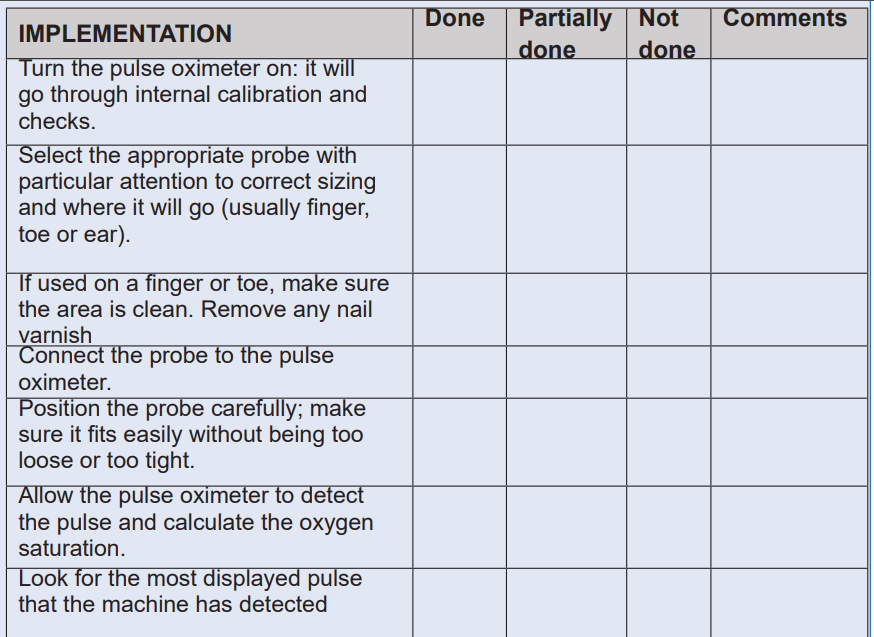
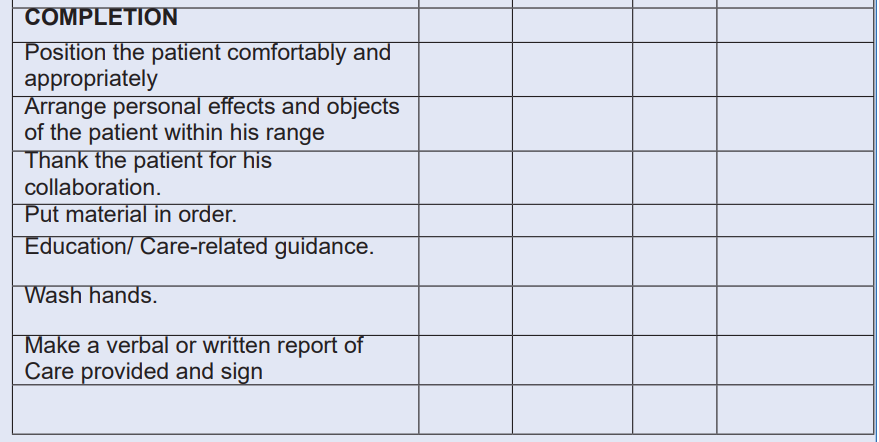
Steps
2.14.6. Technique: Height Measurement
AIMS
• To assess overall health
Learning outcomes:
• Take correctly the height
• Record the results and interpret them.• Communicate results
ASSOCIATE NURSE STUDENT / PREPARATION
• Should appear professional (in full and clean uniform) with student ID Card
• Hair tied back
• Remove watch, jewelries, and Rings
• Wear closed shoes• Hand washing
PATIENT PREPARATION
• Identification of the patient
• Self-presentation to the patient
• Physical and psychological patient preparation
• Assess levels of comprehension and collaboration of the patient• Position the patient in a comfortable position
EQUIPMENTS
• Height gauge, lath fixed on the wall or tape measure and gloves• Pen and height recording flow sheet
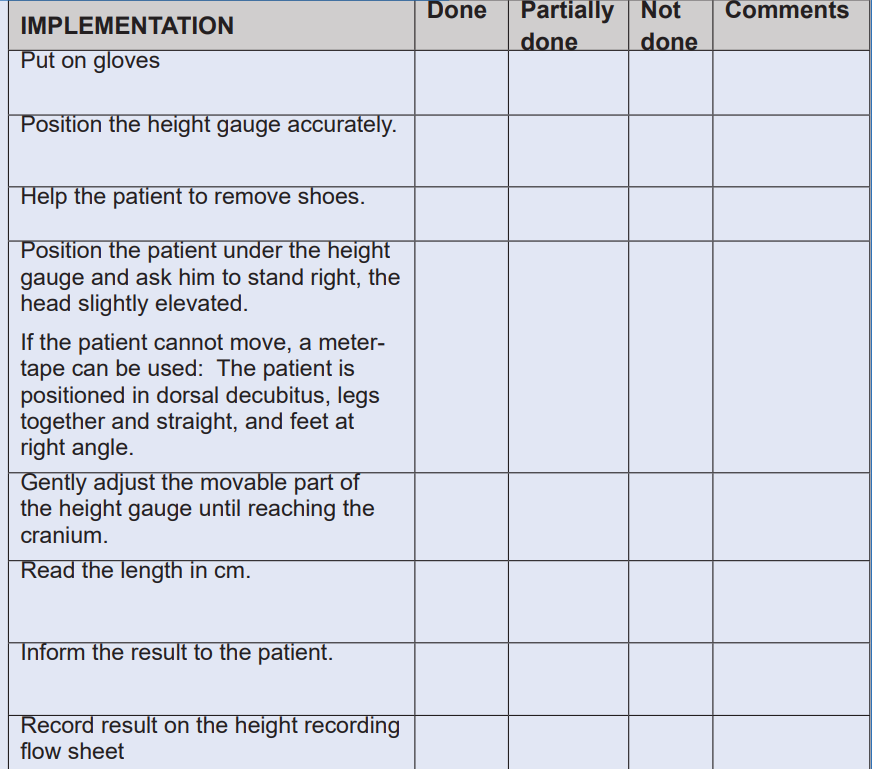
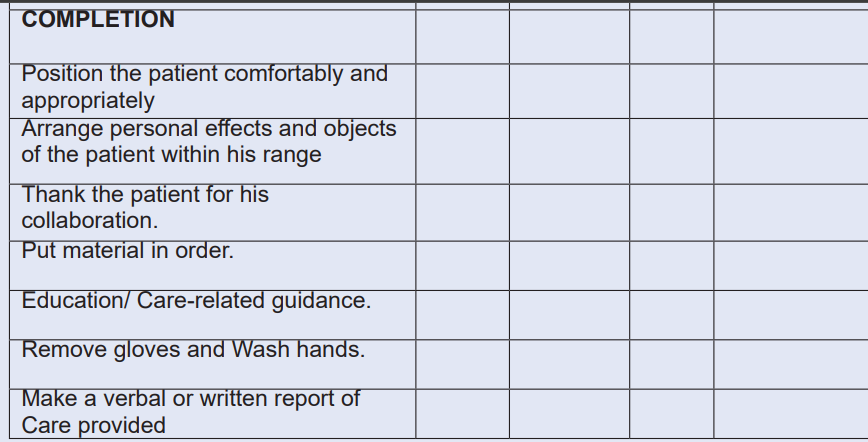
Steps
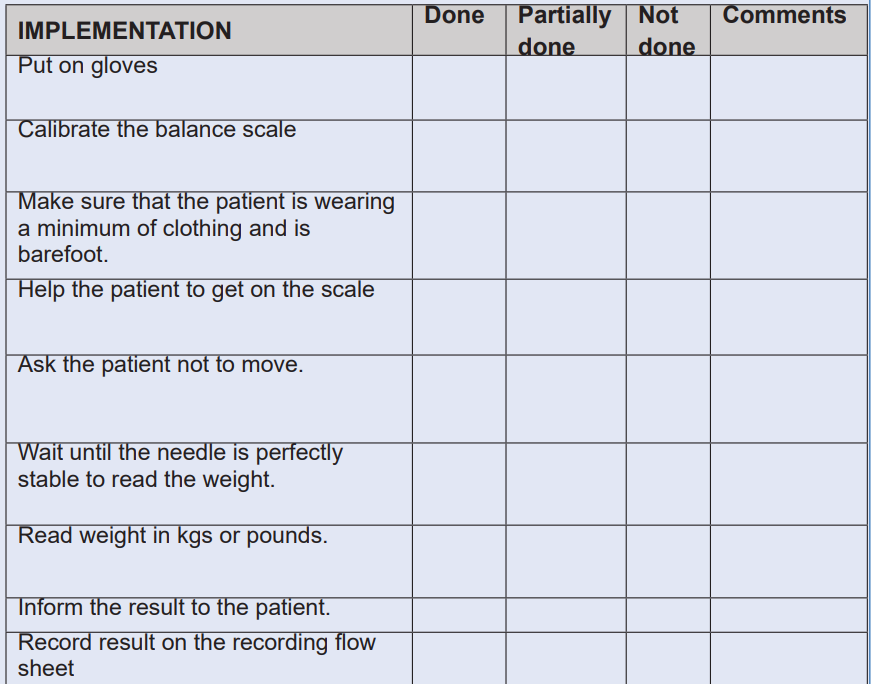
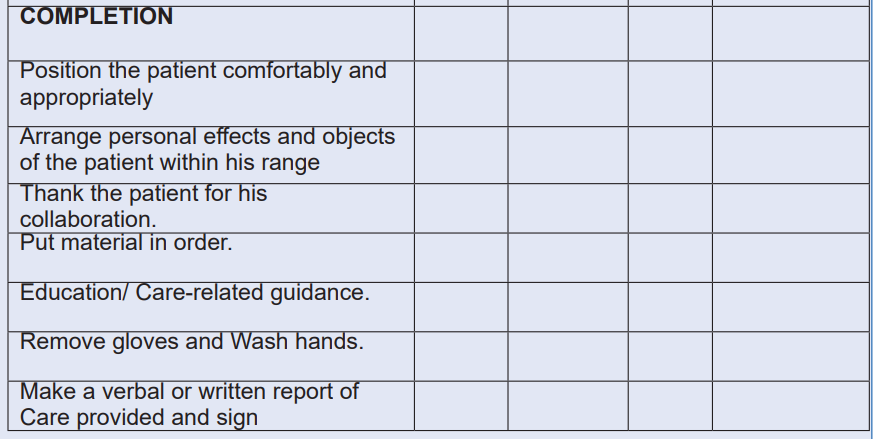
2.4.17.Technique: Weight Measurement
AIMS
• To assess overall of health
Learning outcomes:
• Take correctly the height
• Record the results and interpret them.• Communicate results
ASSOCIATE NURSE STUDENT / PREPARATION
• Should appear professional (in full and clean uniform) with student ID Card
• Hair tied back
• Remove watch, jewelries, and Rings
• Wear closed shoes• Hand washing
PATIENT PREPARATION
• Identification of the patient
• Self-presentation to the patient
• Physical and psychological patient preparation
• Assess levels of comprehension and collaboration of the patient• Position the patient in a comfortable position
EQUIPMENTS
• Appropriate and functional Balance
• Pen, weight recording flow sheet• Gloves
Steps
2.15.Procedure: Drug Administration
2.15.1.Enteral Routes Of Drug Administration
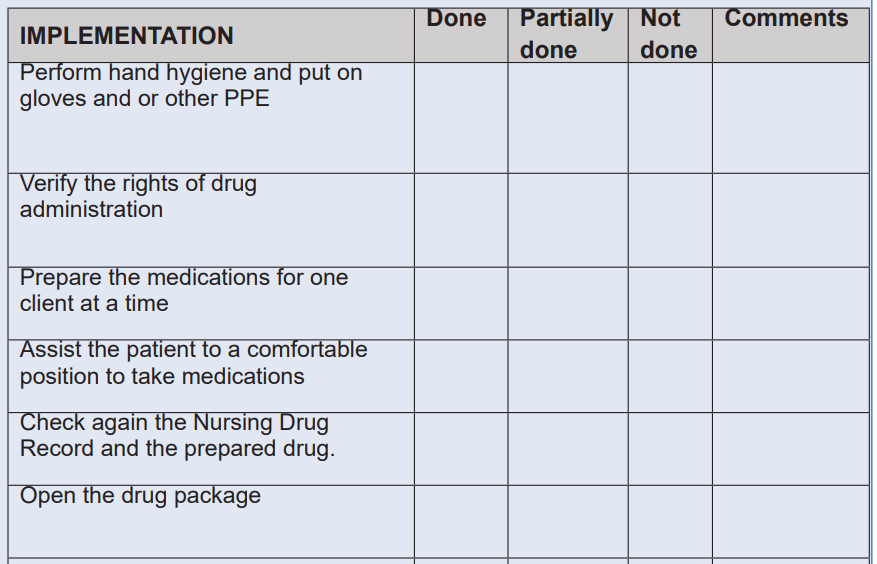
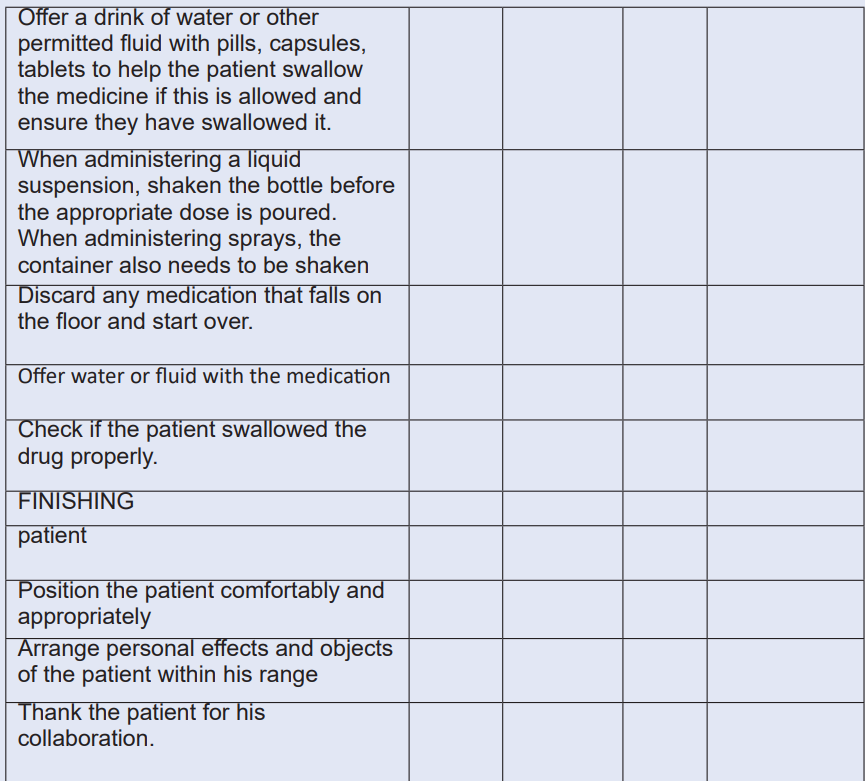
2.15.1.1.Technique: oral drug administration.
AIMS
• To take supplement in order to maintain health,
• To administer medication indicated for oral route• To administer specific medication for local action
ASSOCIATE NURSE STUDENT / PREPARATION
• Should appear professional (in full and clean uniform) with ID Card
• Hair tied back
• Remove watch, jewels, and Rings
• Wear closed shoes• Hand washing
PATIENT PREPARATION
• Identification of the patient
• Review patient’s note and prescription
• Self-presentation to the patient
• Physical and psychological patient preparation
• Assess levels of comprehension and collaboration of the patient
• Adjust the environment of the patient as necessary.
• Explain the procedure and purpose to the patient
• Check for any drug allergies• Cleanliness or condition of the bed and surrounding environment
EQUIPMENTS
• Tray
• kidney tray for waste
• Clean gloves
• Drinking water in a jug
• Medication administration record
• Medication cup
• Drug prescription• Tablet cutter if needed
Steps
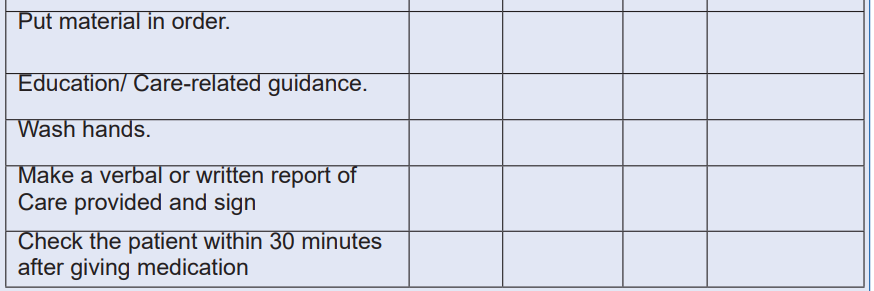
2.15.1.2.Technique: Sublingual Drug Administrations
AIMS
• To ensure a consistent standardized practice for administering medications
sublingually
• To provide the substances that diffuse into the blood through tissues under
the tongue which is predominantly a mucous gland that produces a thickmucinous fluid and lubricates the oral cavity.
ASSOCIATE NURSE STUDENT / PREPARATION
• Should appear professional (in full and clean uniform) with ID Card
• Hair tied back
• Remove watch, jewels, and Rings
• Wear closed shoes• Hand washing
•
PATIENT PREPARATION
• Identification of the patient
• Review patient’s note and prescription
• Self-presentation to the patient
• Physical and psychological patient preparation
• Assess levels of comprehension and collaboration of the patient
• Adjust the environment of the patient as necessary.
• Explain the procedure and purpose to the patient
• Check for any drug allergies• Cleanliness or condition of the bed and surrounding environment
EQUIPMENTS
• Medication,
Steps
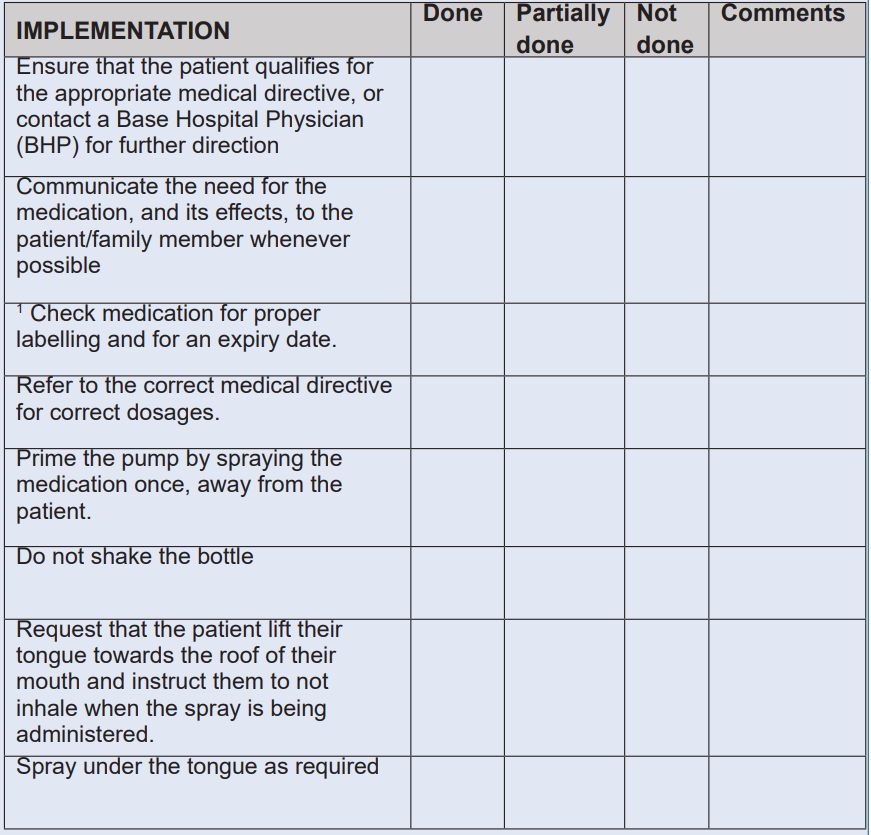
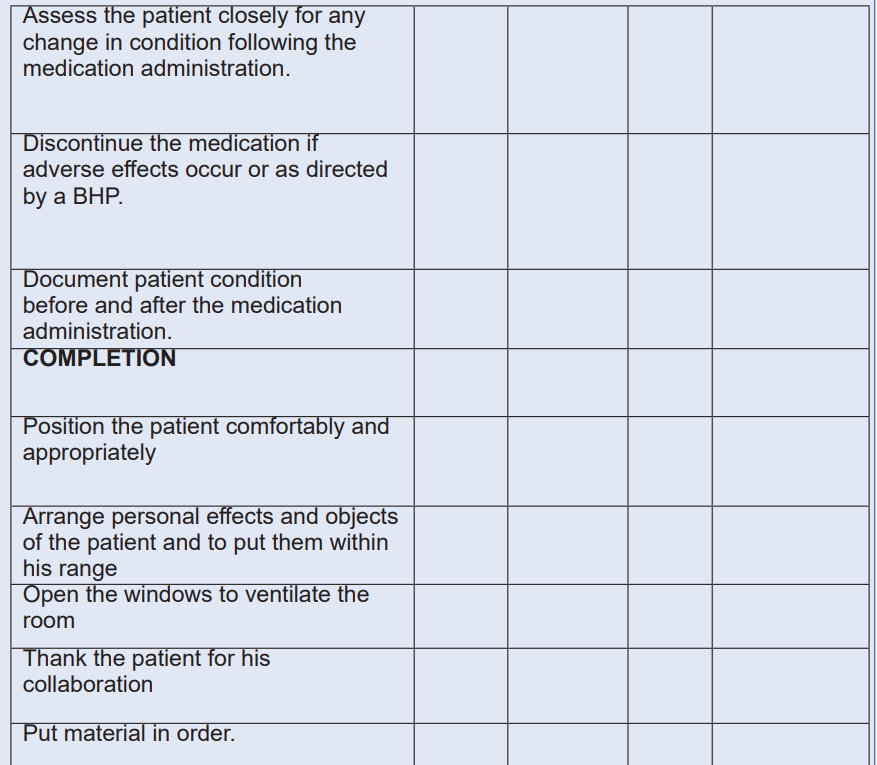
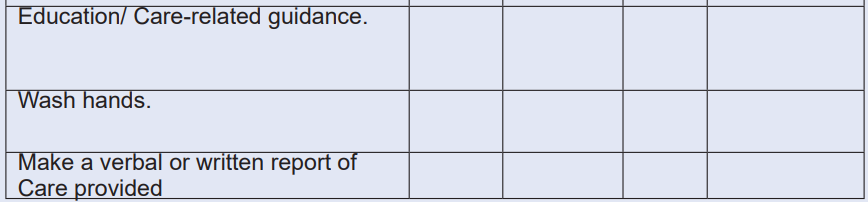
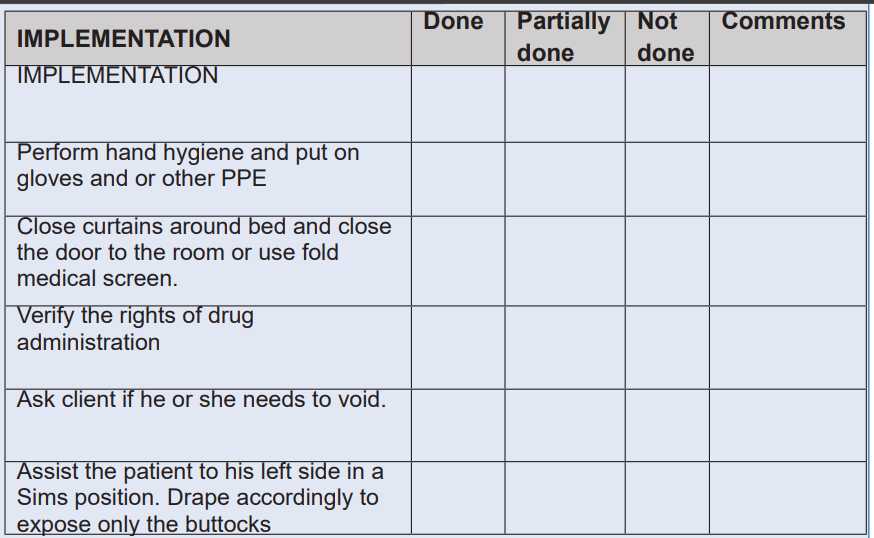
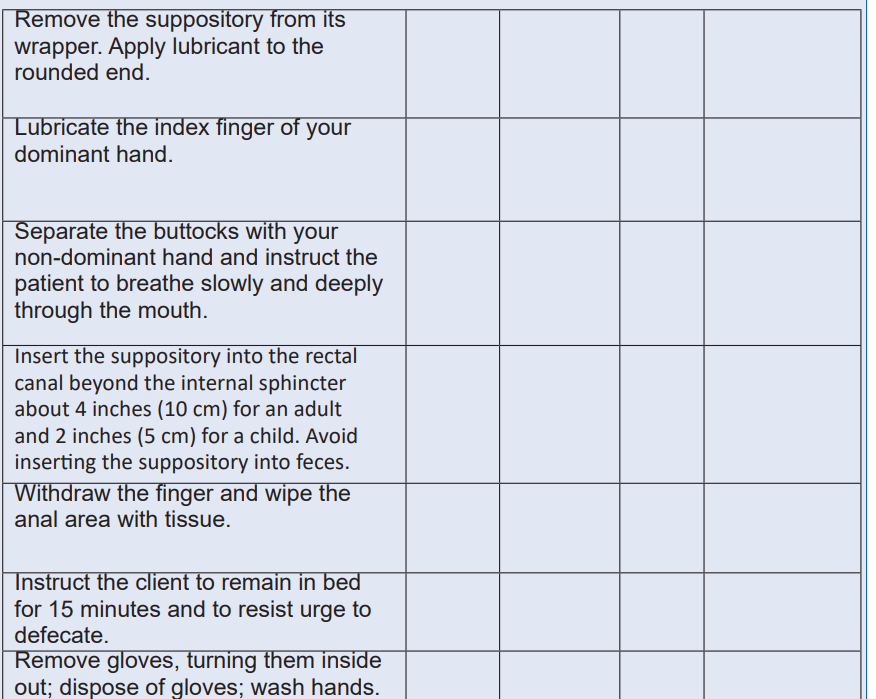
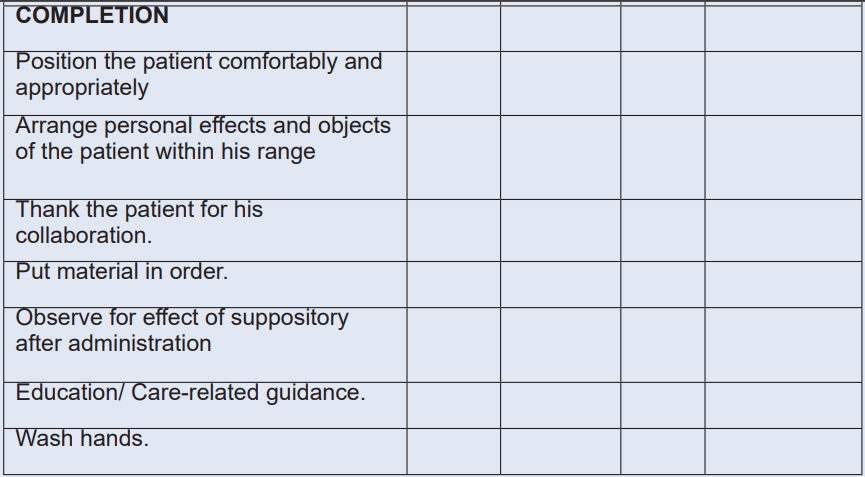
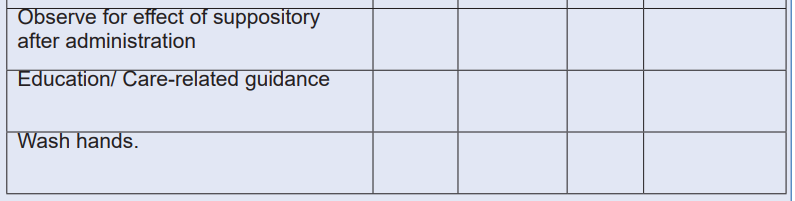
2.15.1.3.Technique: Rectal Suppository Drug Administration
AIMS
• To administer some inflammatory drugs,
• To administer some antipyretic,
• To soften stools in case of constipation• To treat hemorrhoid
ASSOCIATE NURSE STUDENT / PREPARATION
• Should appear professional (in full and clean uniform) with ID Card
• Hair tied back
• Remove watch, jewels, and Rings
• Wear closed shoes
• Hand washing•
PATIENT PREPARATION
• Identification of the patient
• Review patient’s note and prescription
• Self-presentation to the patient
• Physical and psychological patient preparation
• Assess levels of comprehension and collaboration of the patient
• Adjust the environment of the patient as necessary.
• Explain the procedure and purpose to the patient
• Check for any drug allergies• Cleanliness or condition of the bed and surrounding environment
EQUIPMENTS
• Medication administration record,
• Nonsterile gloves
• swabs,
• Bed pan
• Prescribed rectal suppository,• Water-soluble lubricant
Steps
3.10.2. Parenteral Route Of Drugs Administration
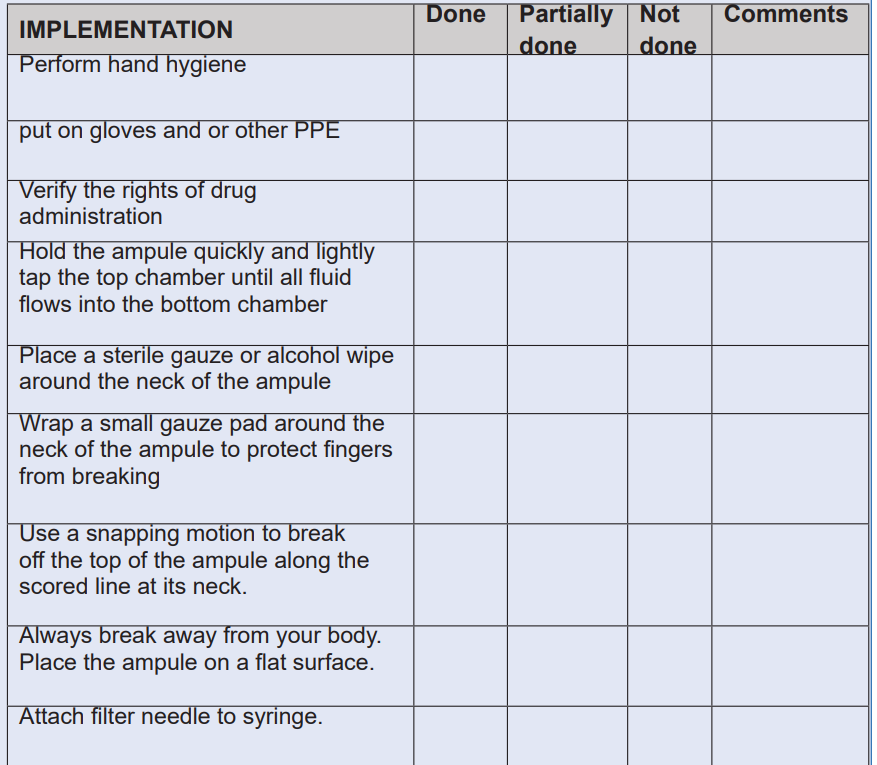
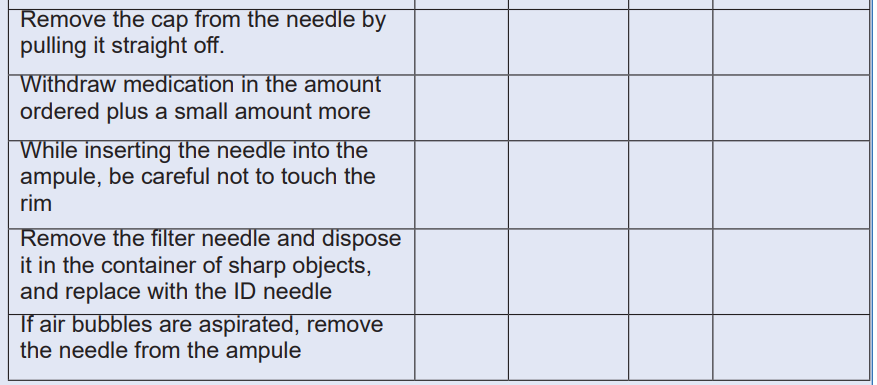
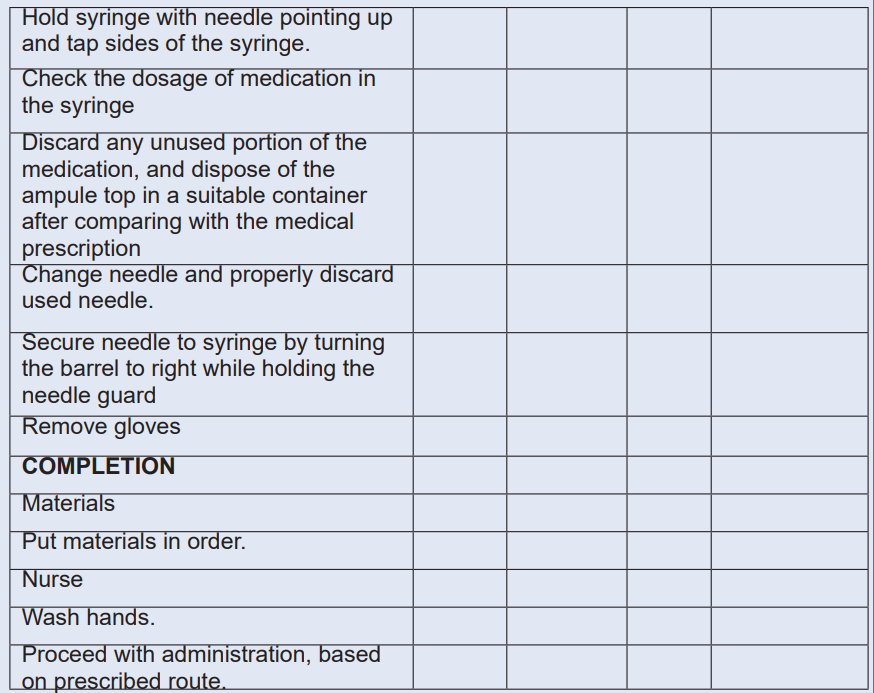
3.10.2.1. Technique: Withdrawing Medication From An Ampoule
AIMS
• To prepare medication before administration.
Leaning outcome
• The student will be able to withdraw the drug from ampoule• The student will be able to hold and manipulate the syringe.
ASSOCIATE NURSE STUDENT / PREPARATION
• Should appear professional (in full and clean uniform) with ID Card
• Hair tied back
• Remove watch, jewels, and Rings
• Wear closed shoes• Hand washing
Materials
• Medication administration record,
• Sterile syringe and needle,• Second needle,
Steps
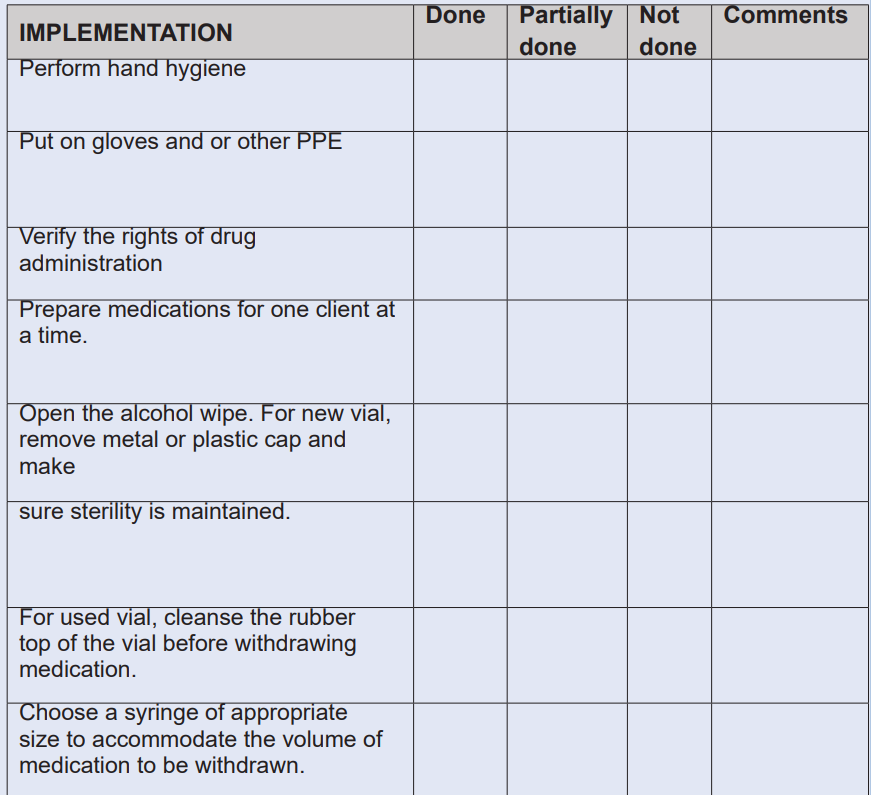
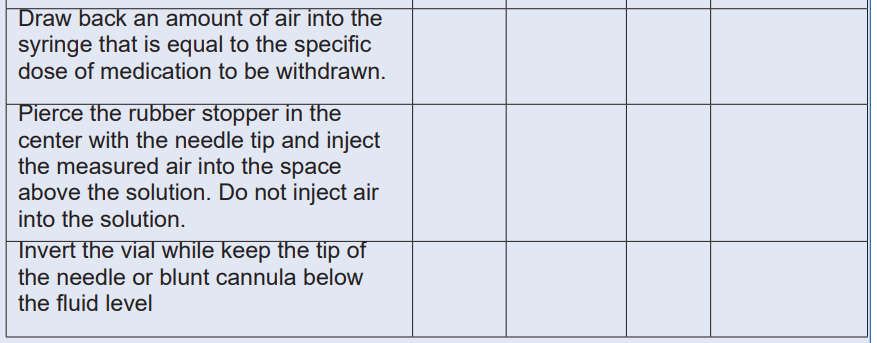
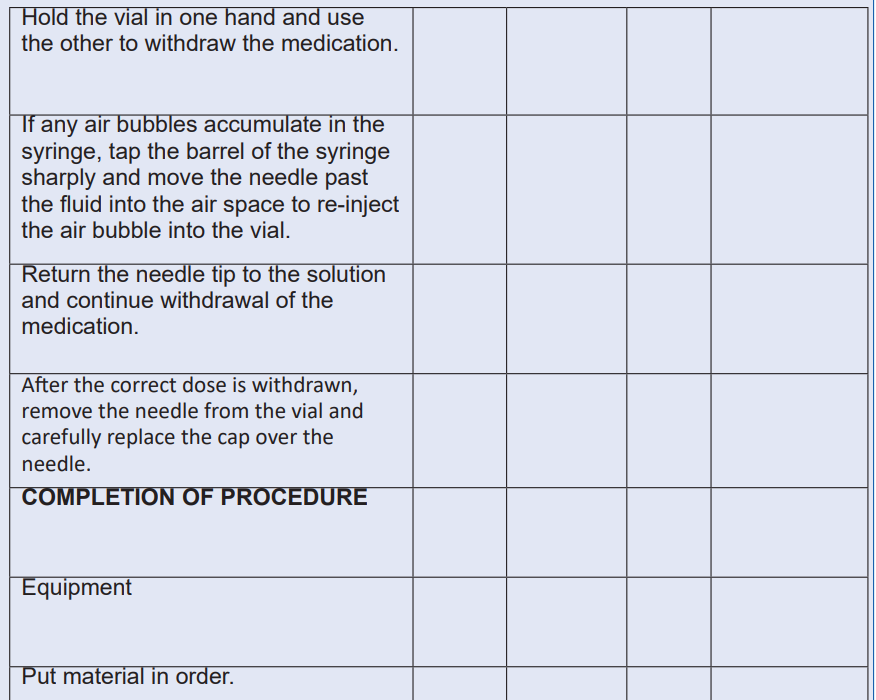
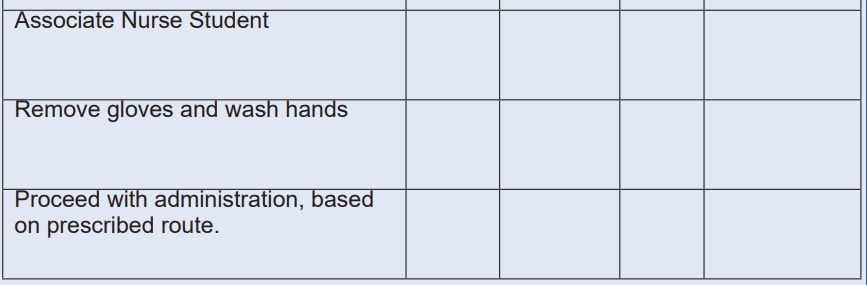
3.10.2.2. Technique : Withdrawing Medication From An Vial
AIMS
• To prepare medication before administration.
Leaning outcome
• The student will be able to withdraw the drug from ampoule• The student will be able to hold and manipulate the syringe
STUDENT / NURSE PREPARATION
• Should appear professional (in full and clean uniform) with ID Card
• Hair tied back
• Remove watch, jewels, and Rings
• Wear closed shoes• Hand washing
Materials
• Medication administration record,
• Sterile syringe and needle,
• Second needle,
• Alcohol swab,
• Sterile gauze,
• Ampoule of prescribed medication,
• Ampoule cutter if available,
• Kidney dish
• Container for discards,
• Nonsterile gloves,• Safety box for sharp instrument.
Steps
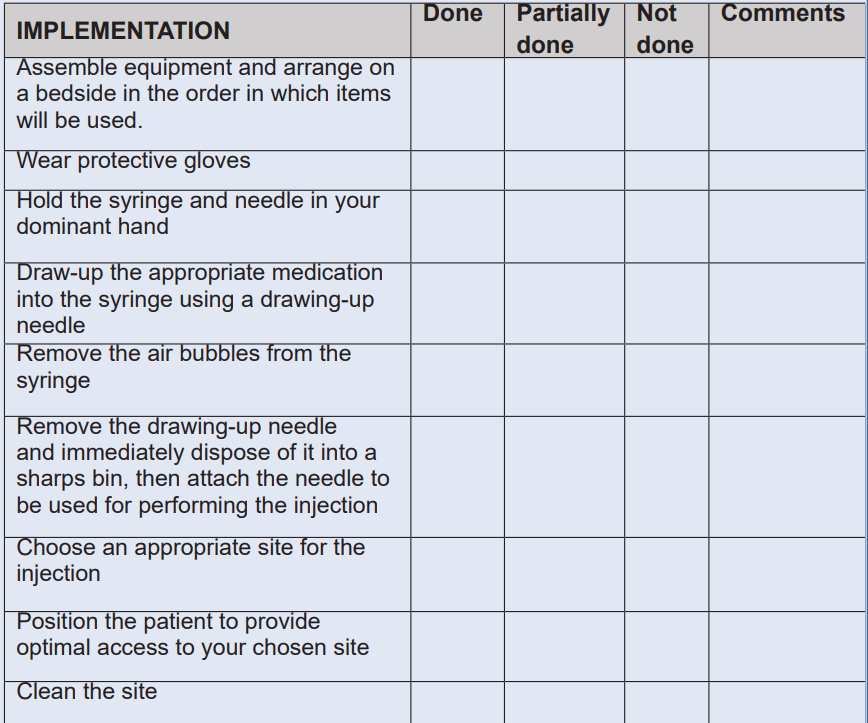
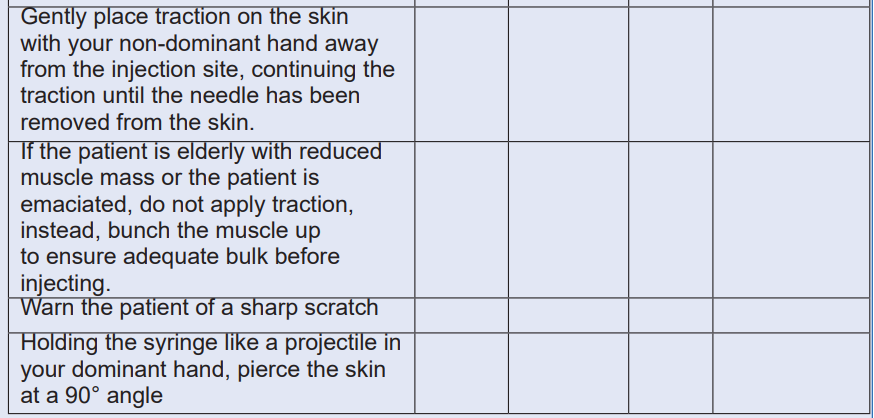
3.10.2.3. Technique: Intramuscular (Im) Injection
AIMS
• To Apply medication through the muscles
• To promote rapid drug absorption• To provide an alternate route of parenteral drug administration
Leaning outcome
• To find suitable sites for administering intramuscular injections;
• To prepare materials for administering intramuscular injections in adults
and paediatric patients;
• To apply the aseptic method during procedures;
• To explain the importance of intramuscular injections;• To assess the risks of potential complications of intramuscular injections.
ASSOCIATE NURSE STUDENT / PREPARATION
• Should appear professional (in full and clean uniform) with ID Card
• Hair tied back
• Remove watch, jewels, and Rings
• Wear closed shoes• Hand washing
PATIENT PREPARATION
• Identification of the patient and ask consent
• Self-presentation to the patient
• Physical and psychological patient preparation
• Assess levels of comprehension and collaboration of the patient
• Adjust the environment of the patient as necessary.• Cleanliness or condition of the bed and surrounding environment
EQUIPMENTS
• Sterile syringes and needles
• Alcohol-based antiseptic solution
• Drug,
• Protective Gloves
• Medication chart
• Dry cotton swab
• Safety box
• Disposable gloves
• Dustbin
• Trolley• Trolley or tray (Plate).
Steps
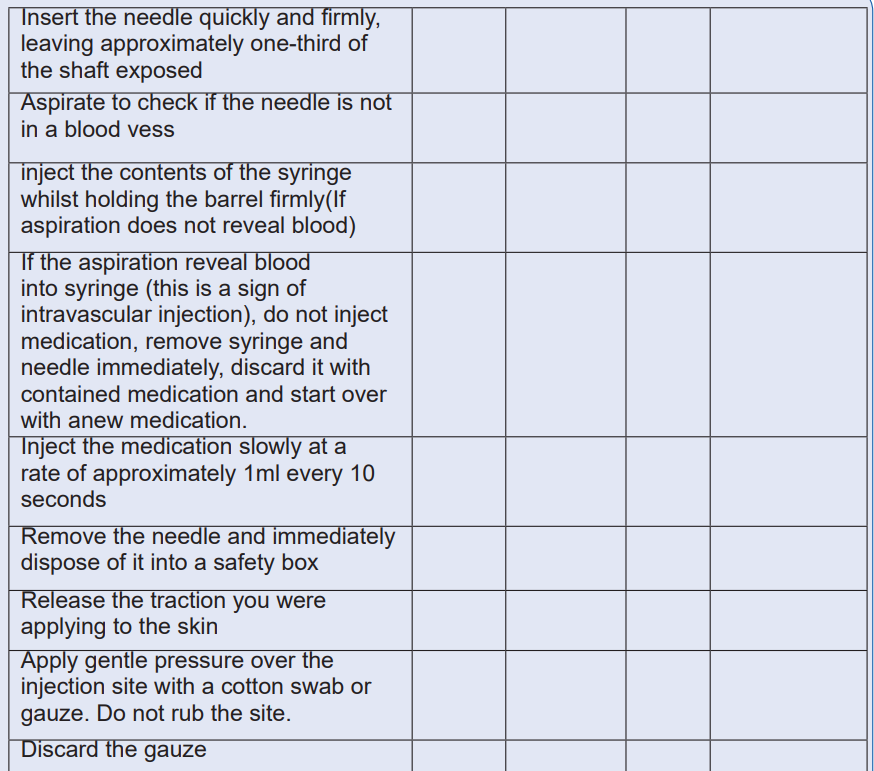
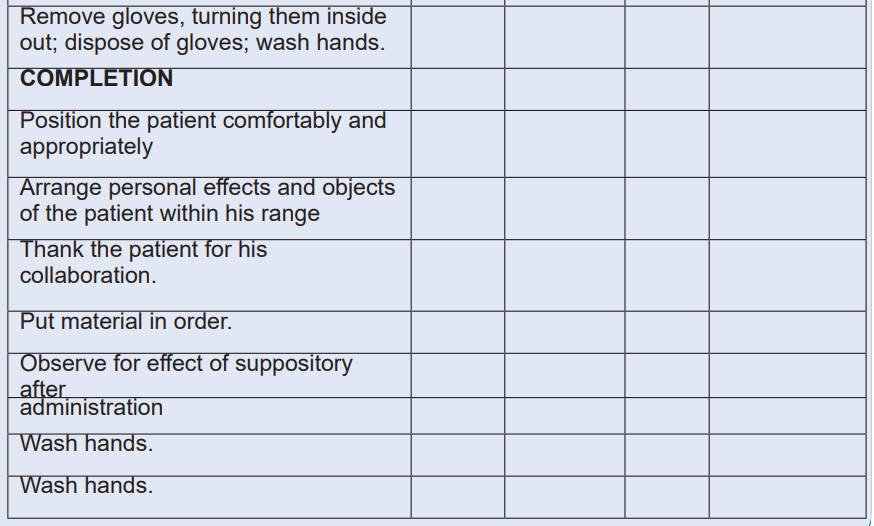
3.10.2.4. Technique: Subcutaneous Injection
AIMS
• To Apply medication under the skin
• To promote rapid drug absorption• To provide an alternate route of parenteral drug administration
Leaning outcome
• To find suitable sites for administering subcutaneous injections;
• To prepare materials for administering subcutaneous injections
• To explain the importance of subcutaneous injections;• To assess the risks of potential complications of subcutaneous injections.
ASSOCIATE NURSE STUDENT / PREPARATION
• Should appear professional (in full and clean uniform) with student ID Card
• Hair tied back
• Remove watch, jewelries, and Rings
• Wear closed and short shoes• Wash hand
PATIENT PREPARATION
• Identification of the patient and ask consent
• Self-presentation to the patient
• Physical and psychological patient preparation
• Assess levels of comprehension and collaboration of the patient
• Adjust the environment of the patient as necessary.• Cleanliness or condition of the bed and surrounding environment
EQUIPMENTS
• Sterile syringes and needles
• Alcohol-based antiseptic solution
• Drug,
• Protective Gloves
• Medication chart
• Dry cotton swab
• Safety box
• Disposable gloves
• Dustbin
• Trolley• Trolley or tray (Plate).
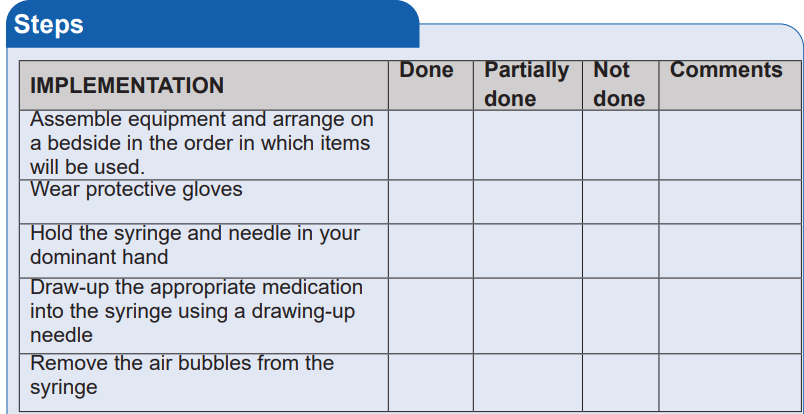
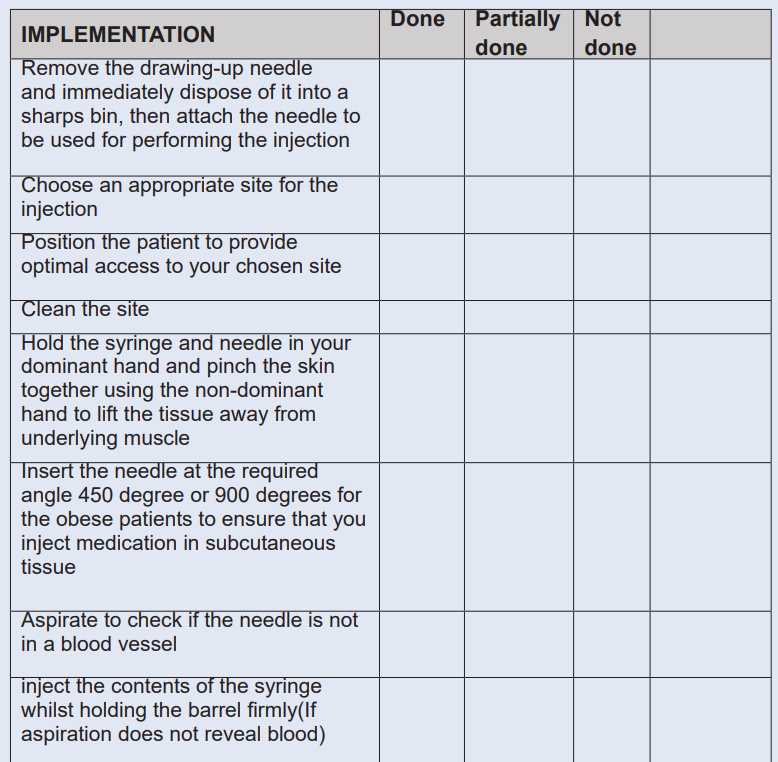
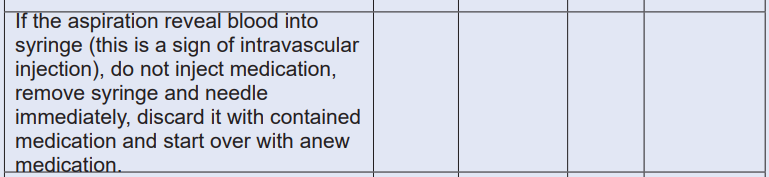
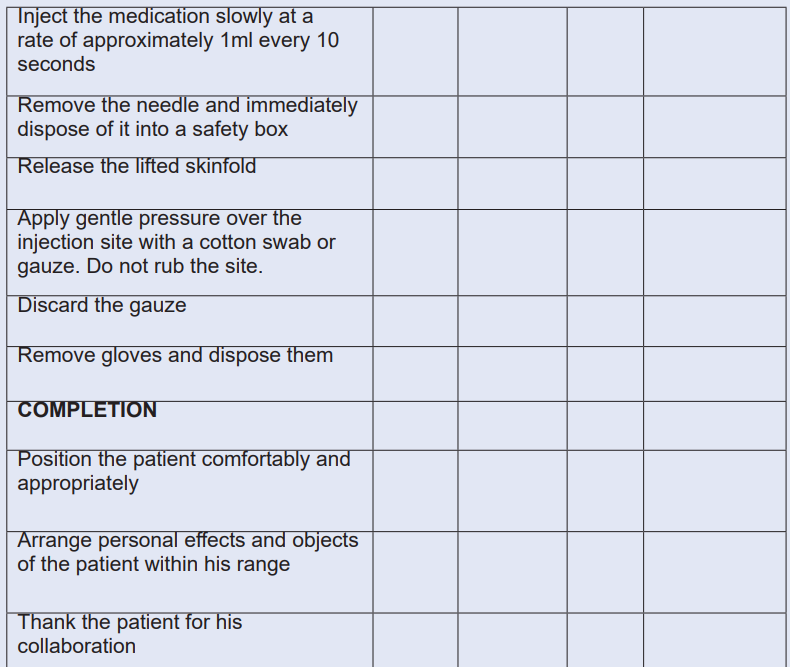
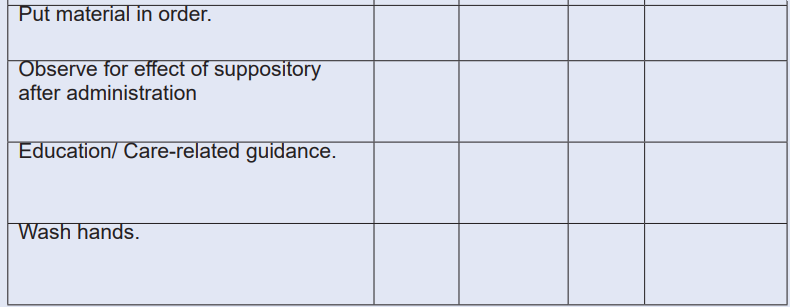
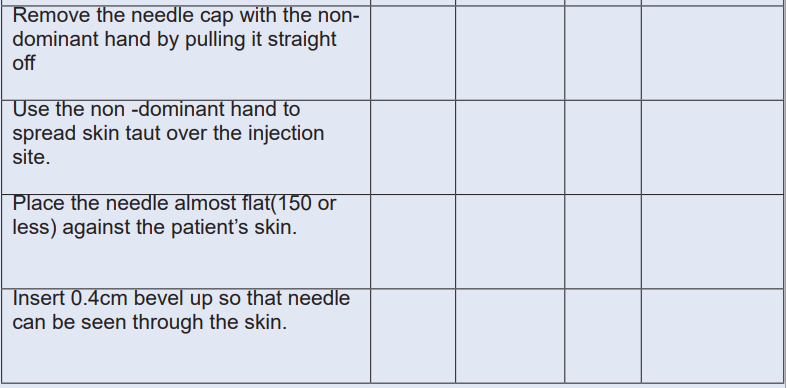
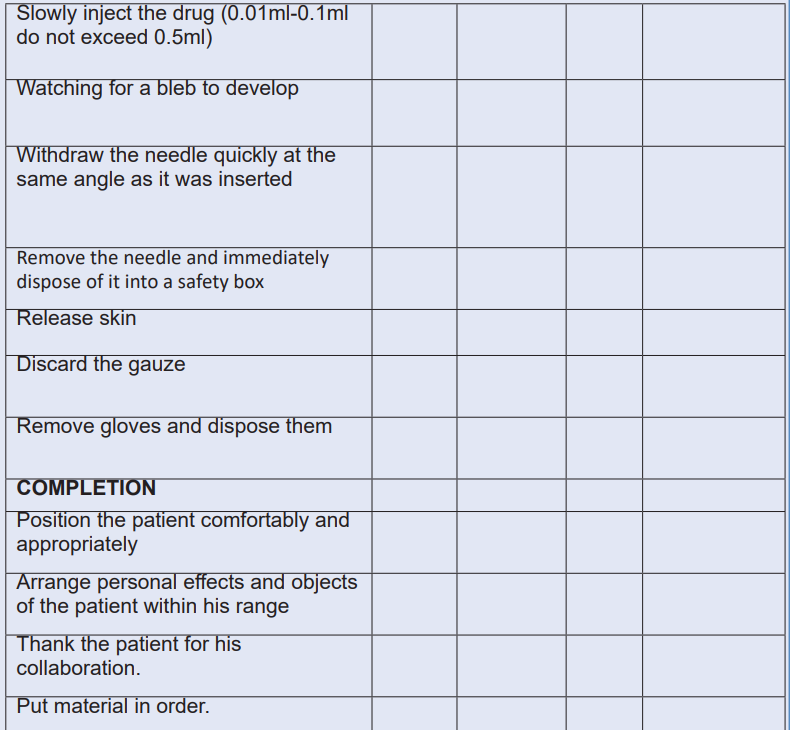
3.10.2.5. Technique: Intradermal (Id) Injection
AIMS
• To Apply medication under the skin
• To promote rapid drug absorption• To provide an alternate route of parenteral drug administration
Leaning outcome
• To find suitable sites for administering subcutaneous injections;
• To prepare materials for administering subcutaneous injections
• To explain the importance of subcutaneous injections;• To assess the risks of potential complications of subcutaneous injections.
ASSOCIATE NURSE STUDENT / PREPARATION
• Should appear professional (in full and clean uniform) with student ID Card
• Hair tied back
• Remove watch, jewelries, and Rings
• Wear closed and short shoes• Wash hand
PATIENT PREPARATION
• Identification of the patient and ask consent
• Self-presentation to the patient
• Physical and psychological patient preparation
• Assess levels of comprehension and collaboration of the patient
• Adjust the environment of the patient as necessary.• Cleanliness or condition of the bed and surrounding environment
EQUIPMENTS
• Sterile syringes and needles
• Alcohol-based antiseptic solution
• Drug,
• Protective Gloves
• Medication chart
• Dry cotton swab
• Safety box
• Disposable gloves
• Dustbin
• Trolley• Trolley or tray (Plate).
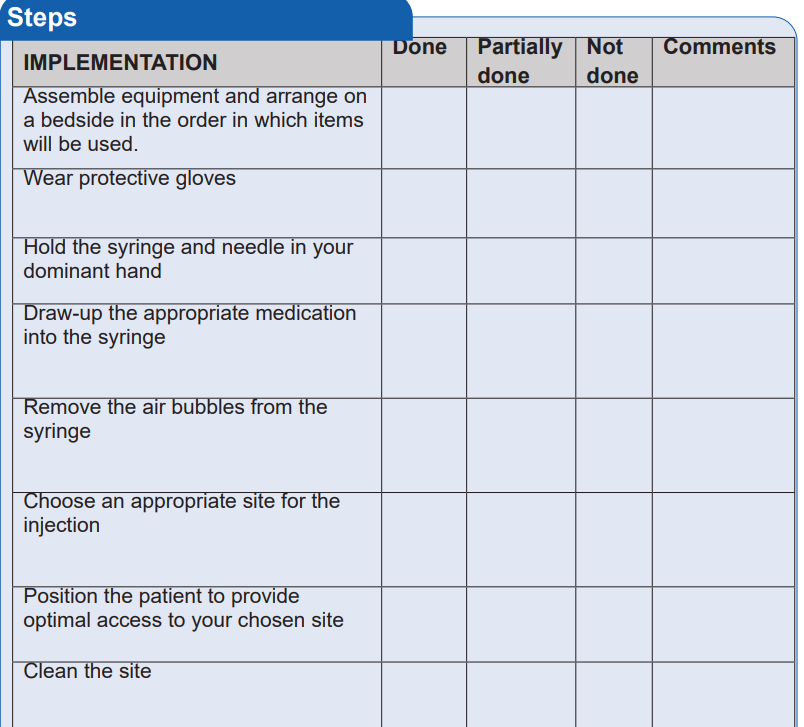
3.10.3. Procedure: Topical Application
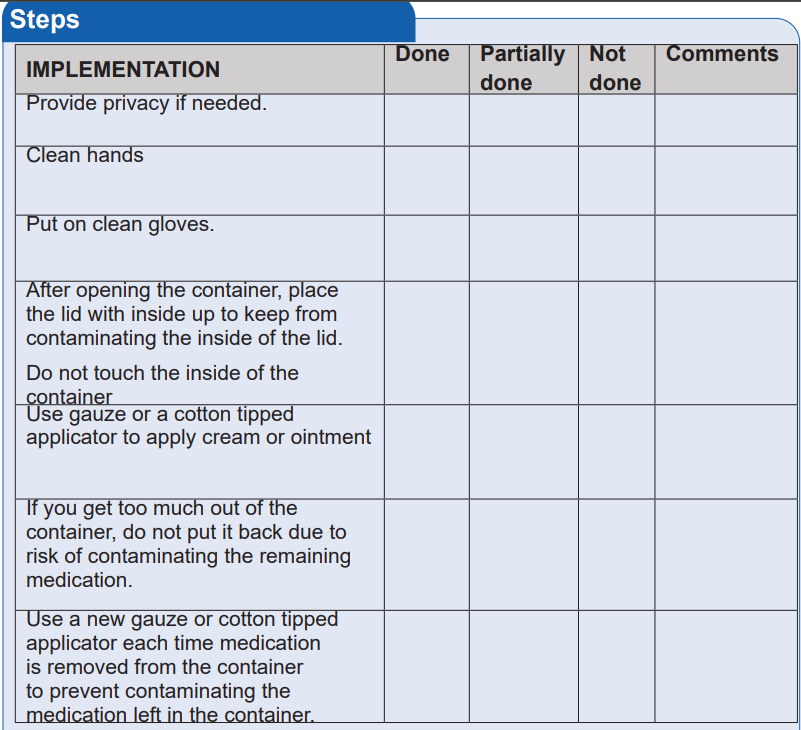
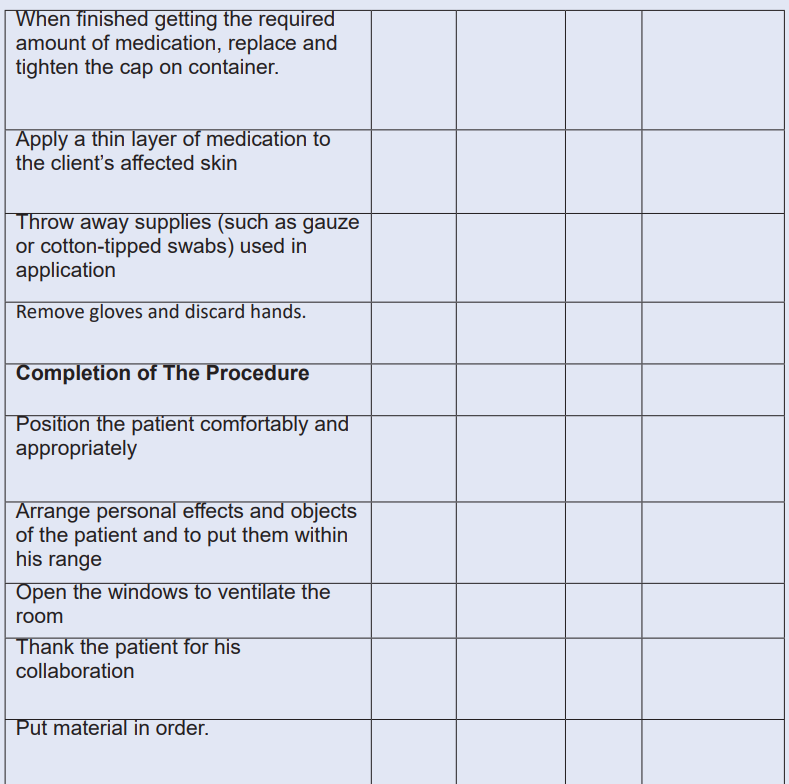
3.10.3.1. Technique: Topical Skin Application
AIMS
• To Apply medication through the skin.
• To produce local effects, some topical preparations have systemic effects,
absorbed through the skin and mucous membrane• To provide the continuous absorption of medication over several hours.
Leaning outcome
• Explain the principles of applying drugs to the skin ;• •Apply the medication to the skin
ASSOCIATE NURSE STUDENT / PREPARATION
• Should appear professional (in full and clean uniform) with student ID Card
• Hair tied back
• Remove watch, jewelries, and Rings
• Wear closed and short shoes• Wash hand
PATIENT PREPARATION
• Identification of the patient and ask consent
• Self-presentation to the patient
• Physical and psychological patient preparation
• Assess levels of comprehension and collaboration of the patient
• Adjust the environment of the patient as necessary.• Cleanliness or condition of the bed and surrounding environment
EQUIPMENTS
• Tray
• Gauzes
• Clean gloves• Topical medication

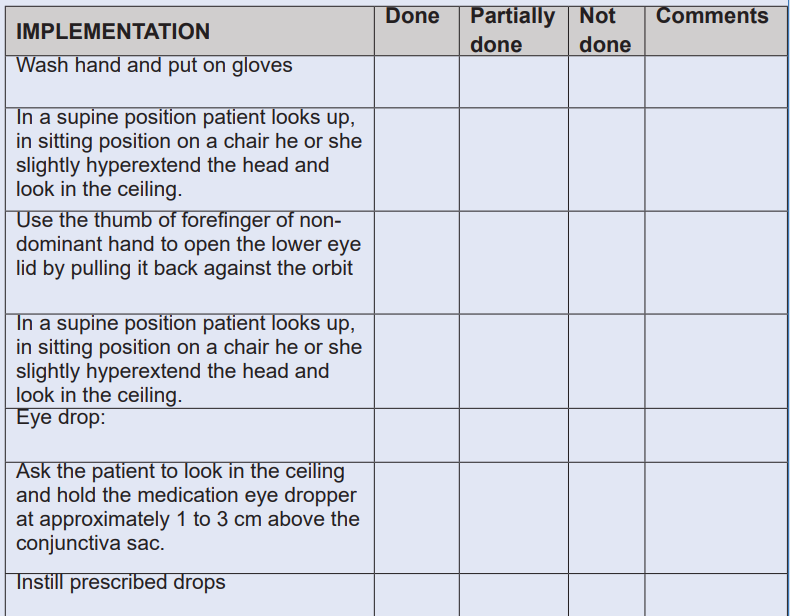
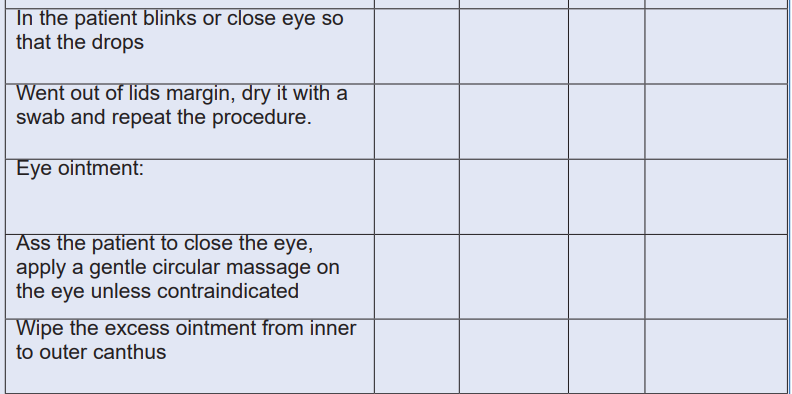
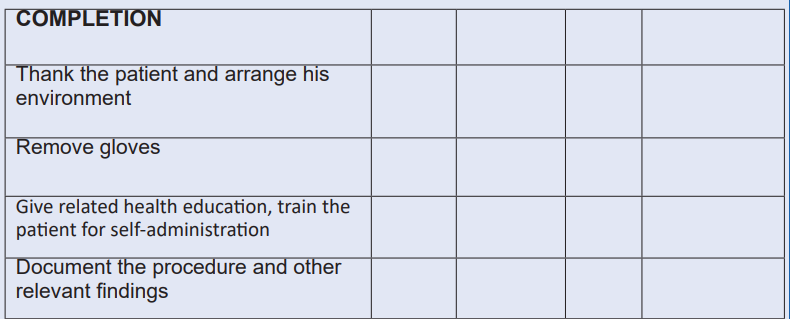
3.10.3.2. Technique: Eye Medication Administration
AIMS
• To administer medication indicated for eye route• To test for medication allergy
ASSOCIATE NURSE STUDENT / PREPARATION
• The nurse introduces to the patient, explain the purpose of that medication
and ask for consent
• Wash hands
• The student nurse prepares and assemble all the materials after disinfecting
the tray/ trolley
• Assess the information related to the drug such as mode of action,
purpose, route, time of onset and peak of action, side effects and nursing
implications
• Apply privacy
• Assess the condition of external eye and note changes
• Assess for allergy, level of consciousness and ability to follow command• Assess the ability for self-administration.
PATIENT PREPARATION
• Identification of the patient and identify patient’s names
• Self-presentation to the patient and ask for consent
• Physical and psychological patient preparation
• Assess levels of comprehension and collaboration of the patient
• Adjust the environment of the patient as necessary.
• Check drug : name of the drug, name of the patient, dose, method and
hour of administration, expiry date
• Explain the procedure and purpose to the patient
• Check for any drug allergies and ensure that there is no skin tenderness.
• Understand the therapeutic indications of the drug, mode of action and its
side effects.• Cleanliness or condition of the bed and surrounding environment
EQUIPMENTS
• Eye medicine,
• Medication chart,
• Clean gloves,
• Swabs,
• Disinfectant,• Tray or trolley.
Steps
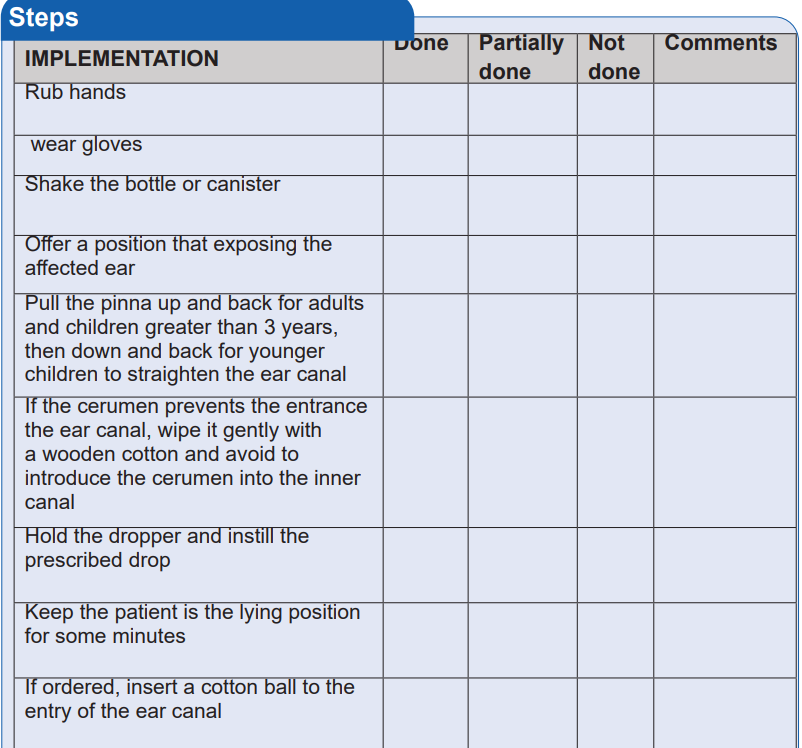
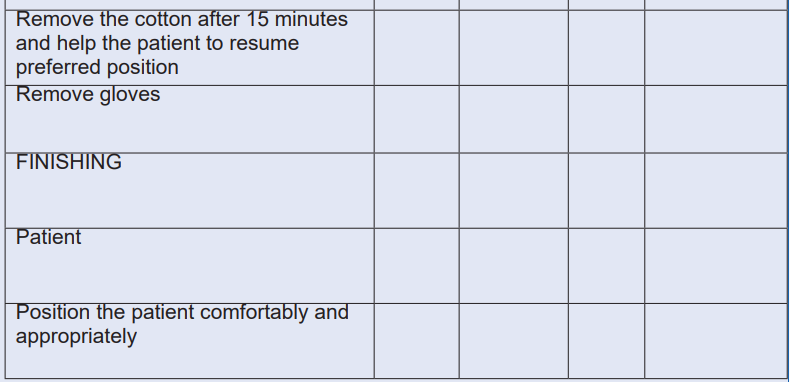
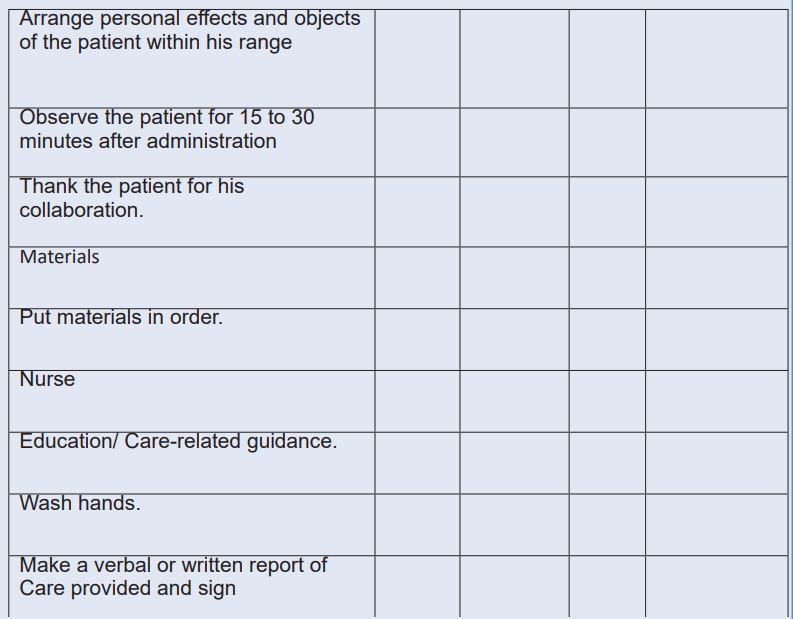
3.10.3.3. Technique: Ear Drug Administration
AIMS
• To take supplement in order to maintain health,
• To administer medication indicated for nasal route• To administer specific medication for local action
ASSOCIATE NURSE STUDENT / PREPARATION
• Should appear professional (in full and clean uniform) with Student’s ID
Card
• Hair tied back
• Remove watch, jewelries, and Rings
• Short cut nails
• Wear closed shoes• Hand washing
PATIENT PREPARATION
• Identification of the patient
• Review patient’s note and prescription
• Self-presentation to the patient
• Physical and psychological patient preparation
• Assess levels of comprehension and collaboration of the patient
• Adjust the environment of the patient as necessary.
• Explain the patient the procedure regarding positioning and sensation to
expect such us burning or straining of mucosa or shocking sensation as
medication strikes into throat .
• Check for any drug allergies• Cleanliness or condition of the bed and surrounding environment
EQUIPMENTS
• Right Medication
• Gloves
• Medication administration record
• Tray
• Drug prescription• Tissues
3.10.3.4. Technique: Nasal Drug Administration
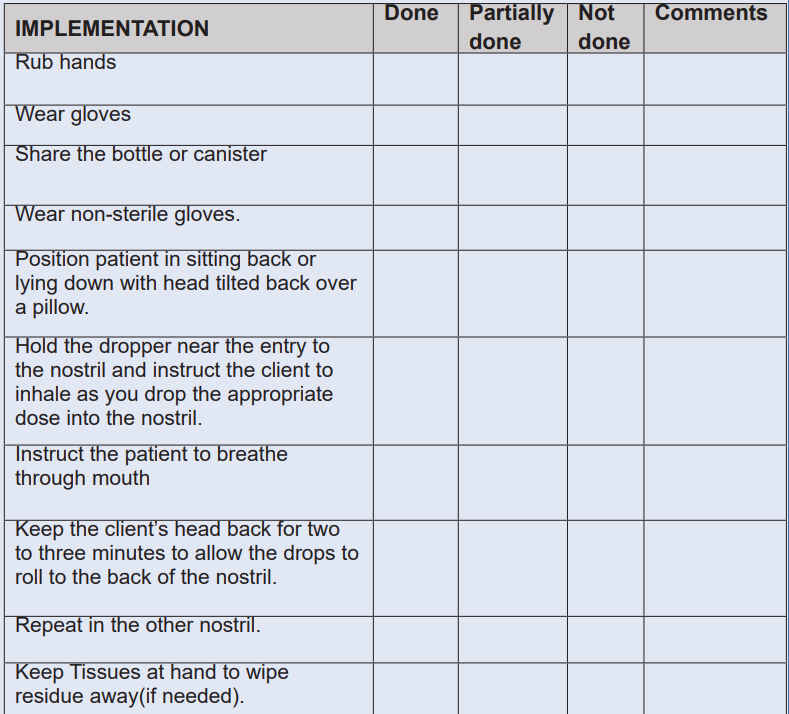
AIMS
• To take supplement in order to maintain health,
• To administer medication indicated for nasal route• To administer specific medication for local action
ASSOCIATE NURSE STUDENT / PREPARATION
• Should appear professional (in full and clean uniform) with Student’s ID
Card
• Hair tied back
• Remove watch, jewelries, and Rings
• Short cut nails
• Wear closed shoes• Hand washing
PATIENT PREPARATION
• Identification of the patient
• Review patient’s note and prescription
• Self-presentation to the patient
• Physical and psychological patient preparation
• Assess levels of comprehension and collaboration of the patient
• Adjust the environment of the patient as necessary.
• Explain the patient the procedure regarding positioning and sensation to
expect such us burning or straining of mucosa or shocking sensation as
medication strikes into throat .
• Check for any drug allergies• Cleanliness or condition of the bed and surrounding environment.
EQUIPMENTS
• Right Medication
• Gloves
• Medication administration record
• Tray
• Drug prescription• Tissues
Steps
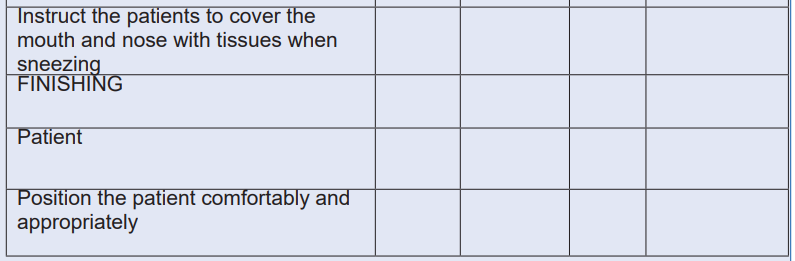
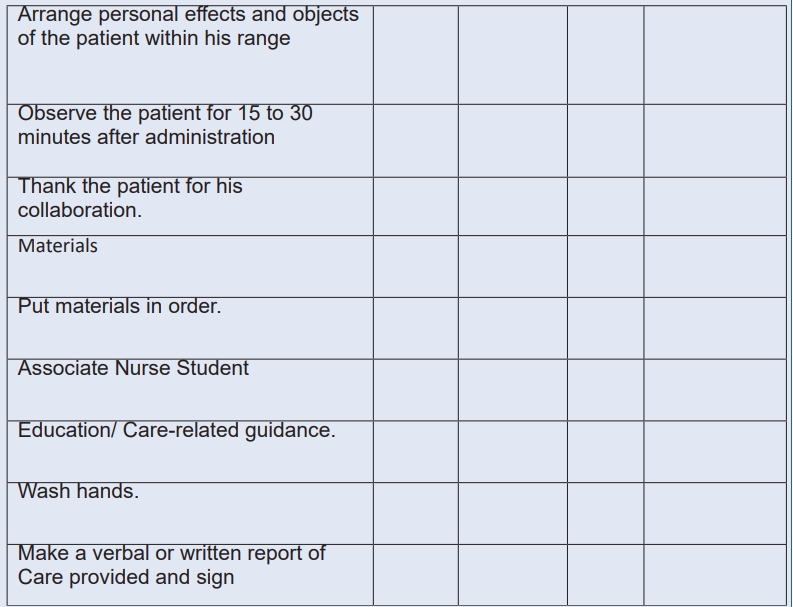
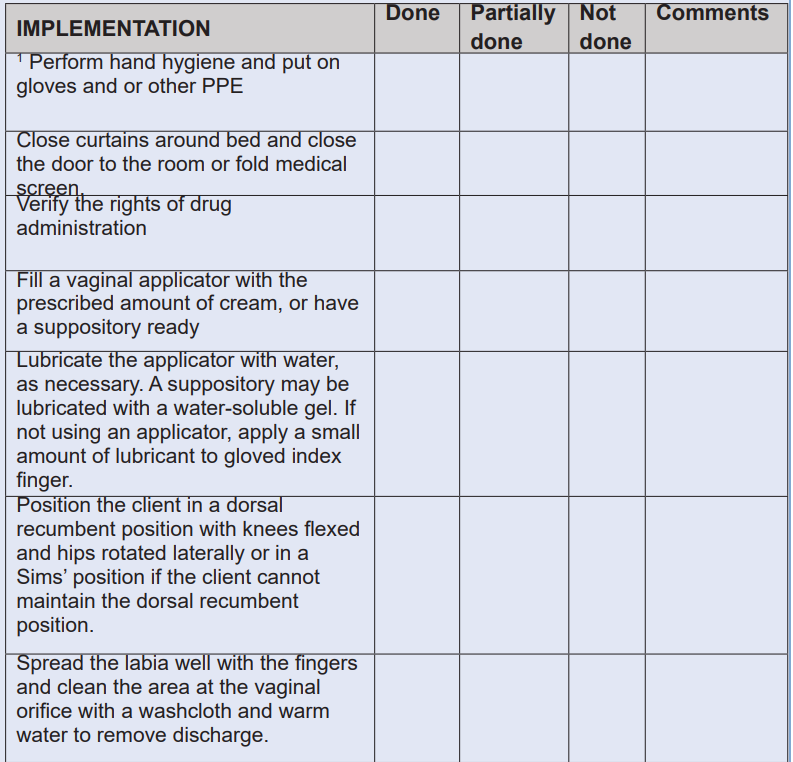
3.10.3.5. Technique: Vaginal Suppository Medical Administration
AIMS
• To treat certain conditions, such as yeast infections.
• To treat fungal infections and vaginal dryness.
• To administer some contraceptives method used as a form of birth control• To provoke uterine muscle contraction
ASSOCIATE NURSE STUDENT / PREPARATION
• Should appear professional (in full and clean uniform) with Student’s ID
Card
• Hair tied back
• Remove watch, jewelries, and Rings
• Short cut nails
• Wear closed shoes• Hand washing
PATIENT PREPARATION
• Identification of the patient
• Self-presentation to the patient and ask for consent
• Physical and psychological patient preparation
• Assess levels of comprehension and collaboration of the patient
• Adjust the environment of the patient as necessary.
• Explain the procedure and purpose to the patient
• Check for any drug allergies• Cleanliness or condition of the bed and surrounding environment.
EQUIPMENTS
• Medication administration record,
• Nonsterile gloves,
• Gauzes
• Prescribed vaginal suppository,
• Water-soluble lubricant,• Disposable applicator
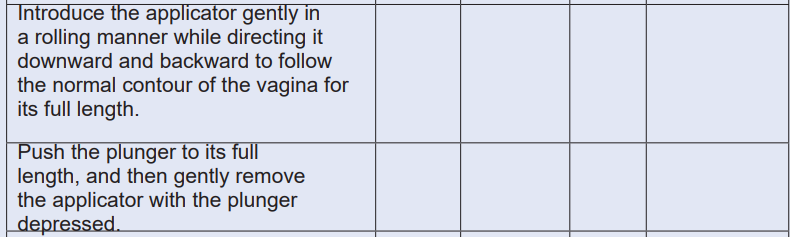
Steps
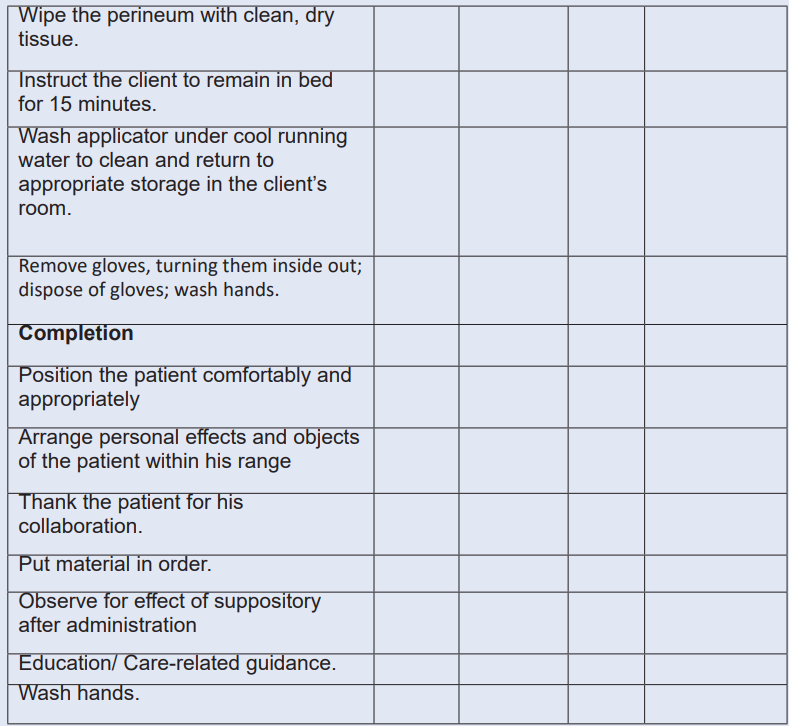
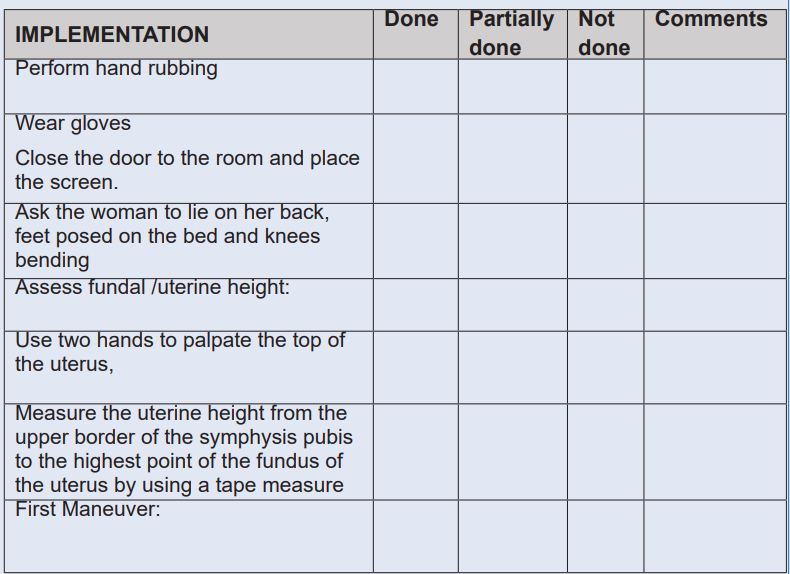
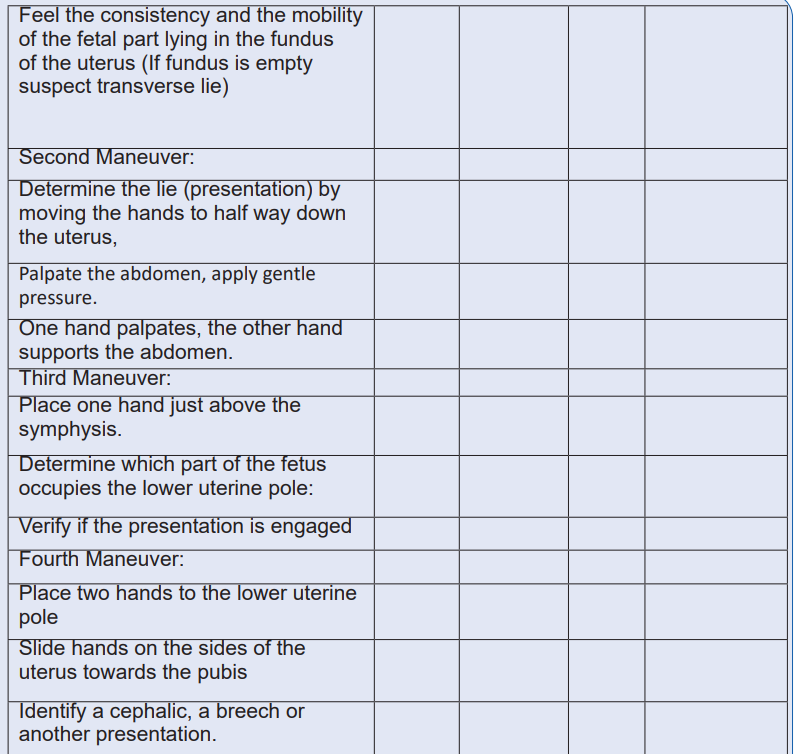
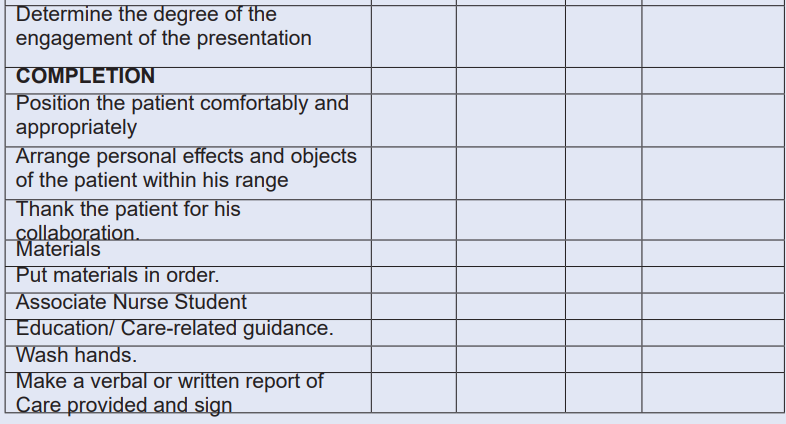
2.16.Technique: Leopord’s Manoeuver
AIMS
• To determine the fetal well being
• To confirm pregnancy
• To determine gestational age
• To determine presentation, lie, position and engagement of the presentingpart
ASSOCIATE NURSE STUDENT / PREPARATION
• Should appear professional (in full and clean uniform) with Student’s ID
Card
• Hair tied back
• Remove watch, jewelries, and Rings
• Wear closed shoes
• Clean and short nails
• Remove watch, jewelries, and Rings
• Wear closed shoes• Wash Hands
PATIENT PREPARATION
• Identification of the patient
• Self-presentation to the patient
• Ask for the consent
• Physical and psychological patient preparation
• Assess levels of comprehension and collaboration of the patient
• Adjust the environment of the patient as necessary.
• Explain the procedure and purpose to the patient
• Ask the client to empty her bladder and explain why
• Check chart for limitations on patient’s physical activity.
• Check Cleanliness or condition of the bed and surrounding environment• Position the patient in a comfortable position
EQUIPMENTS
• Tray
• Table of examination
• Tape measure
• ANC card and Client records
• Gloves (examination gloves)• Dust bin
Steps
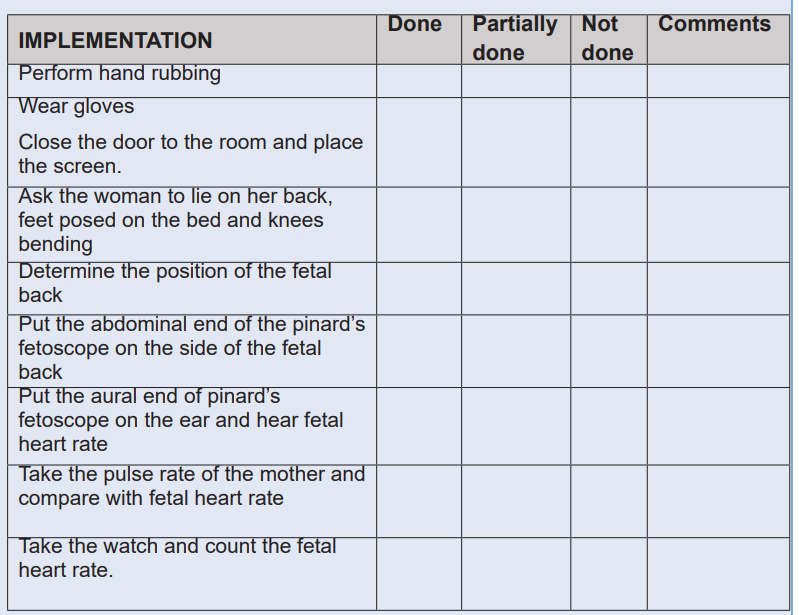
2.17.Technique: Auscultation Of Fetal Heart Rate
AIMS
• To listen and count fetal heart rate• To differentiate Fetal heart rate rhythm from maternal pulse
ASSOCIATE NURSE STUDENT / PREPARATION
• Should appear professional (in full and clean uniform) with Student’s ID
Card
• Hair tied back
• Remove watch, jewelries, and Rings
• Wear closed shoes
• Clean and short nails
• Remove watch, jewelries, and Rings
• Wear closed shoes• Wash Hands
PATIENT PREPARATION
• Identification of the patient
• Self-presentation to the patient
• Ask for the consent
• Physical and psychological patient preparation
• Assess levels of comprehension and collaboration of the patient
• Adjust the environment of the patient as necessary.
• Explain the procedure and purpose to the patient
• Ask the client to empty her bladder and explain why
• Check chart for limitations on patient’s physical activity.
• Check Cleanliness or condition of the bed and surrounding environment• Position the patient in a comfortable position
EQUIPMENTS
• Tray
• Table of examination
• Pinard fetoscope
• ANC card and Client records
• Watch
• Gloves (examination gloves)• Dust bin
Steps
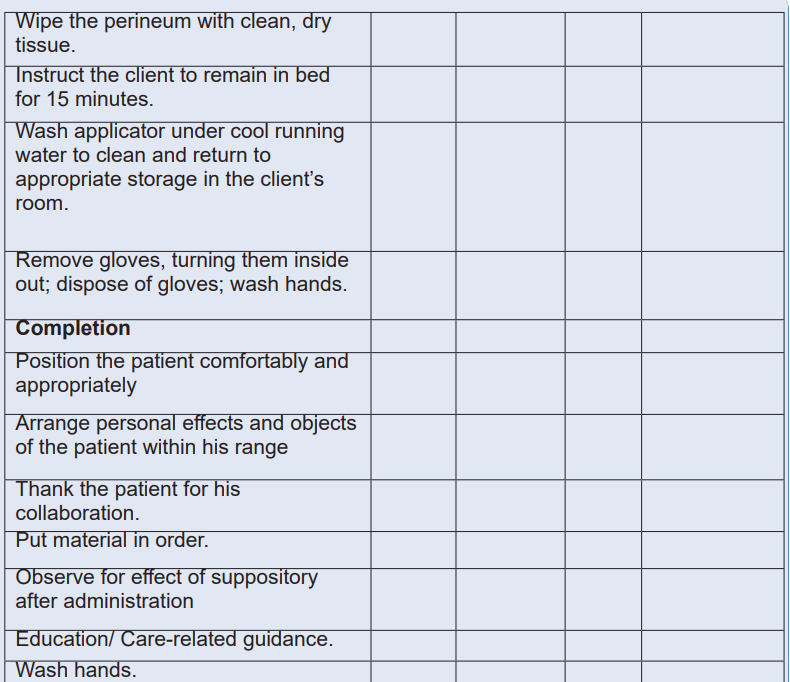
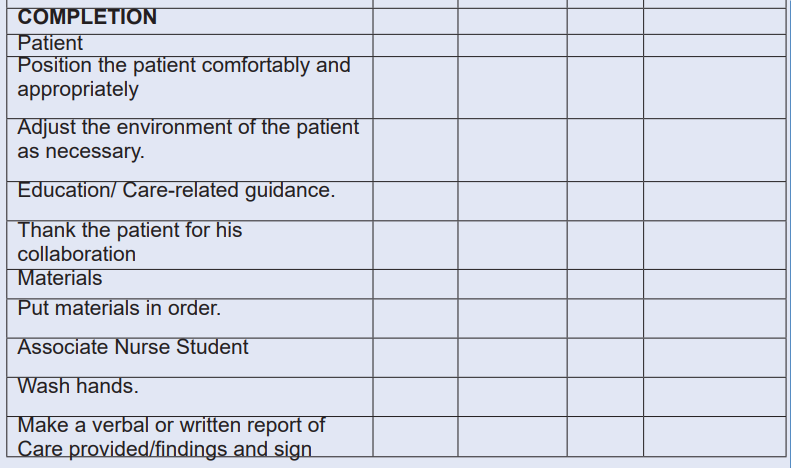
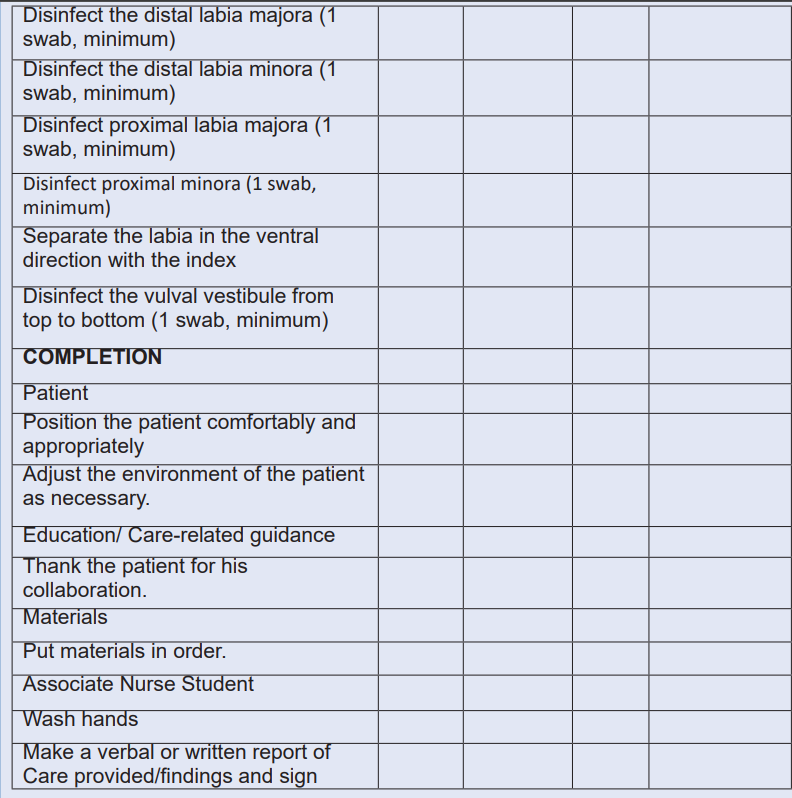
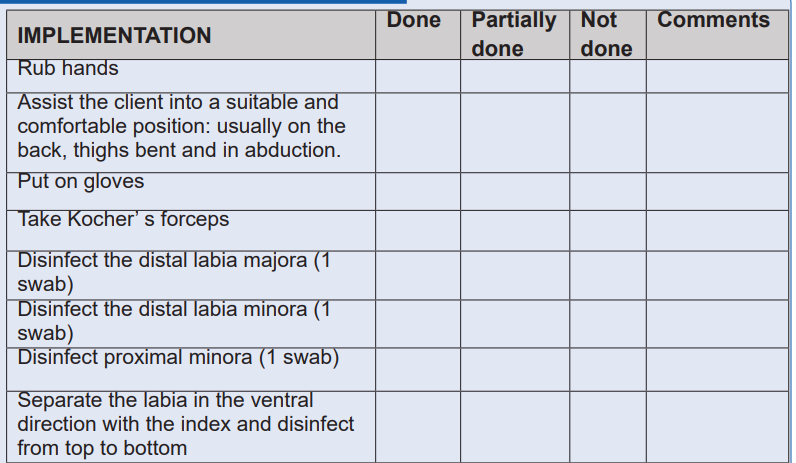
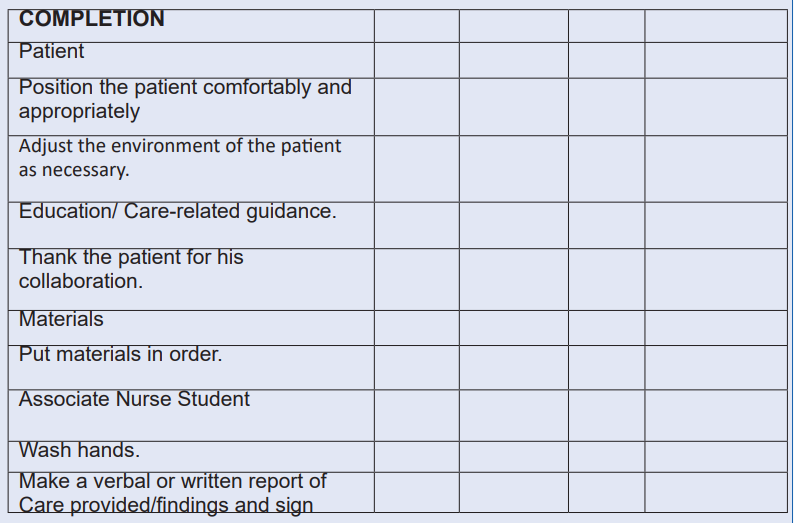
2.18.Technique: Vulval Disinfection
AIMS
• Reduces the risk of infection
ASSOCIATE NURSE STUDENT / PREPARATION
• Should appear professional (in full and clean uniform) with Student’s ID Card
• Hair tied back
• Remove watch, jewelries, and Rings
• Wear closed shoes
• Clean and short nails
• Remove watch, jewelries, and Rings
• Wear closed shoes• Wash Hands
PATIENT PREPARATION
• dentification of the patient
• Self-presentation to the patient
• Ask for the consent
• Physical and psychological patient preparation
• Assess levels of comprehension and collaboration of the patient
• Adjust the environment of the patient as necessary.
• Explain the procedure and purpose to the patient
• Ask the client to empty her bladder and explain why
• Check chart for limitations on patient’s physical activity.
• Check Cleanliness or condition of the bed and surrounding environment
• Position the patient in a comfortable position• Cleanliness or condition of the bed and surrounding environment
EQUIPMENTS
• Table of examination
• Client records
• Set for disinfection (sterile packet containing a gall pot with minimum of 5
swabs and Kocher’s forceps)
• Non-irritant solution for disinfection
• Examination gloves
• Kocher’ s forceps
• Tray or trolley
• Mackintosh and sterile drape
• Folding screen if no curtains available,
• Bucket with solution of decontamination• Dust bin
Steps
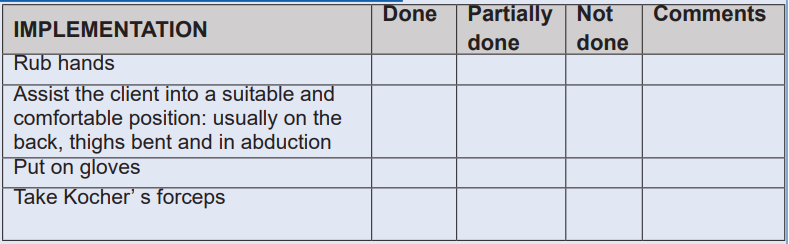
2.19.Technique: Digital Vaginal Examination
AIMS
• To assess the status of the cervix and membranes,
• To assess the position of head and degree of molding.
• To evaluate the bishop score(descent,effacement,dilation,consistence,
position).
• To detect the cephalopelvic disproportion.• To identify complications as cordprolapse, Vasa previa
ASSOCIATE NURSE STUDENT / PREPARATION
• Should appear professional (in full and clean uniform) with Student’s ID
Card
• Hair tied back
• Remove watch, jewelries, and Rings
• Wear closed shoes
• Clean and short nails
• Remove watch, jewelries, and Rings
• Wear closed shoes• Wash Hands
PATIENT PREPARATION
• Identification of the patient
• Self-presentation to the patient
• Ask for the consent
• Physical and psychological patient preparation
• Assess levels of comprehension and collaboration of the patient
• Adjust the environment of the patient as necessary.
• Explain the procedure and purpose to the patient
• Ask the client to empty her bladder and explain why
• Check chart for limitations on patient’s physical activity.
• Check Cleanliness or condition of the bed and surrounding environment• Position the patient in a comfortable position
EQUIPMENTS
• Table of examination
• Client records
• Set for disinfection (sterile packet containing a gall pot with minimum of 5
swabs and Kocher’s forceps)
• Non-irritant solution for disinfection
• Examination gloves
• Kocher’ s forceps
• Tray or trolley
• Mackintosh and sterile drape
• Folding screen if no curtains available,
• Bucket with solution of decontamination• Dust bin
Steps
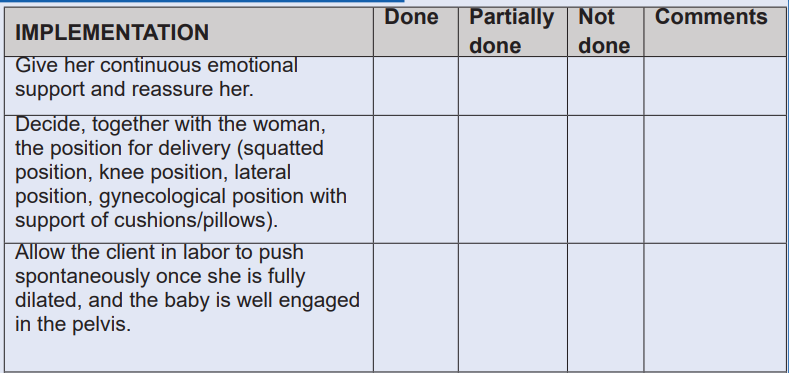
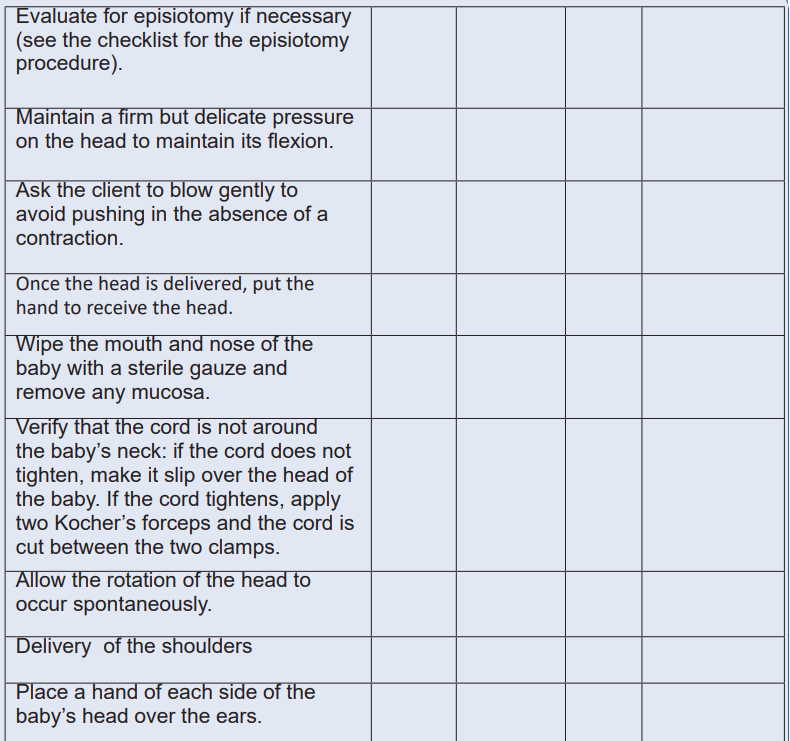
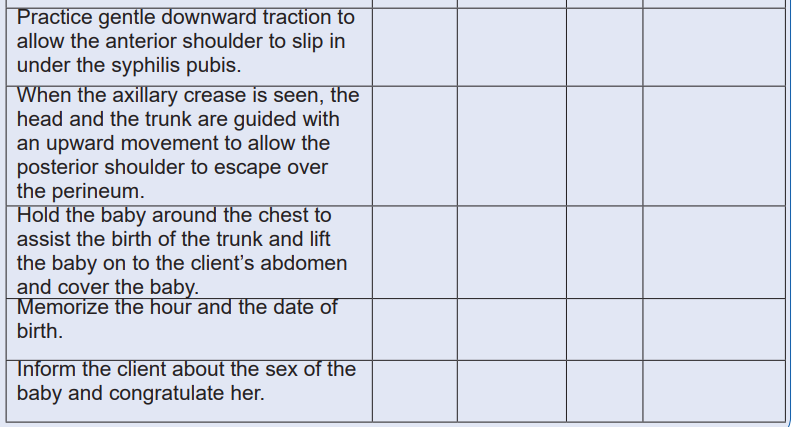
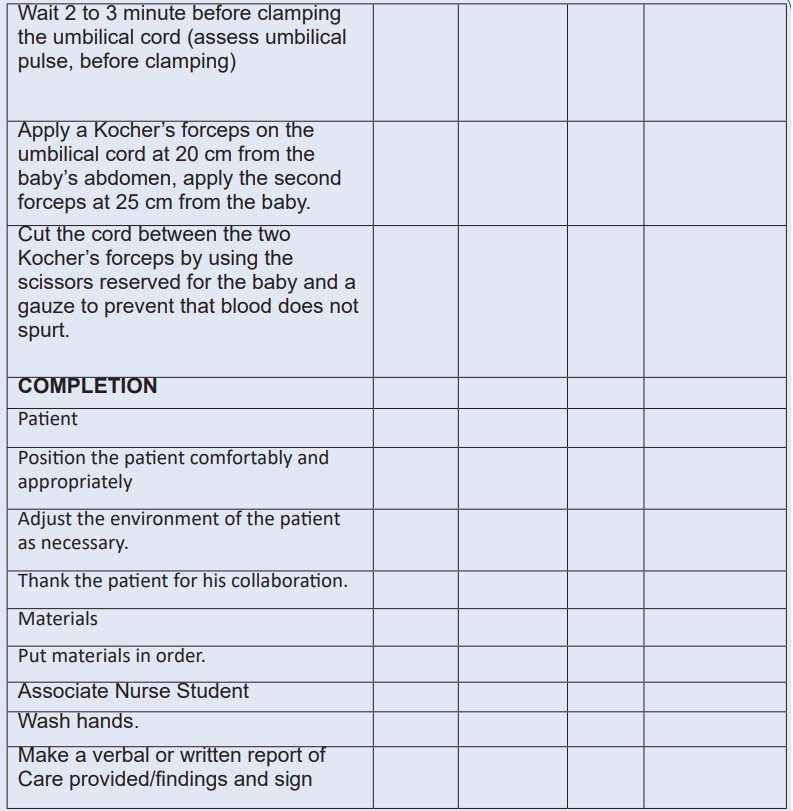
2.20.Technique: Spontaneous Vaginal Delivery
AIMS
• To assist the mother in childbearing safely without the use of drugs,techniques or others special material.
ASSOCIATE NURSE STUDENT / PREPARATION
• Should appear professional (in full and clean uniform) with Student’s ID
Card
• Hair tied back
• Remove watch, jewelries, and Rings
• Wear closed shoes
• Clean and short nails
• Wear closed shoes• Wash Hands
PATIENT PREPARATION
• Identification of the patient
• Self-presentation to the patient
• Ask for the consent
• Physical and psychological patient preparation
• Assess levels of comprehension and collaboration of the patient
• Adjust the environment of the patient as necessary.
• Explain the procedure and purpose to the patient
• Ask the client to empty her bladder and explain why
• Check chart for limitations on patient’s physical activity.
• Respect the client privacy.
• Check Cleanliness or condition of the bed and surrounding environment• Position the patient in a comfortable position
EQUIPMENTS
• Table of examination
• Client records
• Set for disinfection (sterile packet containing a gall pot with minimum of 5
swabs and Kocher’s forceps)
• Non-irritant solution for disinfection
• Examination gloves
• Kocher’ s forceps (serving)
• Tray or trolley
• Mackintosh and sterile drape
• Folding screen if no curtains available,
• Bucket with solution of decontamination
• Dust bin
• Material of protection: plastic apron, boots, glasses, hat and mask.
• Folding screen if no curtains available
• Bucket with solution of decontamination
• Local anesthesia (lignocaine 2%)
• Syringe of 10ml and 2 needles
• Syringe of 2ml and 2 needles (1 for aspiration and 1 IM injection)
• 1 ampoule of 10 IU oxytocin.
• Gauzes
• Foetoscope, Doppler
• Check if the newborn resuscitation equipment is ready and in working
• Material for taking vital signs.• Container for placenta, Dustbin
Steps
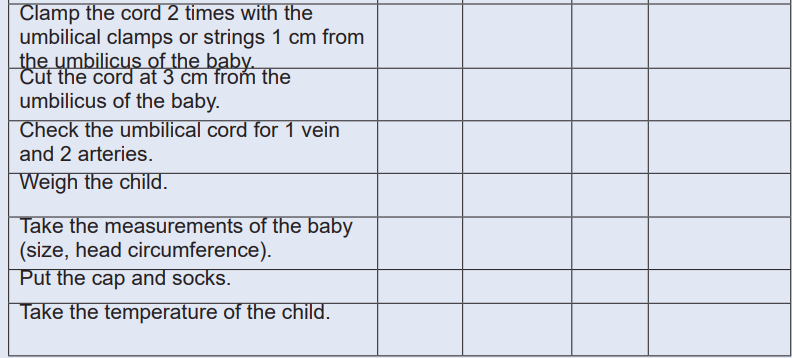
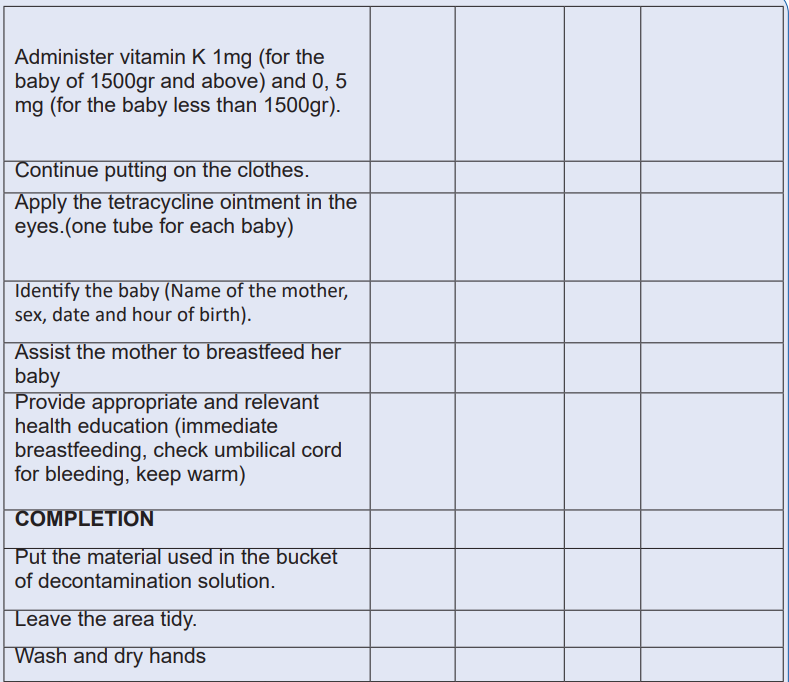
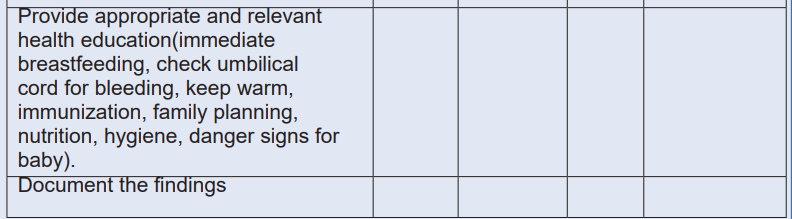
2.21.Technique: Immediate Care Of The New-Born Baby
AIMS
• To detect the newborn abnormalities and reassure the parents
ASSOCIATE NURSE STUDENT / PREPARATION
• Should appear professional (in full and clean uniform) with Student’s ID
Card
• Hair tied back
• Remove watch, jewelries, and Rings
• Wear closed shoes
• Clean and short nails
• Wear closed shoes• Wash Hands
PATIENT PREPARATION
• Introduce to the mother
• Explain the procedure to the mother and obtain her consent
• Ask about newborn’s information (Breastfeeding, elimination, sleeping,state of umbilical cord and skin color)
EQUIPMENTS
• Tape measure,
• Baby weighing scale,
• Radiant warmer (if needed),
• Flannel to cover baby,
• Examination gloves,
• Neonatal stethoscope,
• Watch,
• Thermometer,
• Tongue depressor,
• Vitamin K
• Pamper &baby’s clothes if soiled,• Hand disinfectant.
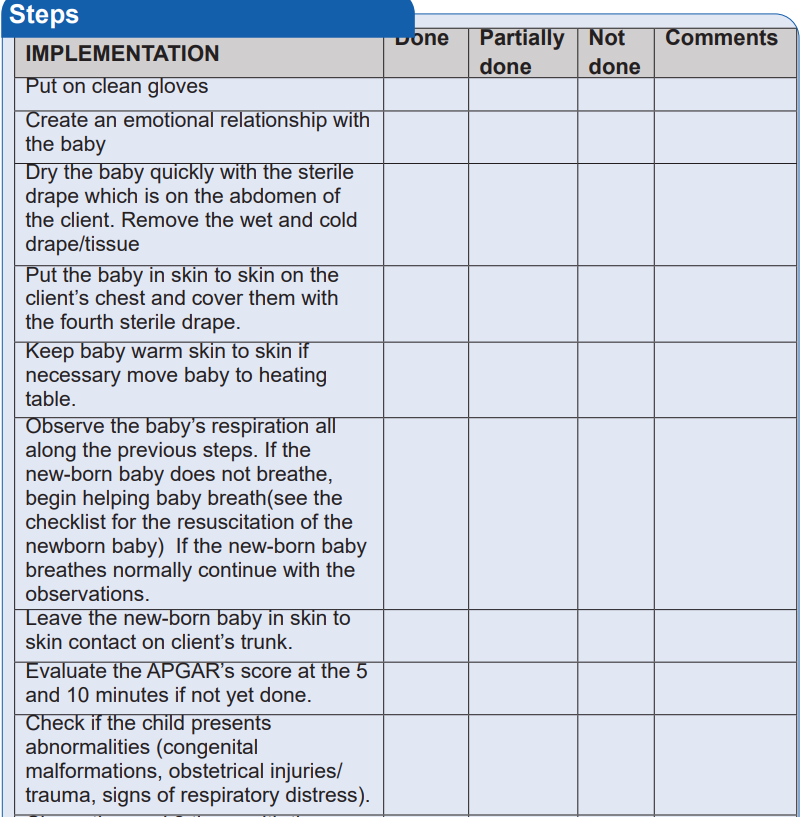
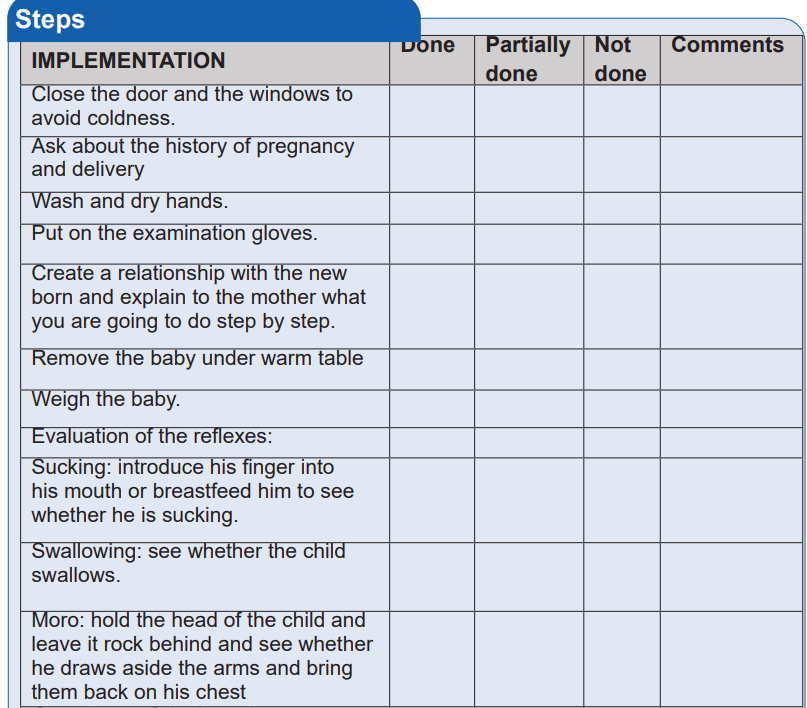
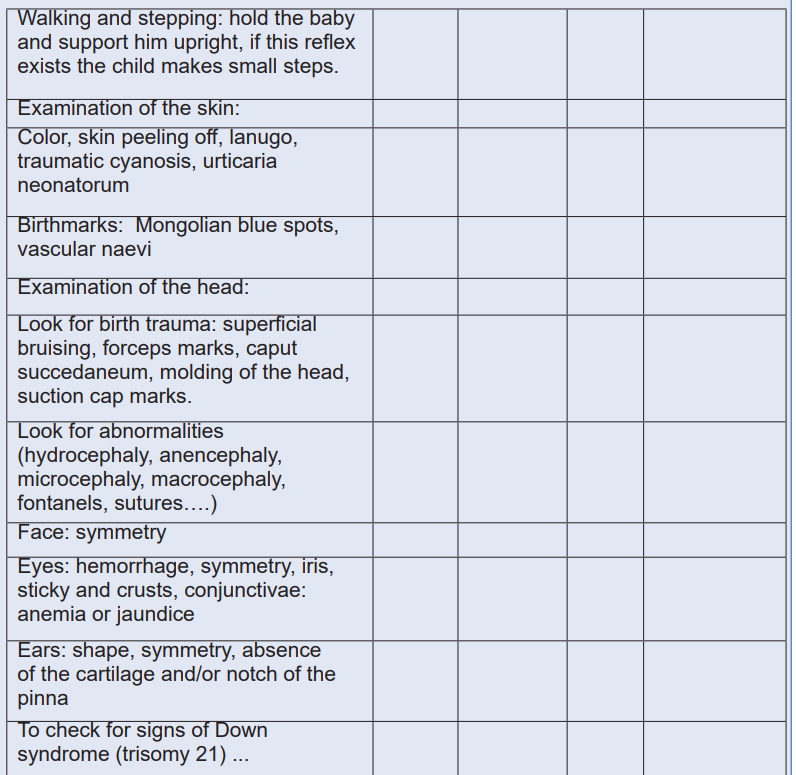
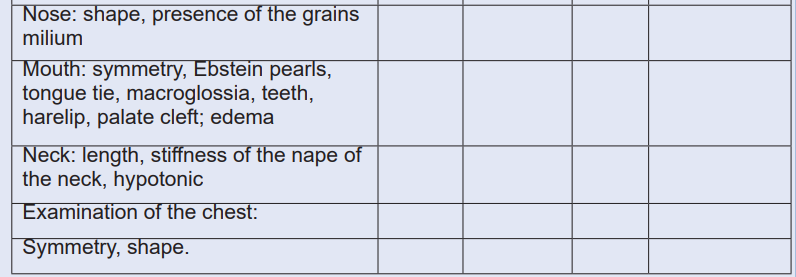
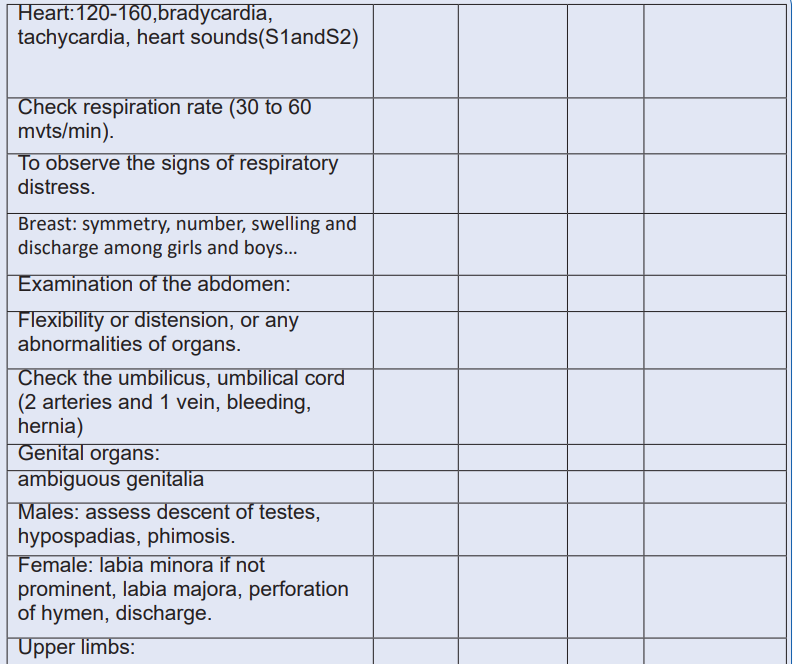
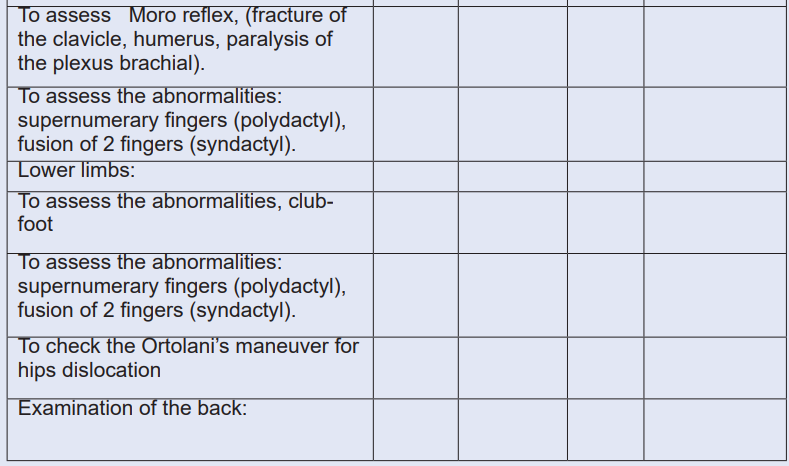
2.22.Technique: Assessment Of The New Born
AIMS
• To assess the adaptations of a newborn after birth
• To detect early possible abnormalities
• To establishes a baseline for subsequent examinations• To reassure the parents
ASSOCIATE NURSE STUDENT / PREPARATION
• Identification of the patient
• Self-presentation to the patient
• Ask for the consent from the parents
• Explain the procedure to the mother and relatives
• Give them opportunity to ask questions.• If possible, let them participate during the care.
PATIENT PREPARATION
• Introduce to the mother
• Explain the procedure to the mother and obtain her consent
• Ask about newborn’s information (Breastfeeding, elimination, sleeping,state of umbilical cord and skin color)
EQUIPMENTS
• Tape measure,
• Baby weighing scale,
• Radiant warmer (if needed),
• Flannel to cover baby,
• Examination gloves,
• Neonatal stethoscope,
• Watch,
• Thermometer,
• Tongue depressor,
• Pamper &baby’s clothes if soiled,• Hand disinfectant.

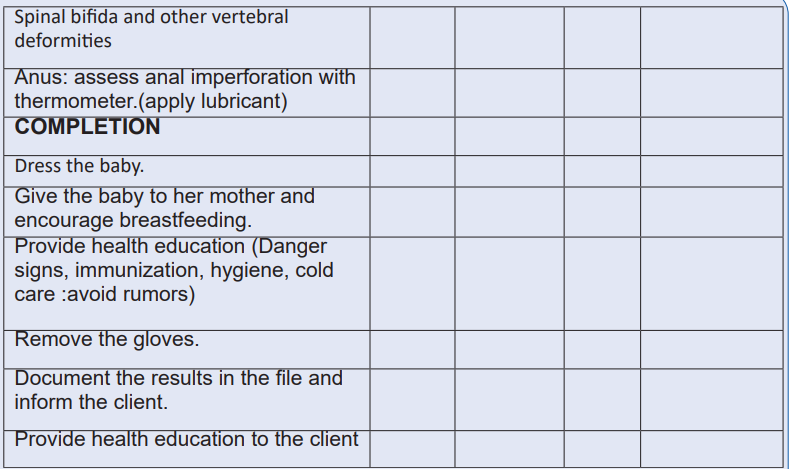
2.23.Technique: Helping Babies Breathe
AIMS
• To ensure the newborn breath within the Golden minute.
ASSOCIATE NURSE STUDENT / PREPARATION
• Should appear professional (in full and clean uniform) with Student’s ID
Card
• Hair tied back
• Remove watch, jewelries, and Rings
• Wear closed shoes
• Clean and short nails
• Wear closed shoes
• Wash Hands and dry
• Close doors & windows to keep the environment warm• Ensure good light
PATIENT PREPARATION
• Introduce to the mother
• Explain to the mother and the relatives about the procedure.• Reassure her and give continuous emotional, physical support
EQUIPMENTS
• Examination gloves,
• Ambu bag,
• Clothes and head cap,
• Stethoscope,
• Penguin (suction)
• Ties,• Scissors