
UNIT 7: DEVELOPMENT TRENDS IN RWANDA
UNIT 7: DEVELOPMENT TRENDS IN RWANDA
Key Unit Competence:
Language use in the context of development trends in Rwanda
Introductory activity:
Answer the following questions:
1. Discuss about the contribution of the mining sector to Rwanda’s
economic growth?
2. What is the importance of tourism in the economic development of
Rwanda?
3. Do you think government agencies like Rwanda Revenue Authority are
of any value to national development?
7.1. Describing Economic Development in Rwanda
7.1.1. Reading and Speaking
Rwanda is a landlocked country situated within East African region, but
geographically located in the central area of the continent. It is one of the world’s
most densely populated countries. According to the World Bank, the country’s gross
domestic product (GDP) in 2012 was estimated at US $ 7.1 billion, with a sustained
annual economic growth rate of more than 8% since 2005. The GDP per capita has
increased from US $ 200 in 1994 to US $ 595 in 2012.
The service sector has been steadily growing to become the current major contributor
to the country’s GDP at 46%, followed by agriculture at 32% and industry at 16%.
More than 85% of the country’s workforce is in the agricultural sector, which has
for long been the engine of the economy. Tea and coffee are the major country’s
exports. However, tourism is the principal generator of foreign currency, with US
$ 282 million in 2012 and US $ 251 million in 2011. During that year, investment
registered in the country totaled US $ 626 million, compared to the set annual target
of US $ 550 million and overall exports increased from US $ 454 million to US $ 639
million the same year.
By the end of the 1994 Genocide against the Tutsi, the country’s economy was utterly
destroyed. The proportion of population below the poverty line rose from 53% to
70 % between 1993 and 1997. Humanitarian aid together with the efforts of the
Rwandan Government to rebuild the country’s economy produced positive results
after implementing an extensive program of privatising state-owned enterprises as
advised by the World Bank.
This was intended to minimise the syphoning of government resources into the
accounts of corrupt individuals. These reforms resulted in a GDP growth of 9% and
13% in 1995 and 1996 respectively.
Consequently, the government of Rwanda embarked on an ambitious development
agenda known as Vision 2020. Among the aims of Vision 2020 was to transform
Rwanda into a knowledge-based, middle-income country by the year 2020. To
match with global trends, in the year 2000 Rwanda also adopted the Millennium
Development Goals (MDGs). It has since been appreciated as one of the highest
achieving states in the world in terms of complying to the international development
standards.
Similarly, in the year 1997, beginning with institutional reforms, Rwanda took on
the journey towards economic transformation. The main objective was to increase
efficiency and accountable use of public resources. The first aspect of these reforms
consisted of restructuring the existing institutions. For example, the Ministry of
Finance and Economic Planning (MINECOFIN) was created from the merger of two
other ministries. In the same year, Rwanda Revenue Authority (RRA) was created-an
independent body in charge of revenue collection to finance national expenditure.
In 1998, the Office of the Auditor General (OAG) was created to monitor and ensure
effective budgetary disciplines and accountability for public funds by all public
institutions.
The Private Sector Federation (PSF) was created in December 1999 to promote and
represent the interests of the business community in Rwanda. The Federation was
charged with the responsibility of organising annual international trade fairs in Kigali
and abroad. The main focus was strengthening the private and business sector.
In collaboration with the Ministry of Trade and Economic Planning, in 2008, the
Private Sector Federation (PSF) drummed for the establishment of The Rwanda
Cooperative Agency (RCA). This led to the birth of thousands of cooperative societies
through which the PSF hoped to raise the standards of living of the ordinary people.
In the recent years, Savings and Credit Cooperatives (SACCOs) under the umbrella
of the national microfinance sector have become a significant component of the
country’s economy. This has significantly contributed to economic development.
In 2011, the balance sheet of these institutions recorded a 12.1% growth andconstituted 37.6% of the financial sector’s total assets.
Likewise, in 2008 Rwanda Development Board (RDB) was established as another
major institutional reform intervention. RDB is a government agency created with a
mission to fast-track economic development in Rwanda. RDB was to achieve greater
coherence, accountability and efficiency within the public sector through the
merger of nine agencies which were formally in charge of investment and export
promotion, information technology, tourism and national parks, support to smalland medium enterprises, commercial registration services and privatization.
As part of a broad effort to embrace information and communication technology
as a tool for socio-economic development, Rwanda has digitalised the payment
systems in the country to meet the requirements of the public and international
standards. The National Bank of Rwanda put in place the Rwanda Integrated Payment
Processing System (RIPPS), an integration of all pre-existing payment systems.
RIPPS allows real-time processing of all electronic payments such as payment for
utilities, communications, checks, as well as interbank direct debits. The system
was implemented to reduce the time lag in payment processing through diverse
platforms that existed before, and to mitigate systemic risk in the financial sector.
The Rwanda Social Security Board (RSSB) was established in 2011 following the
merger of the Social Security Fund of Rwanda and the Rwanda Medical Insurance
Agency. RSSB has the mandate to administer social security in the country through
pension schemes, occupational hazard insurance and medical benefit insurance.
RSSB is financed through the contributions of employees and employers. As a
financial institution, RSSB is supervised by the National Bank of Rwanda and its
activities are overseen by the Ministry of Finance and Economic Planning.
The second element that significantly contributed to the economic transformation
of Rwanda is national poverty reduction strategies initiated since 2002 to drive Vision
2020. These policies have continued to evolve depending on the changing needs of
the economy. The Poverty Reduction Strategy Paper (PRSP) was the first systematic
economic assessment and lead to establishment of the actions needed to reduce
poverty. Between 2002 and 2006, poverty was reduced by two percentage points to
56.7% and extreme poverty fell by 4.2 percentage points from 40% to 35.8%.
During the decade from 2000 to 2010, Rwanda was the 10th fastest growing
economy in the world, with an average annual GDP growth of 8.2%. The first
Economic Development and Poverty Reduction Strategy with its strong policy
reforms reduced extreme poverty by 12% between 2006 and 2011. Over the same
period, the poverty headcount ratio declined from 56.7% to 44.9%. Foreign direct
investments have been steadily increasing as well as exports. The World Bank ranked
Rwanda as the second most reformed economy in the world over the last five years
and the third easiest for doing business in Sub-Saharan Africa, as well the first in the
East African Community in its 2012 Doing Business Report.
The new Economic Development and Poverty Reduction Strategy II (EDPRS
II) intended to address economic challenges by capitalizing on economic
transformation, led by a strong private sector, alleviating constraints to growth of
investments, rural development and poverty reduction (2018 target of 30% poverty
rate), and by productivity and youth employment targeting creation of 200,000 new
jobs annually. There are on-going efforts to develop the country’s services sector
and to strategically position Rwanda as a future destination for foreign investors.
Five sectors have been identified as priority areas.
These include information and communication technology and business
outsourcing, tourism and conservation, logistics, the financial sector, the buoyant
construction sector and the health care sector which are the major contributors torevenue collection.
Adapted from http://www.rwandapedia.rw/explore/economic-development, Retrieved on April 25th, 2018
Read the text on pages 152-155and answer the following questions1. To which extent have the following sectors contributed to Rwanda’s
economic development?a. Service sectorb. Agriculturec. Industry2. In a paragraph, explain the purpose of creating each of these institutions ind. Tourism
Rwanda:a. The Office of the Auditor General (OAG)b. The Private Sector Federation (PSF)c. The Rwanda Development Board (RDB)d. Rwanda Revenue Authority (RRA)3. In not more than 100 words, summarise the above passage pointing out
Rwanda’s economic transformation in terms of institutional reforms and its
impact.
4. Discuss the meaning of the words and phrases below as used in the above
passage. Thereafter, use each of the words to construct a meaningful
sentence.a. … densely populated … (paragraph one)b. … embarked on … (paragraph three)c. … quasi-autonomous … (paragraph four)d. … trade fairs … (paragraph six)e. … time lag … (paragraph eight)f. … mitigate … (paragraph eight)g. … evolve … (paragraph ten)h. … headcount ratio … (paragraph eleven)i. … alleviating … (paragraph twelve)j. … buoyant … (paragraph twelve)
7.1.2. Application Activity
Conduct a research on the progress made in the agricultural sector in Rwanda
since the year 2008. Then write a 300 word composition explaining the strategieslaid down to develop that sector and the impact realised.
7.1.3. Language Structure: The Use of the Simple Past
The Simple Past is used for both recent and distant past actions. It is used to talk
about actions or activities that have been completed, and are not still going on. It is
used with past time expressions, such as ‘yesterday, last year, at 2 o’clock, in 2003, a
year ago,…’
Example1. In 2000, Rwanda embarked on an ambitious development agenda knownas Vision 20202. The Poverty Reduction Strategy Paper was the first systematic economicassessment in Rwanda.3. Between 2006 and 2011, the poverty headcount ratio declined from56.7% to 44.9%.
7.1.4. Sounds and SpellingReminder:• Stress in English is the way that a particular syllable is pronounced with greaterforce than other syllables in the same word. A stressed syllable combines twofeatures:• It is longer than unstressed syllables: This means that its production orpronunciation lasts or takes a great amount of time.
Example1. In the word “Economics”, the third syllable is the stressed one as indicatedhere:/ iːkəˈnɒmɪks /It is louder than other syllables: This implies that the stressed syllable ispronounced with a large amount of sound.2. In the word “Development”, the second syllable is the stressed one asindicated here:/dɪˈveləpmənt/More examplesPrivatization / praɪvətəiˈzeɪʃən /Socio-economic /səʊsiəʊ ekəˈnɒmɪk /Export (noun) / ˈekspɔːt /Export (verb) / ɪkˈspɔːt/7.1.5. Application ActivityIndustry / ˈɪndəstrɪ /
Study the words below as used in the above text, practice their standard
pronunciation and transcribe them into your exercise books. Pay attention to
stressed and unstressed syllables. You can use a dictionary.1. Agriculture2. Tourism3. Autonomy4. Financial5. Budgetary7.1.6. Listening and Speaking: Strategies of Giving Oral
Presentations
Oral presentation refers to addressing or briefing a group of people about a given
topic. Effectiveness at oral presentation requires a mastery of some skills and
techniques. Here below are 13 tips and techniques with which to improve on this
competence:1. Preparation of the event: To participate in a serious oral presentationrequires enough knowledge on the topic to be presented. Therefore it isnecessary to conduct sufficient research in preparation for the event.2. Structuring the presentation in subtopics: Very often, good presentationsare structured in appropriate sub-topics depending on the nature of thecontent. It is advisable to briefly inform the audience about the main partsof the presentation before divulging deep into it.3. Doing a rehearsal: It’s always a good idea to go through the presentationall alone before presenting it to a big audience. A rehearsal can be doneby assuming an audience before you or by asking a few friends to actuallypose as an audience for you. They can help you build up confidence andwhy not ask you a question or two? This step can help you gain confidence,iron out weaknesses related to the topic, master the timing and techniquesof presentation.4. Looking presentable: It’s not a must to wear a suit, but it’s hard for peopleto take a presentation seriously when the presenter is not formally dressed.5. Talking instead of reading: A good oral presentation is done without muchreading. Whereas an oral presentation should be based on a written script,it is advisable to highlight or bold the main points which the presenter canalways develop into a detailed presentation.6. Talking slowly but audibly: inexperienced speakers tend to speak too fast.They forget that the audience might be hearing the material for the firsttime and not as familiar with the topic as they are.7. Using aids: For certain types of presentations, visual aids-such as PowerPoints, handouts, even written materials on the board, can help theaudience locate and grasp the main points. The presenter must ensure thatthese materials are fully explained during the presentation.8. Avoiding too much details: Including massive numbers of quotations orhuge amounts of data in the presentation can overwhelm even the mostattentive audience.9. Being natural: to succeed a presentation, it is important to present anauthentic content in as much as possible natural ways. The presenter mustbe him or herself.10. Keeping eye contact with the audience: A very important part of publicspeaking is to make eye contact with people seated in all parts of the room,even those nodding off in the back. By doing that, the presenter showspeople that he/she is interested in communicating with them, not justgetting through this experience as quickly as possible. And it wouldn’t hurtto leave the podium or desk time to time, and walk around the room a little.Sharing space with the audience can also show the presenter’s interest incommunicating and sharing with them.7.2. Describing Economic Goals11. Appearing relaxed: it’s not a must to be relaxed and indeed few speakersare. However efforts should be made in this regards as much as possible.Drink some water and pose from time to time, and think positive. No oneenjoys listening to speakers who are trembling or sweating.12. Accepting interruptions: Some speakers are terrified that someone willinterrupt them with a question or comment. Actually, this is one of the bestthings that can happen, because it shows that someone in the audiencehas engaged with what has been said. A brief response can actually leadto genuine progress on the point being in motion. A two-way conversationmay reduce tension.13. Finishing with a good conclusion: A satisfying conclusion to the presentationcan help the listeners to assess what they have learnt. This can create akind of feeling in their minds about having learned something from thepresentation to the point that they wish to learn more.7.1.7. Application Activities1. Carry out research about the impact of development programs
implemented in Rwanda with regard to community life improvement.
Then prepare a twenty-five minutes class (oral) presentation.
2. Referring to the guidelines on composition writing (Unit 1) on pages 5-6,
write a 300 word composition: “discussing advantages Rwanda would
enjoy if it increased the volume of exports.”
3. Refer to guidelines on how to conduct a debate in unit 1 debate on:
“For a quick development, physical infrastructure deserves more
funding than the agricultural sector.”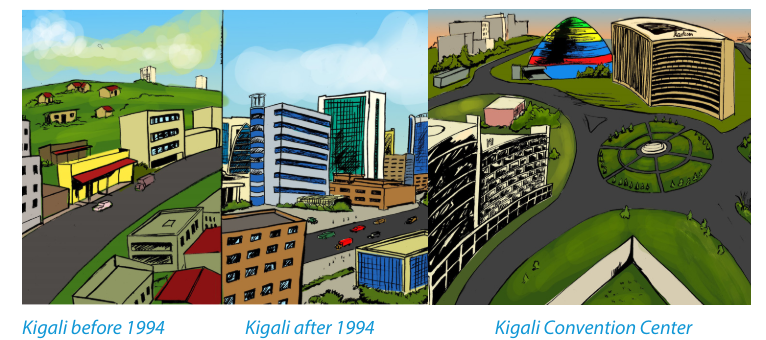 7.2.1. Reading and Writing: Digital Service Delivery
A long-term development strategy “Rwanda vision 2020” was launched by the
government of Rwanda since the year in 2000. The goal of this program was to
transform the country from a low- income agrarian economy to a medium income
export-oriented and knowledge-based economy. One of the pillars and guiding
principles of this program was to harness the resourcefulness of Information and
communication technology. The architects viewed Information and Communication
technology as a major driving force to Rwanda’s transformation into a knowledgebased economy.
Indeed, Rwanda is among the fastest growing African countries in several fields of
ICT: e-commerce and e-services, mobile technologies, applications development
and automation. “Positivo”, the first factory unit of hardware, was installed in Rwanda
since November 9th, 2015 and has been operating for almost three years now. So, it
should not be surprising to see laptops, tablets and other electronic devices with a
label ‘made in Rwanda’. In addition, Rwanda is considered a regional center for the
training of professionals and researchers on communication technologies.The Government of Rwanda supports various projects in ICT. Kigali Technopole,
a center dedicated to ICT development and research in Africa with a focus on
applications relevant to the African markets, is one of them. Rwanda has been driven
into a modern knowledge-based economy for more than a decade. It has provided
ICT solutions beyond borders in Africa and the rest of the world. Technopole was
expected to attract skilled ICT professionals and worldwide companies.In May 2016, the government of Rwanda launched Kigali Innovation City (KIC), a
flagship initiative to catapult the country into a knowledge-based economy. The
aim of KIC (which has replaced the name Technopole) was also to drive digital
transformation through its dynamic ecosystem of technology clusters in which
domestic and international companies have innovated and delivered products andservices for global markets for more than two years.Secondly, KLab (knowledge Lab) is another ICT project based in Rwanda. The project
is an open technology hub in Kigali where students, fresh graduates, entrepreneurs
and innovators come to work on their ideas and projects to turn them into viable
business models. The aim of the project is to encourage young entrepreneurs to
develop their technology-oriented ideas into products and future companies.
Last but not least is the 4G (LTE) project. The Government of Rwanda, in partnership
with the South Korean telecommunications provider (KT Corporation), is rolling out
a high-speed 4G (LTE) broadband network across the country since November 2014.
The network was expected to cover 95% of the population within three years.In a nutshell, ICT has been a real driving force for the country’s economy since the
late 1990s. The government relies on the development of ICT sector, not only to
bring investment and create jobs but also to enable the advancement of Rwandan
public services including education, health care, and finance. The result has been
remarkable.Rwanda has taken a step ahead to improve its education system and now stands as
a model in Africa. The One Laptop per Child (OLPC) program has been implemented
by the government since 2008 and it has played a key role for a number of years
to introduce technology in primary schools and this is still going on. Since 2008,
primary school students have been allowed early access to computer skills and
computer science while expanding their knowledge on specific subjects like science,
mathematics, languages and social sciences through online research or serverhosted content.Over 500 health facilities have been covered by Rwanda Health Management
Information System (R-HMIS) for about a decade since 2012. Many modules have
been added to the system since then such as death audit reporting for all maternal,
neonatal, and child deaths, and the Community Health Information System-a
patient level system for tracking MDR (multi-drug resistant) to patients as well as the
HIV reporting and disease surveillance system which is currently being transitioned.
According to the Ministry of Health, the percentage of health centers connected
to internet has reached 93.8% since 2012. The number of clinical emergencies
supported through Rapid SMS is 25%; while the number of patients at community
level tracked using Rapid SMS has reached 173,131.Mobile money subscribers across all networks have reached 6,480,449, which was
more than twice the number of subscribers in the previous year (2013). The number
of mobile money transactions reached US $ 824.6 million compared to US $ 394
million transacted in the year before.Adapted from https://infomineo.com/rwandas-knowledge-economy/, retrieved on April 25th, 20181. Read the text on pages 160-161 and answer the following questions.
a. What development strategy did the government of Rwanda launch in
2000 and what was its aim?
b. What are the indicators of Rwanda’s advancement in the field of ICT? Of
what economic value is this trend?
2. State the objectives of:
a. Kigali Innovation City
b. Knowledge Lab
3. Discuss the progress attained by Rwanda through ICT in the following
sectors:
a. Education
b. Health
c. Finance
4. Write an eighty-word summary showing how the government of Rwanda
has improved service delivery through ICT initiatives.
5. Carefully study the words and phrases in column A and match them withtheir corresponding meanings in column B
7.2.2. Sound and Spelling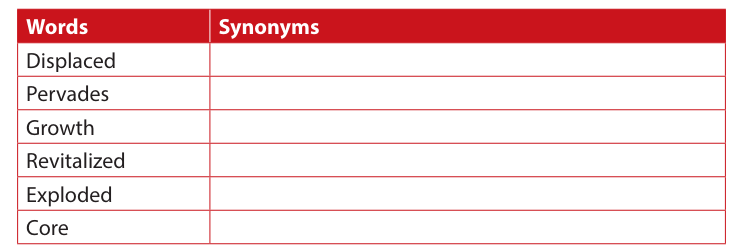
I. Referring to the notes given in Unit seven, sub-heading 7.1 read the following
words as used in the passage on pages 160-161. Strictly follow the phonetic
transcription given and remember the use and importance of the stress.
Remember that monosyllabic words are not stressed in English.a. Progress /ˈprəʊɡres /II. The words listed below are used in the above passage. Read them and practice
b. Entrepreneurs /ɒntrəprəˈnɜːz /
c. Surveillance /səˈveɪləns /
d. Reached / riːtʃt /e. Transacted /trænˈzæktɪd/
their correct pronunciation. Use a dictionary where necessary.a. Percentage7.2.3. Language Structure: The Present Perfect with For and Since
b. Management
c. Implemented
d. Advancement
e. Knowledge
1. Since
We use the present perfect with since to define a period of time before now by
considering its starting point.
Example1. Positivo factory unit of hardware has been installed in Rwanda since 2015.
2. The One Laptop Per Child (OLPC) program has been implemented since
2008.
3. Since its launch, Kigali innovation city has delivered products for global
markets.
4. Rwandans have used ICT to develop the private sector since 2010
2. For
We use the present perfect with for to define a period of time before now by
considering its duration (For six years, for a week, for a month, for hours, for two
hours.)
Example
1. Agriculture has been the backbone of Rwanda’s economy for more than
two decades.
2. Muhire and his wife have worked in the mining sector for five years.
3. ICT has driven Rwanda’s development for years now.
4. Rwanda has been driven into a modern knowledge-based economy for
more than a decade.
7.2.4. Application Activities
I. Construct five meaningful sentences using the present perfect with since
and for. Your sentences should be related to development trends in Rwanda.
II. Conduct a research on Rwanda’s economy and then write a composition on
the following topic: ‘Rwanda’s economic achievements since the year 2010.
7.2.5. Listening and Speaking: Recitation:
How to recite a poem
1. Reciting a poem, just like any other language competences, requires a
number of techniques. Here are some of the practices or techniques that
will help you learn to recite poetry:
2. Choose a Poem that “Speaks to You”: When choosing a poem to recite,
ensure picking a poem that interests you. The more you like the poem, the
more fun you will have learning and reciting it. Whether it’s a funny poem,
a serious poem, a sad poem, a sports poem, a spooky poem, a jump-rope
rhyme, or even a love poem, if it’s a poem that “speaks to you”-a poem
that makes you feel something-you are going to enjoy sharing it with your
audience.
3. Memorize the Poem You Plan to Recite: To recite a poem well, it’s important
to have it firmly committed to memory. If you don’t have the poem
memorized, you are more likely to make mistakes when reciting it, even if
you have it written on a piece of paper in front of you. Memorizing it will
help make your recitation as good as possible.
4. Memorizing a poem requires to read a printed copy out loud as many times
as possible. Depending on the length of the poem, you may have to read
it out loud 10 or 20 times, or possibly even more, but each time you read a
poem out loud, you will remember a little more of it.
Practical steps to follow in order to memorize a poem
1. Get a printed copy of the poem.
2. Look at the poem and read it out loud.
3. Turn it over so you can’t see it.
4. Recite as much of it as you can remember, from the beginning.
5. Repeat steps 2 through 5 until you can recite the entire poem from memory.
6. Study the voice of the poem, and speak in that voice: In other words, if it’s a
poem about a cowboy, see if you can put on a cowboy accent. If it’s a poem
about a monster, try using the scariest monster voice you can. If it’s a poemperson might sound like and try to speak in their voice.
about a baby, an old person, or just some crazy character, think of what that7. Rap the poem: Some poems have a rhythm built into the words. When you
read a jump-rope rhyme, or any other rhythmical poem, you may find that it
is suitable for rapping. If you want to have even more fun with it, try reciting
it to a drum beat or to music.
8. Recite it with a friend: Many poems have more than one voice. That is, a
poem might have different speaking parts-such as the narrator, a mother or
father, a teacher, a child, etc. making it easy to split up and be read by two
or more people. Even if it’s not, perhaps you and a friend could take turns
reading every other line.
9. Put on a play: If a poem tells a small story, you can perform it in the same
way that you can perform a play. You can create sets and props, and even
wear costumes. Make it a drama or a comedy.10. Run around, wave your hands, say it like you mean it: Don’t just limit yourself
to the ideas given above. Recite the poem in any way that seems best to
you. If that means sitting in a chair, or jumping up and down, or stomping
back and forth, or even dancing, that’s okay. Just put some feeling into it
and “read it like you mean it” to give the best performance you can.
11. Have Fun: However you decide to recite a poem, the most important thing
is that you have fun doing it. So pick a poem, memorize it, practice reciting
it a few different ways to see what works best, and then have fun sharing itwith your audience!
7.2.6. Application Activities: Exploring a poem
Another World
Del “Abe” Jones
It’s another world, one that few have seen,
At times wild and brutal, at times so serene.
A place where life abounds in every shape and size,
Where miracles seem to happen right before our eyes.
A garden paradise with “flowers” that can walk
There’s even some creatures that know how to talk,
Also some animals not seen by the eyeAnd fabulous fishes that know how to fly.
It has its own mountains and rivers down below
Still hiding some secrets that we may never know.
For millions of years it’s cared for its own
And would for millions more if it were left alone.
But man pollutes its waters and dumps his garbage there,
Spills oil on its surface and doesn’t seem to care
That oceanic fisheries have collapsed in many places,
Because of overfishing and the lack of protected spaces.
So man destroys marine life all because of greed,
And treats the sea as if it were something we don’t need.
If this persists, those fish stories told from shore to shoreMay someday be nothing more than part of our folklore.
Read the above poem and answer the questions below.1. Identify the two opposite sights from which the poet describes the worldin the first stanza.2. Explain the following sentences used in the above poem3. The “flowers that can walk” (line 5)4. The “creatures that know how to talk” (line 6)5. Comment on the poet’s concern about environment conservation andprotection.6. Discuss the economic loss that man is likely to face if he continues to destroywildlife.7. Practice reciting the above poem.7.3. Describing Economic Achievements
7.3.1. Reading and Writing
Passage 1: Economic Achievements in Rwanda
As one of the effects of the 1994 genocide against the Tutsi,Rwanda’s infrastructure was ravaged and its economy leftwithout future prospects. Many people had severe problemsfind themselves food for the day, and more than two millionpeople were displaced. From these conditions,a remarkable change has taken place.The country has achieved strong economic and social development in recent years
and the eagerness to build a new country pervades today’s Rwanda. In recent years,
economic growth has been 7-8 per cent and the number of people living in poverty
was reduced from 57 per cent to 45 per cent of the population, between 2006 and
2011.Extreme poverty has decreased over the same period, down to 24 per cent. This
means that the number of poor in Rwanda has fallen by an average of 2.4 per cent
per year over the past five years, which is exceptional for Africa and can only be
compared with China, Thailand and Vietnam.Maternal and child mortality has been reduced by half in five years. These very
positive results can be linked to successful health care initiatives, which have also
contributed to basic health insurance for 90 per cent of the population. More and
more children-about 80 per cent-have completed their primary education. With
the 2008 election, Rwanda was the first country in the world to have a majority of
women in parliament.The private sector has seen constant growth, and the modernization of farming will
revitalize the core of the Rwandan economy. Special efforts were made in the ICT
sector in order to reduce dependence on agriculture which employed about 90 per
cent of the population. The proportion of the population owning a mobile phone
has literally exploded and amounts to 45 per cent.Rwanda has produced the development programme ‘Vision 2020’, which illustrates
the country’s ambitious targets for the future. The aim was for Rwanda to become
a middle-income country by 2020. One tool to achieve this is the country’s current
strategy to combat poverty, which underlines the development of the private sector,
the construction of a knowledge-based society and good governance for greater
public participation and accountability.Adapted from https://www.sida.se/English/where-we-work/Africa/Rwanda/Developments-in-Rwanda/, Retrieved on April 25th, 2018Read the text on page 167and answer questions that follow1. How did the 1994 genocide against the Tutsi affect Rwanda’s economy?2. Discuss Rwanda’s economic achievement indicators between 2006 and2011.3. Explain the purpose of ‘Vision 2020’ program in terms of economicdevelopment.4. Study the words in the following table as used in the above passage andthen provide their synonyms.7.3.2. Application ActivitiesI. In at least sixty words, write a paragraph to summarize the above passageshowing how Rwanda has developed economically over the past twodecades in terms of poverty reduction.II. Research on the importance of ICT for Rwanda’s economy and then writea composition of about 350 words discussing the contribution of ICT onRwanda’s economic development.Passage 2: Gender Equality and Economic GrowthThe first premise of this equation is to define gender equality.Is its connotation in socio-economic terms very encompassing?Or is gender equality just labour market parity?Studies suggest countries around the globe could raisetheir respective Growth
Domestic Product (GDP) levels if more women were giventhe chance to enter the labor market. This, however,will necessitate gender equality policy actions of one kind or another.Although the tools to be used may vary based on countries,there are certain common aspects that willbe subject of discussion in the coming years.Gender equality is a multidimensional term assuming economic,cultural and social dimensions. The discussion would alwaysbe considered under three primary topics.The right to education is on top of these.
The second topic is the equal right and opportunity to work. There are major
inconsistencies in the levels of labor force involvement between women and men.This is to a great extent due to perceptions about the role of women in the interface
between housework and work. Conventionally, women have been anticipated to
perform most of the work in the home as a matter of course, irrespective of which
partner is most suited to the task. This old-fashioned attitude still remains an
important explanation of the differences in women’s labor participation.The third aspect covers the nature of women’s work and pay.It is a commonly known fact that women have lower pay levels than men,which directly reflects the differing conditions and environments underwhich women and men live. This applies to everything from theunequal sharing of household work, to pay discrimination againstin the labor market.In perspective, if we confine our observations to only employment-related factors,
such a vital condition for labour market parity is not adequate by itself. If women
or men are discriminated against in terms of access to education, then the human
capital of our society will not be nurtured. Gender equality is then the absence
of gender-based discrimination. The relationship between gender equality andeconomic growth which is the pace of GDP change, ought to rationally be affirmative.
When gender equality is present in the labor market, work in society is distributed
rationally between all the genders based on aptitude and skill. This means that a
given occupation is allotted to the person most appropriate and not due to biases
or discriminating rules or practices. This leads to a better economic outcome than
in alternative cases because skill and ability determine the outcome rather than
historic socio-economic boundaries and stereotypes.Globally, a number of strategies are required to achieve committed and vital politicalaction in this regard. This means that we should consider how gender imbalances in
political institutions can affect matters in this connection. Data collected suggests
that countries with higher GDP levels have higher female employment rates andmore
women in the parliament than countries with lower levels of female economic
engagement. The skewed dissemination of power between women and men,
evident in the world today, is not encouraging long-term gender equality, without
which sustainable economic development is definitely not achievable.By Meera Kaul, Writer and Founder of The Meera Kaul FoundationAdopted from https://www.entrepreneur.com/article/273825, Retrieved on May 3th, 2018Read the text on pages 168-169 and answer questions that follow1. Explain how gender equality can contribute to the increase of a nation’s GDP.2. Explain how gender imbalances can affect job distribution.3. Write a 85word paragraph, summarising the above passage focusing onthe impact of gender equality on Rwanda’s economic growth.4. Explain the meaning of the words and phrases below used in the abovetext. Thereafter, use each one of them to construct a meaningful sentence.1. … gender equality … (paragraph one)2. … human capital … (paragraph four)3. … labour force … (paragraph five)4. … opportunity to work … (paragraph five)5. … employment-related factors … (paragraph seven)6. … gender-based discrimination … (paragraph seven)7. … economic outcome … (paragraph eight)8. … socio-economic boundaries … (paragraph eight)9. … gender imbalances … (paragraph nine)10. … female employment rates … (paragraph eight)7.3.3. Application Activities
I. Carry out a research on the extent to which gender equality policy has been7.3.4. Sounds and spelling
implemented in Rwanda from the year 2008 up to-date and then write a
300 word composition on the relationship between gender equality and
economic growth.
II. Debate on the following motion: “Everything a man can do, a woman can do
much better.”
I. With reference to what you learnt from this unit sub-heading 7.2 page 160,read the following words with the correct accent.a. Development/ dɪˈveləpmənt /b. Poverty/ ˈpɒvəti /c. Average/ˈævərɪdʒ/d. Accountability/əˈkaʊn.tə’bil.ət.i/e. Construction /kənˈstrʌkʃən/II. Now, practice the pronunciation of the words below. Use a dictionary where
necessary.1. Infrastructure2. Modernization3. Middle-income4. Growth5. Economy7.4 UNIT SELF ASSESSMENT7.4.1. Comprehension and Vocabulary
The importance of physical infrastructure for a nation’s economicdevelopment
Why is physical infrastructure so important to a nation’s development? The answer
is that once goods are produced, they need to be transported to the ports and
airports for transportation to other states and countries. This means that excellent
roads are needed to transport the goods or otherwise, they would be delayedleading to economic and reputational losses.
Indeed, if a manufacturer produces goods quickly but is unable to transport them
to the destination as fast as they can, then there is no point in making the goodsin an efficient manner in the first place.
Roads, Ports, and Airports: good roads are also needed for manufacturers to obtain
raw materials and other components. In addition, ports that are well functioning
and where ships do not need to wait for longer periods of time or in other words,
are not congested, are very crucial for economic growth as otherwise, the loading,
and unloading of goods from the ships would cause losses to the exporters and
importers. Similarly, there is a need to develop airports that are modern and
efficient for freer and easier movement of people in and out of the countries. For
all these reasons, it is vital that the physical infrastructure needs to be as efficientand as productive as possible.
Power and water: these utilities are also important for the development of a city’s
infrastructure. Indeed, if there is power outages and blackouts or what are known
as “power holidays” or “industry holidays”, the manufacturers’ production goesdown as a consequence of these timeouts.
Rural-urban migration: if a city is unable to cope with the influx of migrants andto accommodate the growing number of people, then the people working inthe plants and factories would be unable to function effectively and to workproductively. Therefore it would be the responsibility of plants and industries toprovide housing for their workers and hence contribute to the development ofinfrastructure in the city.Physical Infrastructure and Economic growth: no nation develops without
investing in infrastructure. Indeed, in the aftermath of the Second World War, the
Western countries massively invested in infrastructure. Japan and South Korea
and later China undertook a drastic improvement in their infrastructure so as to
ensure faster economic growth and development. There is evidence that such
investments in infrastructure facilitate and spur economic growth by providing
connectivity as well as enhancing productivity and efficiency.Moreover, investments in infrastructure work as a force multiplier whereby the
money invested in building highways, ports and airports, not only creates the
“hardware or cornerstone” for a nation’s development, but also results into more
growth. Indeed the huge amounts of money are spent on construction materials,
wages, and production of other raw materials which help those industries to grow
faster. Thus, the people needed to staff the plants and factories should be able to
work productively.Finally, there are no shortcuts to success. There are no substitutes for infrastructure
development and there are no shortcuts for faster economic growth. It is only
when these aspects are taken care of that a nation develops. Therefore, unless
a developing country invests in all elements of the infrastructure component,
its development would be slow and retarded, and it would lose out in the race
for economic competitiveness. This is the hard truth and the bitter reality which
should hopefully spur the country to invest in its infrastructure.Adapted from https://www.managementstudyguide.com/importance-of-infrastructure-in-a-nationsdevelopment.htm, Retrieved on April 25th, 2018Read the above text and in complete sentences, answer the following questions1. What is the importance of infrastructure for a country’s development?2. Explain how power and water, as elements of infrastructure, affect themanufacturers’ production.3. Taking example on the case of Japan, South Korea and China, identify thepurpose of infrastructure.4. What is likely to happen if a country does not invest in its infrastructure?5. What do the following words mean as used in the above text?a. … congested … (paragraph two)b. … timeouts … (paragraph three)c. … blackouts … (paragraph three)d. … drastic … (paragraph four)e. … aftermath … (paragraph four)f. … plants … (paragraph five)g. ... hardware....(paragraph five)7.4.2. Grammar and PhonologyI. Carefully study the sentences below and then use the Past Simple Tense ofthe verbs given in brackets to fill in the gaps.a. The World Bank........Rwanda as the second most reformed economy inthe world over the last five years (rank)b. Rwanda’s economy …….. by 1.7 percent in the first Quarter 2017(grow)c. Rwanda’s GDP…………. Frw 1,817 billion, up from Frw 1,593 billion in2017. (reach)d. Rwanda’s economic growth ……….. the previously projected 5.2 percent and grew by 6.1 per cent last year. (exceed)e. The Minister for Finance and Economic Planning ……….. Rwandans onthe economic growth attained throughout the country(congratulate)f. A good harvest of food crops in season B and C ……… Rwanda’seconomy last year.( boost)g. Rwanda ………… most of the Millennium Development Goals(MDGs) by the end of 2015. (meet)h. The poverty rate ………… from 44% in 2011 to 39% in 2014. (drop)i. Rwanda’s industrialization ……………… a big change in 2018(undergo)j. In 2012, the industrial sector in Rwanda ………….. for 16% of GrossDomestic Product. (account)II. Choose the correct answer: since or for?a. 4G (LTE) has been used in Rwanda ……. three years now.b. Rwanda has drastically developed its economy ….… 1994.III. Give the phonetic transcription of the words below:c. Agriculture has been the backbone of Rwanda’s economy ….… morethan two decades.d. The country has shifted to a knowledge-based economy ……. theintroduction of ICT.e. The use of modern methods in farming has improved the agriculturalsector ….… the late 1990sf. Poverty has been alleviated ….… the last twenty years.g. Women have been empowered ….… the year 2008.h. The one laptop per child has eased the learning process …..… tenyears now in Rwanda.i. Rwanda’s infrastructure has been further developed ….… 2000j. Kigali has been Africa’s ICT hub … ten years.a. Outages7.4.3. Summary
b. Aftermath
c. Spur
d. Influx
e. Component
f. CeaseIn not more than 80 words, summarize the passage below pointing out the
economic importance of wetlands (Marshlands).Economic benefits of WetlandsWetlands come in many different forms. They can be tidal zones, marshes, bogs
or swamps among many other types. However, they all share characteristics that
make them wetlands. They are areas where water is present above or near the
surface of the soil for at least a portion of the year, and the soil and vegetation
present are determined by the presence of water. Some wetlands need to be
dry for part of the year to maintain their hydrologic cycle. Wetlands provide
several ecosystem services such as reducing erosion, recharging aquifers and
providing habitat for several wildlife species.
Wetlands act as a natural sponge. When high rainfall events occur, surfacewater must go somewhere. Wetlands retain and slow down the flow of surfacewater then slowly release the water, which significantly reduces the amountof flooding downstream. Since the water is slowed down, there is time for it torecharge ground water and improve water quality because sediments fall outof the water column and nutrients are taken up by aquatic plants. Wetlands alsoact as bioremediation sites because they have the ability to remove pollutantsfrom surface water. They are so good at this that they are sometimes used totreat wastewater.Wetlands provide excellent habitat for many fish and wildlife species. Severalfish species use wetlands to breed and raise young ones. Wetlands providecover, food and water for several wildlife species such as muskrat, red-earedslider and bullfrog. They also serve for nesting, breeding and feeding severalavian wildlife species such as waterfowl, blackbirds and cranes. Wetlands tendto have higher plant diversity than the surrounding area, which is good formost wildlife species. In parts of the Great Plains, wetlands act as an oasis dueto the increased plant and animal life around them.Wetlands are an important resource, yet often overlooked. Keeping them
healthy is critical to maintain clean water and to support wildlife and fish
populations.Adapted from https://www.noble.org/news/publications/ag-news-and-views/2015/may/wetlandsprovide-ecological-and-economic-benefits/, Retrieved on April 26th, 20187.4.4. Essay writingCarry out research on the importance of using modern methods in the miningsector and write a 300 word essay on this topic: “Modernising the mining sectorin Rwanda”.