
Unit 4: TRANS- SAHARAN TRADE
Key unit competence: To be able to describe the development and
decline of Trans Saharan Trade.
Observe the below picture and say what you see on.
Which idea does the picture suggest to you about the geographical
location?
Relate this picture to the new unit that has to be studied here.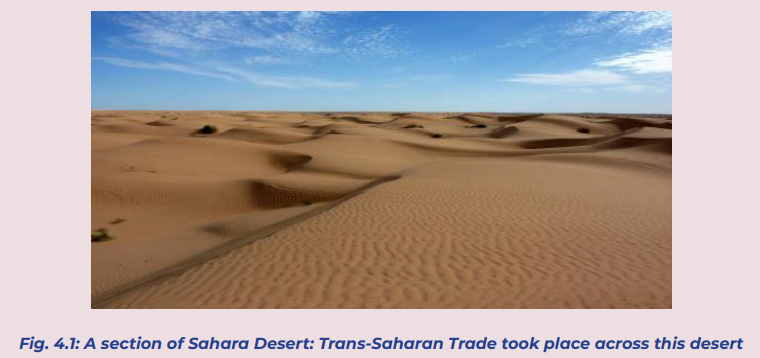
4.1. Rise and development of Trans-Saharan Trade
After answering the following three questions, read the following
case study and find out the reasons that may lead to the expansion
of Neza’s business.
1. Use a dictionary to find the meanings of the following:
(a) trans
(b) trade
2. Using an atlas, identify and list the major deserts of Africa.
3. Describe the characteristics of desert climate.
Case study
Neza started a small retail shop in Kibuye Town. After three years, she
turned it into a wholesale shop. It did not take long before she opened a
very big supermarket to replace the wholesale shop. Currently, she hopesto start a new firm.
State the possible reasons that may have led to the expansion of Neza’s
business.
One of the deserts that you have mentioned probably is Sahara Desert.
Sahara Desert is the biggest desert in Africa. The Trans-Saharan Trade
was conducted across it.
Trans-Saharan Trade was the trade or commercial activity carried out
between the north African Berbers and west African negroes across the
Sahara desert. Some historians suggested that the trade might have
begun in the 2nd century.The volume of trade remained low until camels were introduced form
Asia. After that the volume of trade increased.Furthermore, the trade gained momentum in the 7th Century when
the Arabs conquered North Africa. The conquest forced the Berbers to
migrate southwards. Consequently, it gave them a greater advantage to
participate in the trade. By the 11th Century, a profitable trade had been
developed. During this trade, the Berbers from North Africa acted as
middle men.
The following factors show the reasons behind the growth and expansion
of Trans-Saharan Trade.
(i) Introduction of Camels
The introduction of camels greatly helped in its improvement, especially
in the means of transport. In addition to the above, the camels could also
carry large amounts of goods. They could also take long without drinkingwater.
(ii) Emergence of West African empires
Some of such important empires included Mali, Ghana and Songhai.
The leaders of those empires ensured security for the traders which
encouraged more people to join the trade.
(iii) The conquest of North Africa by the ArabsThis forced the Berbers to migrate southwards. They finally reached
West Africa. That marked the beginning of the trade. Furthermore, they
introduced a common language (Arabic). This encouraged the coming ofmore Arabs who participated in the trade thereby developing it.
(iv) The spread of Islamic religion in West AfricaWith the spread of Islam in West Africa, Muslim traders felt secure to
carry out trade. Islam acted as a uniting factor. Islam also increased trustamong the traders through brotherhood and unity.
(v)Re-production of different commodities by West and North AfricaThis led to the need of exchanging goods produced in the two regions. It
eventually led to the development of the trade for example gold, slaves
and kola nuts from west Africa, camels, clothes and weapons from northAfrica. It eventually led to the development of the trade.
(vi) The presence of the Tuaregs and BerbersThe Tuaregs of the desert maintained wells and guided traders and the
Berbers initiated and provided capital in the trade.(vii) High profits
The trade grew because of the high profits that were involved. This
attracted many more people to join.
(viii) Absence of natural barriersThere were no natural barriers such as lakes and mountains between
North Africa and West Africa. This made movement of goods and peopleeasy.
Trans-Saharan Trade was done the same way trade is done today. The
only difference is that there was no standard medium of exchange
in form of money.
.Identify and explain the factors for the rise and development of
Trans Saharan Trade. 8.14.2. Effects of the Trans–Saharan Trade
According to you, in not more than 100 words, identify and discuss
the socio- economic importance of the market you visited in the
community.
The market you visited in your community serve similar importance
like the Trans- Saharan Trade. Both provide employment
opportunities and foster economic development in terms of taxes.The effects Trans-Saharan Trade were:
(i) The trade led to the exploitation of African resources such as minerals,
ivory and agricultural products. That led to their exhaustion.(ii) It led to the introduction of new commodities in West Africa such as
beads, clothes and guns.
(iii) It led to the development of many trading centers/towns that grew
into big cities. Such centers were Tripoli, Fez, and Timbuktu.
(iv) It led to the development of trade routes that have become permanent
roads till today.
(v) The trade also provided employment opportunities to many people
such as guides, guards and porters. It improved their standards of
living.
(vi) Many people who participated in the trade became rich. For instance,
kings of West Africa and the Arabs.
(vii) The trade also created a lot of suffering to the Africans. Most of them
were taken into slavery.
(viii) It also led to depopulation of many areas due to slavery.
(ix) It led to the introduction of Islam into West Africa. This was due to the
participation of many Arabs in the trade.
(x) It led to intermarriages between the Arabs and the Africans. This gave
rise to a new race of coloured Africans.
(xi) It led to the spread of Islamic education. For example, Islamic
universities were established in Mali and Songhai.
(xii) The trade also brought many Arabs into West Africa. These Arabs
settled there permanently.
(xiii) The trade also created a lot of insecurity as guns were brought in big
numbers.
(xiv) It also brought Islamic architecture into West Africa. Most of the
buildings resembled those of the Islamic world.
Explain the effects of Trans Saharan Trade.
1. In your own point of view, why do you think businesses fail?
2. Suggest ways that can be undertaken to avoid business failure.
Any trading activity may collapse due to certain factors. Trans-Saharan\
Trade also declined due to the following factors:(i) Slave trade was abolished and thus Trans-Saharan Trade could not
continue. Slaves were an important item of the trade.(ii) The introduction of cheap European goods made the African goods
to lose market. This led to the decline of Trans-Saharan Trade.(iii) Increasing insecurity along the trade routes also discouraged the
traders leading to its decline.(iv) The trade declined because of the discovery of gold in other parts of the world.
For example, the discovery of gold in America.(v)It also declined due to the constant shortage of water. Most oases dried up.(vi) The death of important kings led to the decline of the trade. Such
kings included Mansa Musa of Mali Empire and Askia Mohammed of
Songhai Empire.(vii) The trade declined because of the downfall of some West African
empires. Such empires included Mali, Songhai, and Ghana.(viii)The rise and development of Trans-Atlantic Slave Trade led to the
decline of Trans-Saharan Trade. Trans-Atlantic Slave Trade was more
profitable than Trans-Saharan Trade.(ix) The trade also declined because of high taxation imposed on the
traders in West Africa. High taxation reduced their profits.
(x) The discovery of the sea route through the Mediterranean Sea to
West Africa also led to its decline. This provided an alternative means
of transport for the traders that was cheap, safe and quick.
(xi) There was a shortage of raw materials such as gold and ivory. This led
to the decline of Trans-Saharan Trade.(xii)The colonization of Africa by the European powers made these
Europeans to become controllers of Africa. This led to the decline of
Trans-Saharan Trade.
Trade is conducted for purposes of profits. When profit is well
managed through savings and investments, it creates positive
socio-economic changes on society. It changes people’s
standards of living, increasing savings and reducing dependency ratios.

Mention and explain the factors for the decline of Trans Saharan
Trade
1. Examine the factors for the growth and development of
Trans-Saharan Trade.
2. Highlight the challenges that the traders faced during the
Trans- Saharan Trade.
3. Analyse the factors for the decline of Trans-Saharan Trade.
4. Discuss the effects of Trans-Saharan Trade.