
Unit 5: TRANS-ATLANTIC SLAVE TRADE (TRIANGULAR TRADE)
Key unit competence: To be able to analyze the growth
and effects of the Trans-Atlantic Slave Trade
Observe the below map and say what you see on it. Identify the
Trans Atlantic Slave
Trade that was carried out between three continents and explain all
the process.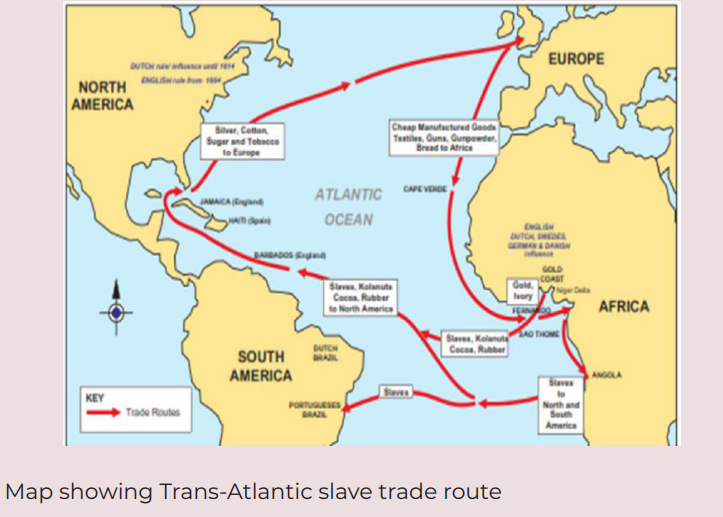
5.1. Factors for the rise, growth and development of Trans Atlantic Slave Trade
1. From your knowledge of Unit 8 about the Trans-Saharan
Trade, write down the meanings of ‘trans’ and ‘trade’.
2. Using an atlas, identify oceans of the world.
3. When mangoes are in plenty, their price goes down. In this
case, supply exceeds demand. On the other hand, when
mangoes are out of season, their price goes up. In this case,
demand exceeds supply. According to you how would you
explain the meaning of ‘demand’ and ‘supply’?
The Trans-Atlantic Slave Trade was the trade which involved Europe,
West Africa and the West Indies (America) across the Atlantic Ocean. It
was also called the Triangular Trade. This was because the ships used to
make three stages in the course of their journey. That is, from Europe
to West Africa, America and back to Europe. This made the shape of a
triangle.
Some of the reasons that you gave in reference to Activity 4.2 are very
important. They help us to see the link between Trans-Saharan Trade and
Triangular Trade. They help us analyse factors that led to development of
the two trades.
Let us now look at the factors that led to the rise and growth of Triangular
Trade.(i) The Industrial Revolution in Europe: Industrialists needed raw
materials and market for their manufactured goods. The Europeans
resorted to Africans for market. In return, they obtained slaves
who were sold to European plantation owners in exchange for raw
materials.
(ii) The discovery of America and West Indies by Spain in 1492: The
discovery of America and West Indies in 1492 led to the establishment
of cotton, tobacco and sugarcane plantation which all required the
labour, therefore it was suggested that West Africa would supply the
required labour. It was labour from Africa to the American plantations
that led to the development of the trade.
(iii) The decline of Trans-Saharan Trade: This led to the rise of
Trans Atlantic Slave Trade. There was a constant demand for slaves
and commodities thereafter.
(iv) The introduction of armed conflicts in African politics: High
demand for firearms by African rulers to defend and expand their
states made them to exchange the slaves for firearms leading to the
rise and growth of the Trans-Atlantic slave trade.
Other factors were:(i) The trade was profitable to the Europeans and Africans who were
involved in it. African chiefs and other participants got European
goods which were of high value.
(ii) There was a desire by African chiefs to get wealth and political
power. This could be obtained through the acquisition of arms andmaintaining friendship with Europeans
(iii) There was the growth of new merchants in Europe as feudalism
was declining. The new merchants of Europe wanted to accumulate a
lot of wealth. This became a justification to participate in the Triangular
Trade.
(iv) There was development of consumer culture among the African
chiefs. There was also the need for the European goods. These two
needs encouraged the Africans to sell their fellow Africans into slavery.
(v) There was increased demand for certain luxurious goods such
as sugar, alcohol, clothes and mirrors. This demand led to rise and
growth of Trans-Atlantic Slave Trade.
(vi) The winds and ocean currents helped to steer the European ships
to America and Africa. These were the north-east trade winds and the
north equatorial currents.
(vii) Africans were considerably physically fit. They could withstand
harsh climatic conditions in America compared to Europeans or
Asians.
(viii) The supply of firearms became a factor for the development of
Triangular Trade. Africans wanted to acquire firearms to defend
themselves against enemies and calm down internal wars.
Identify and explain the factors for the rise and development of
Trans-Atlantic Slave trade.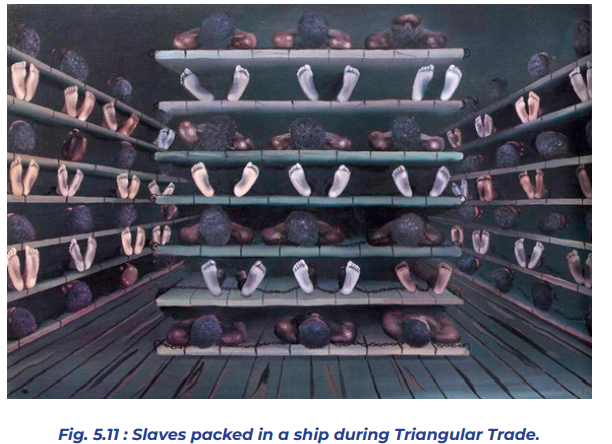

Use the books in library and internet conduct research on the
meaning of “migration” and its effects
Migration of people comes with various effects. These effects can be
social, political or economic. Triangular Trade too had some effects. The
effects have been discussed below.Social effects(i) It led to depopulation of many areas through constant wars and raids.
Approximately 15.4 million people were exported.(ii) It led to dehumanisation of human beings. That is, human beings
lost valuem and were reduced to minor items.
(iii) Raids and wars displaced many people from their homes while
others ran away into hiding.
(iv) There was general moral decay in Africa. The punishments which
used to be given to the offenders in the society were ignored.
Instead, they were sold into slavery.(v) Africans were disposed to different parts of the world to form new
races. Some were sent to America, Portugal, France and Spain.(vi) It greatly accelerated the spread of Christianity in predominantly
Islamic states of West Africa.Political effects
(i) It led to the growth of trading states such as Calabar and Bonny
along the coast.(ii) It led to the growth and expansion of some empires in West
Africa. Most of those empires such as Dahomey, Oyo and Asante
participated in the trade.(iii) It led to the destruction of strong states and empires due to
frequent wars and raids.
(iv) It delayed the European penetration in the interior of West Africa.
This was because the middlemen wanted to maintain their
positions. This hindered the development in the interior compared
to the coastal towns.Economic effects
(i) It led to the decline of Trans-Saharan Trade.
(ii) It reversed Africa trade from North Africa towards the coast of West
Africa.
(iii) Centres of wealth and power moved. They moved from the Sudanese
states to forest states and to the coastal trading communities.
(iv) It hindered economic development of West Africa because people
paid attention on slave trade. People neglected agriculture, industry
and legitimate trade.
(v) African local industry art and craft such as pottery and weaving
declined. This was because the products made were replaced with
European finished goods.
(vi) Insecurity that prevailed stopped people from carrying out
agriculture. Crops and livestock were destroyed leading to famine.
(vii) Europeans made a lot of profits from slave trade; these profits from
slave trade contributed to the Industrial Revolution and urbanization
in Europe
(viii) It encouraged the development of coastal towns and ports such as
Accra and Lagos.
4. Analyse the economic impact of Trans - Atlantic slave trade
1.Explain why Trans-Atlantic Slave Trade is commonly referred to as
‘Triangular Trade’.
2.Triangular Trade had to rise, grow and develop because of various
3.Explain the effects of Triangular Trade on West Africa, Europe and
America.