
Unit 7:ORGANIZATION OF PRE- UNIT 7 COLONIAL RWANDA
Key Unit Competence: To be able to describe the organization
of precolonial Rwanda.
Observe the below picture and explain which kinds of activities
people you see on it are performing. Which idea does the picture
suggest you about the social organization of the pre-colonial
Rwanda?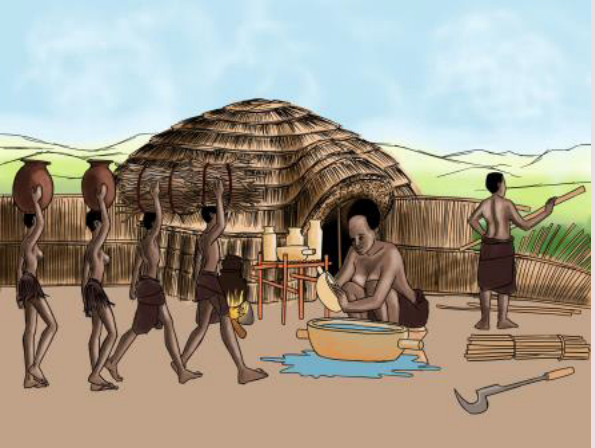
7.1. Social organization of the Rwandan traditional society

Describe the social organization of the Pre-colonial Rwanda.
Family, lineage and clan
The social organization of Pre-colonial Rwanda was based on three main
elements including nuclear family, lineage and clan.Nuclear family
The nuclear family was a key element of this organization. It was
composed of the husband, his spouse and children if they had them. For
polygamy, a man had many wives and single children. Every wife had her
own homestead and their husband used to visit them one after one.In case of death of a spouse, a woman would remarry with one of the
members of the family of the deceased in order to form a Leviticus family.
The children resulting from this union were socially considered at thesame level like those of other spouses.
The husband was the natural head of the family and he was therefore the
first socially responsible person. Moreover, all the members of his family
recognized his authority.
In general, a family played several roles. It was the basic unit of cooperation
and economic production. It produced all that it needed. In any case,
people only went to the market if it was unavoidable. For a polygamous
family, every nucleus family consisted of an independent unit of
production. It was the husband who sold his labor. The occupations for
women depended on the social status of the family (rich families
had big sized livestock while poor ones kept small-sized livestock).
According to the Rwandan mentality, an increased number of children
brought happiness and strength to the family. Marriage of a daughter
made it possible to extend alliances with other lineage groups.
A daughter was considered as a linking factor between families. The
lineage and eventually the army were responsible for the socialization of
children.Lineage
The lineage is a set of several families descending from one common
and real ancestor and recognizable because of the genealogical tree
traces. People who claim the same lineage take on the name of the
common ancestors. Apart carrying a proper genealogic remembrance,
the members of the same lineage have kept a minimum residential unity.
In the traditional Rwanda, two types of lineages were distinguished:
the minor lineage, inzu and major lineage, umuryango. A minor lineage
was created when members of the same family could be named after
a common and real ancestor thanks to his fame yielded from his great
achievements while, on the other side, the birth of a major lineage was
done when within a minor lineage there was the emergence of another
strong leader whose descendants could be recognized under his namebut who went on also being named after their former eponym ancestor.
The following are examples of names of some lineages:
1. Abarashi of Nyakarashi
2. Abananura of Kananura
3. Abahindiro of GahindiroClan
The term “clan” corresponds to the term “ubwoko” in Kinyarwanda
language and its institution neither has a chief or a particular internal
organization”. The term “clan” means a group of people who claim to
be descendants from one common mythical ancestor. It is a legendary
group or a fabulous ascendancy to which a group of people are attached.
However, it is not always possible to establish all the genealogic ties
between the common ancestor and the entire group. Besides, the
clan implies a social category and not a corporate group and it has no
procedures that manage business of common benefits.
The clan is different from a small lineage “inzu” and from a big lineage
“umuryango”. The clan is not even a residential grouping; its members
are located all over the country.The clan is a set of several lineages claiming a same mythic common
ancestor, but rather far off and fictitious. It is not easy to trace it using
a genealogical tree. The members of same clan share the same culture,
same taboos and same totem.The clan is a group, which is characterized by a biological relationship
shared by members who show mutual solidarity. The clan’s totem
symbolizes unity among its members.In reality, the clan is not a descendant group, but clan members have
common ties which are instead social identities of individual identification
in relationship with others, a way to find friend almost from anywhere
and benefit from their hospitality or their support. These entities also play
a role in marriage because in principle the exogamy of clans prevails in
the choice of the partner.
Clans also have animal totems and when possible, animal taboos. The
main clans had totems as their recognition sign, in this situation they
were from animal species: an animal, a bird, a mammal, batrachians and
a reptile.
The following are totems that have been identified and their animal
totems: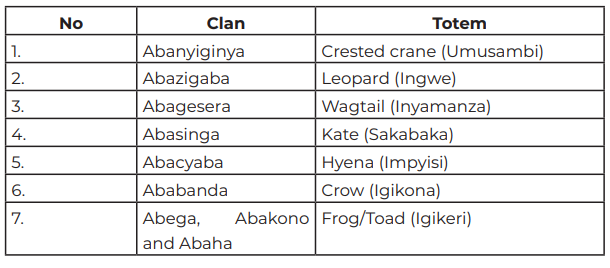
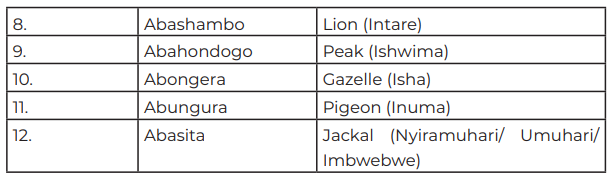
Certain clans have taboo. Banyiginya have impwi as their taboo. Impwi is
a variety of antelope living in high altitude forests, with short horns and
rounded cheeks. Bega have as taboo Ifuti which is a calf which at birth
has come out with first its back rather than the head. Bagesera have a
monkey as taboo. Basinga have as a taboo Inka y’Inyombya which is a
cow with white and black parts on the skin.Alliance and solidarity in traditional society.
The alliance between families and individuals was reinforced andmaintained through marriage and solidarity
Traditional marriage.
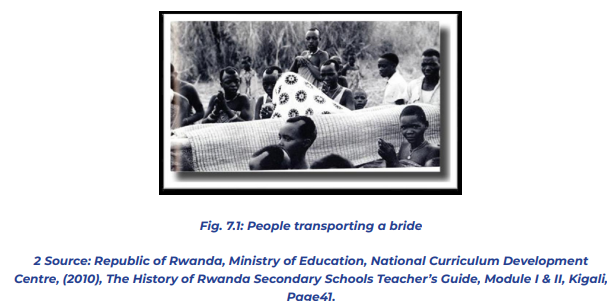
In traditional Rwanda, a daughter was considered as a linking factor
between families. Marriage was a union between a man and woman,
after the former had paid dowry and after organizing ceremonies where
big quantities of beer were served.
The dowry generally consisted of a cow, but it could also consist of goats
and hoes depending on the region. As for people of lower social standing,
dowry consisted of services rendered by the future husband in the home
of his future father-in-law. In actual fact, this last category was tantamount
to free marriage.Solidarity
Solidarity is a result of an alliance between individuals and families and the
feeling which pushes people towards mutual assistance. This manifests
itself through various actions and attitudes:Blood pact (Kunywana / Guca ku nda)
Blood pact was more serious and permanent because it involved a ritual
of blood. The individuals who wanted to make this blood pact would suck
a little of each other’s blood and drink it to signify eternal or unending
friendship.Rescuing (Gutabarana)
Rescuing was physical mutual help. It also meant being very close to the
family friend in order to help and support each other. For instance, this
could be the case in time of emergency like when a friend or a neighborhad lost a member of his or her family.
Giving cow each other also strengthened friendship between families and
Giving a cow (Guhana inka)
individuals. This practice was considered so serious that the person who
received the cow would at times swear by the name of donors: “Yampaye
inka …! (He has given me a cow!)”Division of labor
In the Rwandan society, it is worth noting that every able member even
young children had to be active. But all members of the society were
not equally strong. Therefore, there were activities reserved for certain
categories of people: men, women and children.
For men: to fish, to hunt, to dig the fields, to build houses, to herd cows or
goats and to serve in the army;
For women: to look after babies, to maintain the house, to prepare the
food, to weave, to fetch water and to collect firewood;
For children: to collect firewood, to fetch water, to herd cows or goats, to
sweep or clean house.
Division of laborAs the children grew up, parents began initiating them in the work of
adults according to their sex. Boys educated by their father and girls
educated by their mother (mu rubohero).EducationRwandans had informal education which was general and Intore
education.
Education went with sex and age brackets. Young girls were taught by
their mothers and paternal aunts. Boys were taught by their fathers onhunting and agriculture.
Young boys from rich families went to the king’s palace to be trained.
They were trained on warrior drills and were commonly known as Intore.
1.Explain different roles played by clans in the Pre-colonial Rwanda.
2.The clans of the Banyiginya, Abega and these of Abagesera and
Abasinga had animal totems. Examine the importance of these
animals for these clans
7.2. Cultural organization
Use internet and other documents to justify how the Kingdom of
Rwanda had developed a very flourishing culture.
Traditional religion
Conception of Imana (God)
In the Pre-colonial period, Rwandans were monotheists who believed
in One Supreme Being. They commonly accepted their God (Imana)
as omnipotent, omnipresent and omniscient. However, there were no
rites for Imana, no temple to worship Imana but Imana is present in
throughout some aspects of the daily living of Rwandans. For instance, in
naming their children, Rwandans referred to the idea of the role played
by Imana in their day-to-day activities and life. These names are like:
Ndayisaba( I implore God), Ndayisenga (I pray God), Niyibizi(It is God who
knows), Habyarimana (It is God who procreates),
Harerimana( It is Godwho nurtures), etc.Omnipresence of Abazimu
By “Abazimu” the spirit of the departed loved ones was understood.
According to the belief of Banyarwanda, a human being is made up a
visible part (body) and an invisible part (soul) one called “shadow”. Upon
dying, the union of body and soul disappears and in a mysterious way the
soul is transformed into a spirit called in Kinyarwanda “Umuzimu”. (From
the verb “Kuzima” meaning to cease existing). Rwandans distinguish
three categories of Abazimu:
–Abazimu b’abakurambere (Sprits of ancestors)
–Abazimu bo mu muryango (Sprits of ancestors from the large family)–Abazimu b’ibyinjirizi (Sprits of intruders)
Guterekera or cult for ancestorsThis rite concerns to offer some things as food or drinks to Umuzimu. That
rite took place in small huts called Indaro. The gestures are accompanied
by oral requests formulation according to circumstances. The offertories
are symbols because are the smallest. Often these offertories are the
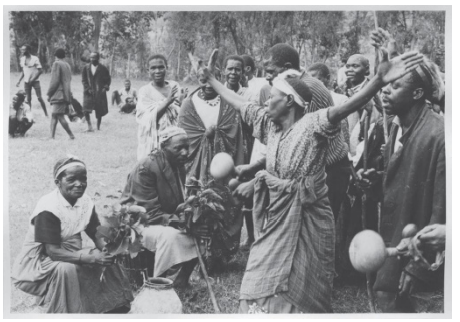
things which were liked by Umuzimu during his/her life.Kubandwa
The rite of Kubandwa is a ritual ceremony accomplished in two steps and
consists of offering the offertories to Ryangombe and other Imandwa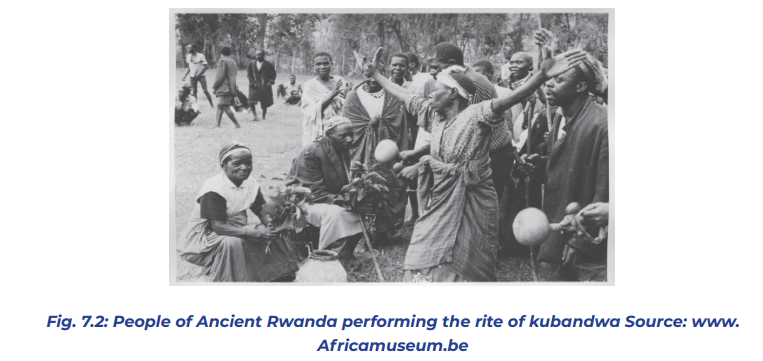
According to the tradition, Ryangombe was a hunter whose origin area
is Nkole in Uganda. But other areas are supposed to be his origin as well
as Bugoyi, Ndorwa and Bwanamukari. Ryangombe is the son of Babinga
and Nyiraryangombe. He had three wives Nyirakajumba, Gacubya and
Karyango. He had also two boys named Binego and Ruhanga and two
girls Bukiranzuzi and Nyabirungu.
The first stage of kubandwa is “Kwatura” (initiation ceremony). By
accomplishment of this stage, a novice is admitted in the community of
Imandwa and he gets a new name and new parents. He is called from
now” Uruzingo” The second step, called “Gusubizwaho” or “Gusubira ku
ntebe” (confirmation ceremony), the novice is invited to sit once again on
the seat of Ryangombe. By this confirmation, he/she takes the definitive
name and became Imandwa. This name of Imandwa also refers to the
specialist and the medium of the cult.
As far as the ‘Ukubandwa’ or feast for the initiated members was concerned,
this ritual was organized in terms of solemn and public ceremonies. It was
accompanied by gestures, speeches and chants in honor of the “king of
spirits” who was Ryangombe. Its membership was generally restricted to
those who were already initiated, and those who had applied to become
candidates for initiation. The non-initiated members were called ‘Inzingo’.
After death, the ‘Inzingo’ were taken to Nyiragongo, an active volcano,
whereas the ‘Imandwa’ were compensated after death. They joined
Ryangombe in paradise in a place where a volcano had gone extinct, i.e.
in Muhabura and specifically to Karisimbi.
A similar cult was practiced in the north of the country and it was rendered
to Nyabingi. Legend traces Nyabingi’s origin to Ndorwa or Karagwe. She
was a noble woman never married and died very old. After her death, her
followers (Abagirwa or Ababyukurutsa) spread her cult. Legend says that
she was the daughter of Nyakajumba and Nyabunyana.
Introduction of Nyabingi’s cult in Rwanda corresponded to the end of
reign of Kigeli IV Rwabugiri and it was known in Umutara, Rukiga, Kibari,
Murera, Buhoma, Bugamba, Bugoyi and Kanage.
The rites of uguterekera and ukubabandwa were performed so as to
appease the departed spirits. As result, the spirits gave mercy and
protection to the all members of the family that has performed these rites.
In most cases, the rite of uguterekera and that of ukubandwa were
preceded by another rite of ukuraguza, (divination). For all intents and
purposes, the ancient Rwandese always consulted diviners. The diviner
knew how to interpret the signs of the visible world and God’s willingness.
Rites and TaboosThe Rites (Imigenzo/Imihango) and taboos (Imiziro) can be considered to
have been in the framework of religion in traditional Rwanda. They are
part of beliefs which influenced behavior of ancient Rwandans.
RitesRwandan society had various rites. These were activities that were
performed in a particular way or occasion during ceremonies such as the
naming a child (Kwita umwana izina or Gusohora umwana), marriage,
funerals…
Child naming: This ceremony was done on the evening of the eighth
day after a new baby was born. It began with bringing the baby out to
the public for the first time. This was called gusohora umwana. All village
children from three to ten years would come and cultivate a piece of land
using sticks that were shaped in the form of a hoe. Thereafter, a male
adult would stop them, and throw water at them. The kids would then run
home to be given food in front of adults. The kids would be requested toput forward names, and the father would give the name he had selected.
Death ceremony: Whenever a person died, family members would take
part in certain rituals for sendoff. There was always a period of mourning
(kwirabura) announced by head of the family. During that period, sexual
relations and working in fields were forbidden. At the end of it, they
performed kwera ceremony, to mark the end of mourning.Taboos and forbidden things
Taboos in Rwanda were commonly known as Kirazira, meaning forbidden.
These were activities that were not allowed to be done because they could
bring curses. The following taboos existed in Rwandan society:(i) Children were forbidden to sit on their father’s stool.
(ii) Whistling at night was prohibited.
(iii) Sitting on a mortar was forbidden.
(iv) One could not marry from his or her own clan.
(v) A wife was not supposed to mention the name of her father -in- law.
(vi) Premarital pregnancy was prohibited.
(vii) Girls were forbidden to climb trees.
(viii) Killing a wagtail (Kwica inyamanza).
ClothingRwandans had their traditional clothes made from plant products and
animal skins. Plant product clothes included bark clothes from fig treeand banana stem barks. They were joined together to make a garment.Clothes of skin included uruyonga for boys over ten years, ishabure
indengera for girls and inkanda for women. Men put on calf hides while
leopard skins were for kings and chiefs.
Oral literature
Rwandans practised oral literature. Their oral literature included folk
tales (imigani), proverbs, riddles and poems. The poems were of many
categories. These included pastoral poems, dynastic poems, warrior or
epic poems and esoteric code. Other forms of literature were life histories,
plays and historical recitations. It was passed down to future generations
by word of mouth, typically through memorisation and recitation. It was
considered as a verbal form of art.
1. Give the meaning of the terms of Imana (God) and Nyabingi
according to the beliefs of Rwandans in the Pre-colonial period.
2. Account for two taboos that prevailed in Ancient Rwanda.7.3. Political and military organization
Carry out a research in your school library, and demonstrate the
Pre-colonial Rwanda was politically and militarily well organized.
The Kingdom of Rwanda also had its administrative system. The Kingdom
of Rwanda is known to have started in a small area of Gasabo. It enlarged
to a bigger size and was named Rwanda rugari rwa Gasabo, meaning the
big size of Rwanda.
The kingdom of Rwanda was headed by a king with a title of Umwami.
This gave him dignity and respect among others.The political and administrative structure of Pre-colonial Rwanda mainly
that of the 19th Century under the rule of King Kigeri IV Rwabugiri was built
on four pillars, namely a monarchy conceived in terms of a theocracy, a
two-headed monarchy (King and Queen Mother), and a policy of territorial
aggrandizement, conquest and patriotism.
Political organizationThe Pre-colonial Rwanda had several institutions reinforced the king
and his representatives. These institutions include Ubwiru (court
secrets), Ubuhake (gifts of cows), Ubusizi (dynastic poetry was important
in legitimizing the ruling king), Ubucurabwenge (knowledge on the
dynastic genealogy), Ibitekerezo by’Imiryango (family historic narratives),
etc. In effect, the structure of King Rwabugiri’s political organization was
complex. But all in all, the entire system of government rotated aroundthe king and the court.
The Ancient kingdom of Rwanda was divided into Ibiti or Districts which
were large constituencies covering several hills and villages. Ibiti were
divided into Ibikingi which were a collection of different hills where
administrative authority was exercised. Igikingi consisted of division (a
hill or a sub-hill) rich in pastures which was part of the provincial division.The king gave land to cattle keepers who became his direct clients
and who were only indebted to him. The Ibikingi were similar to subchieftaincy
divisions of the colonial era. There were two types of Ibikingi:
the‘administrative Igikingi’ and ‘pastoral Igikingi’. It should be noted that
some administrative Ibikingi could coincide with pastoral Ibikingi.
– Some Ibikingi depended on royal authority ruled by the king’s
representative called “Igisonga”;
– Others belonged to the chiefs of the traditional militias;
– The last category of Ibikingi was known as “Ingarigari” belonged to
the Queen-Mother.Administration in Pre-colonial Rwanda was centralized; all powers were in
the hands of the Umwami (King) and he was assisted in his functions by
Umugabekazi (Queen-mother), Custodians of the esoteric code( Abiru)
and chiefs.
King (Umwami )The army and patriotism were the main instruments used to achieve the
monarchy’s goals and objectives but the court was the cornerstone and
workshop where the Nyiginya State was shaped.He occupied the topmost position in the political, administrative and
military hierarchy to the extent that these functions were closely linked.Following his nomination, the king identified himself as a separate entity
from the nobility. The kingdom of Rwanda was sacred and the king was
therefore supposed to have the divine origin. The term Imana (God) refers
to the Creator but also to the essence of life and the fertility of the land
and humans. The king and dynastic drums were the very centre of unity
in the kingdom.
The king was the sole proprietor of everything and had every right to life
and death over his subjects. He was also in charge of the armies, lawmaker
and supreme judge. His sentences had no appeal.
The king, as the head of the kingdom, had daily life that was rather unique.
He lived alongside Abiru who performed various rituals as kingdom
ritualists. Some words were specifically used on the life style of the king.
For example:• Carrying him on a stretcher (Kuremererwa)The king usually came from Abanyiginya clan. The king’s authority had
• His speech (Irivuze umwami)
• His palace (Ingoro)
• Travelling (Kurambagira)
• His death (Gutanga)
a symbol of a sacred royal drum called Kalinga. There were other smalldrums such as Kiragutse, Mpatsibihugu and Rucabagome.
Queen-mother (Umugabekazi)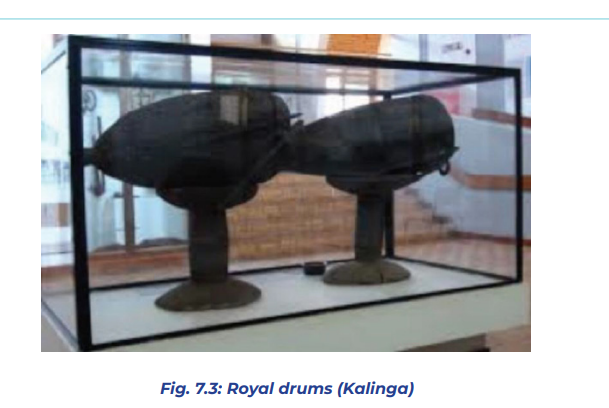 She was usually the mother/step mother of the king. She could perform
some ceremonies defined by the tradition. She was the confident and
chief advisor to the king. She could orient the king’s actions and act as
regent in case the king came to the throne when he was still young.Custodians of the esoteric code (Abiru)They were the guardians of the tradition and royal secrets. They were high
dignitaries and they came second as advisors of the king. They mastered
the rites and symbolic procedures and processes of the country and their
accomplishment. The king confided to them the name of his successorand he passed recommendations to the successor through them.
Abiru were responsible for the continuity of traditional and were under
the authority of the king. Their function was hereditary. They were also
responsible for knowing:–The order in which queens were chosen and the matri-dynastic clan
(Ibibanda) of the next queen-mother (Abega, Abasinga, Abaha,
Abazigaba, Abagesera and Abakono);
– Rules of enthronement of the new king (Inzira y’ubwimike);
– Rules regarding decoration of royal drumsUbwiru was an institution with a text of eighteen Inzira (but only seventeen
are available). In Pre-colonial Rwanda, Ubwiru was a very important legal
reference and can be compared to a constitution in modern Rwanda. The
content of Ubwiru is presented as follows:– Irage ry’abami (permanent last wills of the kings);
– Umurage w’ingoma (will of succession to the throne);
– Inzira z’ubwiru (fixed official text of the ritual);
– Intekerezo z’ubwiru (history and comment of the three preceding
titles).The examples of some rituals or inzira z’ubwiru:– Inzira ya Gicurasi (procedures for mourning or more specifically, theChiefs (Abatware b’intebe)
procedures of closing the National mourning)
– Inzira y’umuriro (fire procedures)
– Inzira y’ umuganura (procedures of handling the feast of the firstrains)
They were the heads of Ibiti appointed by the king and lived most of their
lives in the royal court. They were consulted by the king especially in the
time of crises. They had following functions of:– Controlling farmers and cattle keepers;The great chiefs (Abatware b’intebe) were largely responsible for the
– Supervising closely and control the functions of land and cattle subchiefs;
– Commanding the army;
– Raising taxes for the king, ikoro and other services;– Distributing land and to withdraw it from others if it was felt necessary.
recruitment and mobilization of the mass as far as the protection and
maintenance of security of the country were concerned.
At the level of “Igikingi” the administration was insured by three chiefs.
These chiefs were appointed by the king depending on their merit or the
merit of their families.
The chief responsible of land (Umutware w’ ubutaka)
He was in charge of agricultural production and responsible for collecting
royal tribute, “ikoro” from agricultural production. He had the responsibility
to settle disputes arising from land issues like land distribution and
settling new inhabitants on his land.
The chief responsible for cattle (Umutware w’umukenke)
He was responsible for pastures in his Igikingi and collected tax dues
from cattle keepers. He had to know and supervise pastures reserved for
Inyambo or cows for the royal court.The army chief (Umutware w’ingabo)He had the role of commanding the army and participating in the fighting
between Rwanda and her enemies. He was also in charge to settle
disputes between other chiefs and conflicts between the pastoralists.
Military organization
In traditional Rwanda, the military institution was very strong and
powerful.The army in Ancient Rwanda had the following roles:– Expanding country;The army was a vehicle for strengthening certain cultural and social
– Participating in the different wars;
– Fighting against cattle rustlers and various raids;– Ensuring territorial security
values. At every beginning of a new reign, the king had to start training
his own army of young Rwandans. At the royal court, there was a military
training camp known as “Itorero” where the young men Intore recruited
from among the king’s favorite chiefs learnt and practiced such values
as generosity, courage, patriotism, the moral responsibility, self-discipline,
the quality of being a man, “kuba umugabo”.
They received also special military training consisting of physical
exercises, shooting with bows and arrows, throwing javelin, composing
and memorizing of heroic poems, dancing.
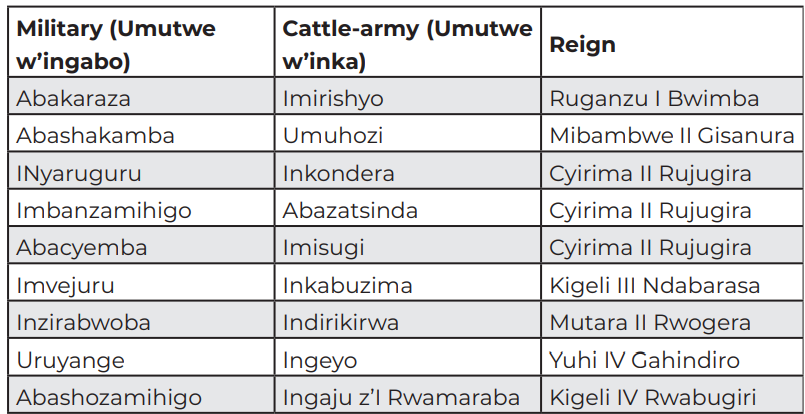
The royal army was organized in militias ( Imitwe y’ ingabo) under the
command of the army chief as well as at royal court’s level as at Ibikingi’s
level. The Royal army lived in military camps called “Ingerero”. The
organization and formation of the militias corresponded to the formation
of the “Cattle army” (“Imitwe y’ Inka”). This cattle army was reserved tofeed the related militias.
Examples:
1. Describe the role that was played by the king and the queen
mother in the administration of their country in the Pre-colonial
Rwanda.2. Explain the role that was played by the institution of army inRwanda during the pre-colonial period.
7.4. Organization of Itorero in ancient Rwanda
Traditional Rwandans had different ways of learning and inculcating
in children different values. One of them is through Itorero.Learning Activity 7.4Describe how traditional itorero was worked and its benefits to the
traditional Rwandan society.
Itorero was started by King Gihanga Ngomijana. He was the first King
of Rwanda. It dates back to pre-colonial times, and started with the
aim of teaching Rwandans their values. It would promote peace and
unity among Rwandans. It would teach boys above 14 years of age. The
tradition of Itorero provided formative training for future leaders. These
community leaders and fighters were trained in military tactics, hand
to hand combat, jumping, racing, javelin, shooting and endurance. They
were also taught concepts of patriotism, the Rwandan spirit, wisdom,heroism, unity, taboos, eloquence, hunting and loyalty to the army
Traditionally Itorero was a traditional institution where Rwandans would
learn rhetoric, patriotism, social relations, sports, dancing, songs and
defence. This system was created so that young people could grow with
an understanding of their culture. Participants were encouraged to
discuss and explore Rwandan cultural values.
As a traditional school, itorero trainers planned daily activities according
to different priorities and every newcomer in itorero had to undergo
initiation. Each Itorero included 40 to 100 participants of various age
groups and had its own unique name. The best graduates would receive
cows or land as rewards.Key aspects of itorero in ancient Rwanda
Here are some key aspects of Itorero in ancient Rwanda:
Moral and Ethical Training
Itorero served as a platform for imparting moral and ethical values to the
younger generation. Elders and community leaders used this institutionto teach principles of integrity, respect, and responsibility.
Initiation ritesItorero was involved in the initiation of young people into adulthood. This
included ceremonies and rituals that marked important life transitions,such as reaching a certain age or getting married
Military training for Defense and SecurityItorero was responsible for military training. It played a role in preparing
young men for defense and security purposes, especially during times of
conflict.Social cohesionItorero fostered a sense of community and social cohesion. Through
communal activities and rituals, people developed a shared identity and
a sense of belonging to the larger society.
Training Future LeadersItorero played a role in identifying and grooming future leaders within the
community. Leadership skills were often cultivated through participation
in Itorero activities.Preservation of TraditionItorero contributed to the preservation and transmission of cultural
traditions, including dance, music, and oral histories. It played a vital role
in maintaining the cultural heritage of the Rwandan people.Mediation and Dispute ResolutionItorero often served as a platform for resolving conflicts within the
community. Elders and leaders used traditional methods to mediate
disputes and maintain social harmony.
Spiritual and Religious PracticesItorero sometimes incorporated spiritual and religious elements,
connecting the community to its belief systems and promoting a senseof the sacred.
Symbolic functionsItorero involved various symbolic ceremonies, often characterized by
dance, music, and elaborate rituals that symbolized different aspects of
life, culture, and spirituality.It’s important to note that the specific functions and practices of Itorerocould vary across different regions and communities in ancient Rwanda.
Referring to Itorero in traditional Rwanda, why should Itorero be revived
in contemporary Rwanda?
7.5. Economic organization
By using History textbooks or internet, carry out a research
and analyse the role that was played by the different sectors
of the Precolonial Rwandan economy in satisfying the needs
of Rwandans during this period.
Economic organization in Ancient Rwanda was based on the followingeconomic activities: agriculture, animal rearing, handicrafts and trade.
AgricultureAgriculture was the principle activity characterized by archaic production
method (tools, crop rotation system, conservation methods…) which gave
poor yields. Agriculture was subsistence in nature; this means individual
or the family consumption. Cultivation was carried out according to the
climate seasons such as Umuhindo (short rainy season), Urugaryi (short
dry season), Itumba(long rainy season) and Icyi or Impeshyi(long dryseason).
The main crops cultivated were beans, sorghum, peas, maize, yams,
bananas, tobacco, sweet potatoes, local green leaves (Isogi), calabashes.
The Rwandans used to cultivate one part of land at a time leaving the
other in order not to exhaust the fertility (fallowing).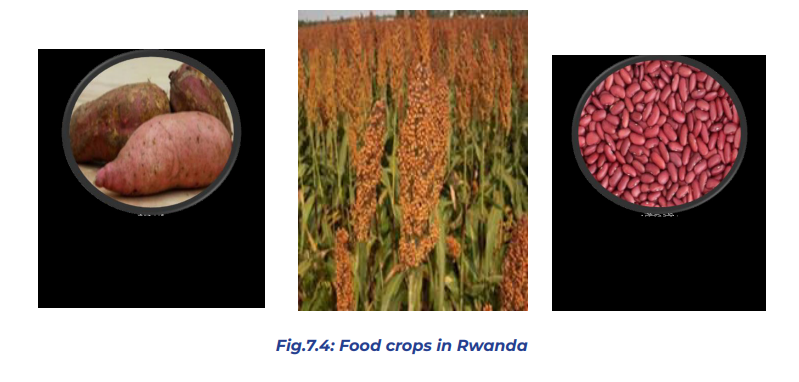
Animal rearing
The animal production in ancient Rwanda was mainly based on cattle
rearing, goats, sheep and the keeping of the dogs and the bees.
Cattle rearing occupied a very important place in Rwandan life because
the cows were the measure of wealth and expressed the social prestige.
Products from cows were milk, meat, butter, hides and skins used for
clothing.A cow was also used to cement social relations between the different
families when they exchanged it as a sign of love and friendship. Cows
were also given as dowry or marriage settlement.
HandicraftIt was a very important activity in the daily life of Rwandans. It was fromhandicraft that Rwandans could get most tools to satisfy their daily needs.They made clothes, metal and wooden objects destined for commercialpurposes.The clothes made were the following:– Ishabure for the girls;
– Inkanda for the women;
– Indengera for women
– Uruhu for the men;– Impuzu made from skin of umuvumu while ishabure, inkanda anduruhu were made from the skins of animals.
Metal tools made included spears, arrows, knives and hoes. Three regions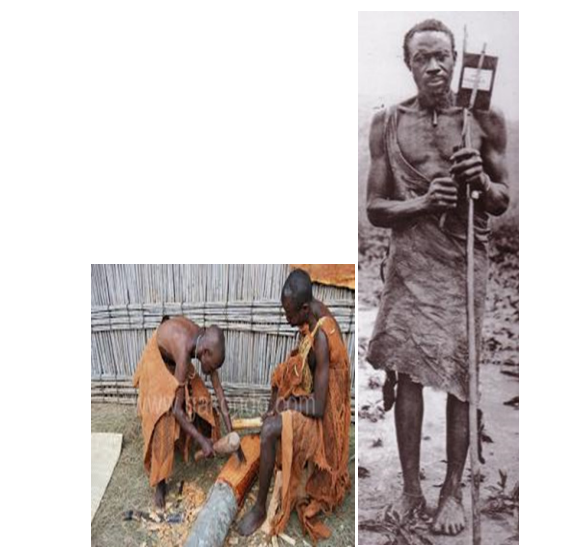
of Rwanda had celebrity on making and production of hoes such as:– Buberuka: Amaberuka
– Buramba: Amaramba
– Rusengesi: AmasengesiWooden tools included bowl (Imbehe), mortal (Isekuru), banana wine
press (Umuvure), milk pot (Ibyansi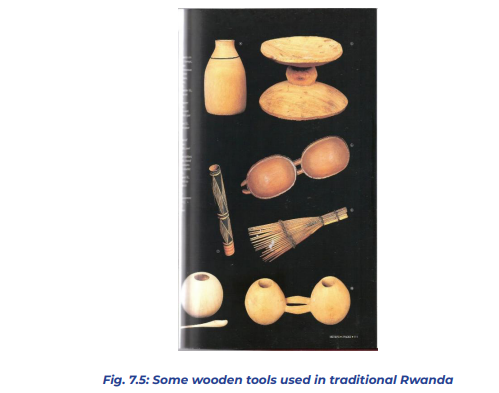
Ceramic products made from clay mixed with Insibo included the pots
known as intango, uduherezo, inzabya, ibibindi and inkono.
Weaving was done by women and it was admired for its finesse. Material
used in basket making included Urumamfu (wild millet grass), intamyi
(papyrus stems), Uruhivu (raphia fibers), ibirere (dead banana leaves). The
women produced bee hives, baskets, mats…These products were used in
daily life for decoration, carrying things, conservation of harvested crops.
Trade
Trade system in traditional Rwanda involved exchange of goods for other
goods, which was known as a barter system. The trade was mainly based
on agricultural products, animal products and handicrafts.
Many markets or commercial centers through the country especially the
northwestern regions were the following: Mushwiza, Ryabizige, Mulinzi,
Mubuga, Butare, Kazirabageni, Mururu, Rwanza, Itetero, Buramba, Kaziba,Agasakuza, Miyove and Vunga.
The main imported products from the neighboring countries included
the following:
–The salt from Lake Eduard;
–The bracelet from Masisi and Buhavu;
–The perfume from Ijwi Island
Although ancient Rwandans cultivated and make other economicactivities, there were the time for famines.
Famine and epizooties
The Kingdom of Rwanda suffered several famines during the pre-colonial
period. People gave these famines different names depending on the
harm made, villages affected and time.Famines were primarily caused by prolonged sunshine that resulted to
drought. The drought made plants dry out in gardens before the harvest
season.
It was also because of constant wars of expansion that made so many
people busy in fighting. They forgot to practise agriculture as people were
still running up and down. They had no time to settle down and cultivate.
Poor timing of agricultural seasons culminated into famine at one time
or another. Crops could either be affected by floods or meet sunshineseason before reaching harvest season.
Pests and diseases also affected crops. They were eaten up by pests
and attacked by various diseases leading to drying out. Common pests
included locusts, grasshoppers, rodents and rats.
Trade
Trade system in traditional Rwanda involved exchange of goods for other
goods, which was known as a barter system. The trade was mainly based
on agricultural products, animal products and handicrafts.
Many markets or commercial centers through the country especially thenorthwestern regions were the following: Mushwiza, Ryabizige, Mulinzi,
Mubuga, Butare, Kazirabageni, Mururu, Rwanza, Itetero, Buramba, Kaziba,
Agasakuza, Miyove and Vunga.
The main imported products from the neighboring countries included
the following:–The salt from Lake Eduard;
–The bracelet from Masisi and Buhavu;
–The perfume from Ijwi Island
Although ancient Rwandans cultivated and make other economic
activities, there were the time for famines.
Famine and epizooties
The Kingdom of Rwanda suffered several famines during the pre-colonial
period. People gave these famines different names depending on the
harm made, villages affected and time.Famines were primarily caused by prolonged sunshine that resulted to
drought. The drought made plants dry out in gardens before the harvest
season.It was also because of constant wars of expansion that made so many
people busy in fighting. They forgot to practise agriculture as people were
still running up and down. They had no time to settle down and cultivate.
Poor timing of agricultural seasons culminated into famine at one time
or another. Crops could either be affected by floods or meet sunshine
season before reaching harvest season.
Pests and diseases also affected crops. They were eaten up by pests
and attacked by various diseases leading to drying out. Common pestsincluded locusts, grasshoppers, rodents and rats.
Different famines that affected Rwanda at different times had far reaching
effects. These were:• A big number of people and animals died due to lack of food andSome of the famines that affected Rwanda in the pre-colonial period
pasture respectively.
•Vegetation dried out leading to destruction of environment and
natural beauty. This was felt especially in case where famine was
caused by prolonged sunshine.
• Famine also affected the Kingdom of Rwanda negatively in terms of
the economy. It led to reduction of royalties and taxes.
• People also suffered from poor feeding because of inadequate food
supply in various families of Rwanda. Several granaries of families
remained empty.
include the following:
Macumu famine (1690): This was the famine that occurred in Rwanda
in the period between 1690 and 1708. It was during the reign of Cyilima
II Rujugira. It was caused by warfare that characterised his reign as well
as a large number of emigrants into the kingdom from Bunyambiriri toBugoyi, north east of Lake Kivu.
Rukungugu famine (1797): This affected Rwanda during the reign of Yuhi
IV Gahindiro. It was caused by drought that hit the country between 1797
and 1830. This famine led to the drying of crops due to lack of sufficient
rainfall.
Muhatigicumuro famine (1890): This was experienced in some parts of
Huye. It was caused by insufficient rains, which affected crop fields in
the whole region. This famine led to crop failure, which not only affected
people, but animals as well.
Kijugunya famine (1895): It happened during the reign of Kigeli IV
Rwabugiri. There was massive crop failure caused by drought that affected
the Rwanda Kingdom. Many people starved.
Ruyaga famine (1902-1903): This famine struck several parts of Rwanda
causing widespread scarcity of food. This was because of crop failure
and death of cattle. It occurred during the reign of King Yuhi V Musinga 1. From economic activities carried out by Rwandans in the7.6. Socio-political and economic dependence in precolonial Rwanda
Precolonial period, identify different items that were internally
produced and these ones they were imported from outside.
2. Explain the role played by the cow in the Pre-colonial Rwanda.
3. Identify different names of hoes that were manufactured in the
Pre- colonial Rwanda.
4. In the Pre-colonial Rwanda, famines were very recurrent. Explain
three effects of these famines.
By using History textbooks, research on the main dependences
in which most of Rwandans were involved in in the pre-colonialRwanda.
Pastoral clientelism (Ubuhake)
It was a social, political and economic dependence of Pre-colonial Rwanda
that was mainly based on the cow. It was a customary contract which was
not obligatory between the owner of cattle, a rich man known as Shebuja
(Patron) and a person who wished to acquire cow called Umugaragu
(Client or Servant). The latter who was often poor, socially weak and
isolated asked the wealthier for social protection. Once the demand wasaccepted, the seeker accepted to perform duties for patron.
The following were the duties of the client:(i) Cultivating the fields of the patron
(ii) Looking after the cattle and ensuring that the milk was of good
quality
(iii) Repairing homesteads
(iv) Guarding homes at night
(v) Providing water
(vi) Providing liquor
(vii) Building fences
(viii) Escorting the patron to war
(ix) Acting as a messenger
(x) Giving cows in the event of epizootics, in the event of bereavement
(Inshumbushanyo)
(xi) Taking a part in patron’s happy or sad events, etc. Patron’s duties
included:
(i) Protecting the client against those who were socially stronger
than himand others likely to be enemies(ii) Assisting the client in court (kurengera)