
UNIT 3: CAUSES AND EFFECTS OF THE FIRST WORLD WAR (1914–1918)
Key unit competence: To be able to explain the causes and effectsof the First World War.
Introductory Activity 3.1
Examine the causes and effects of the First World War, presentyour results to the class
Introduction
For a long time, trouble had been developing in Europe. It was
centred in the Balkans, an area which both Russia and AustriaHungary
wanted to control. A small nation in the Balkans called
Serbia hoped to unite the Slavs in the area and expand its territory. Since
many Slavs lived in Austria-Hungary, Serbia knew that it would haveto defeat Austria-Hungary and hoped to get help from Russia.
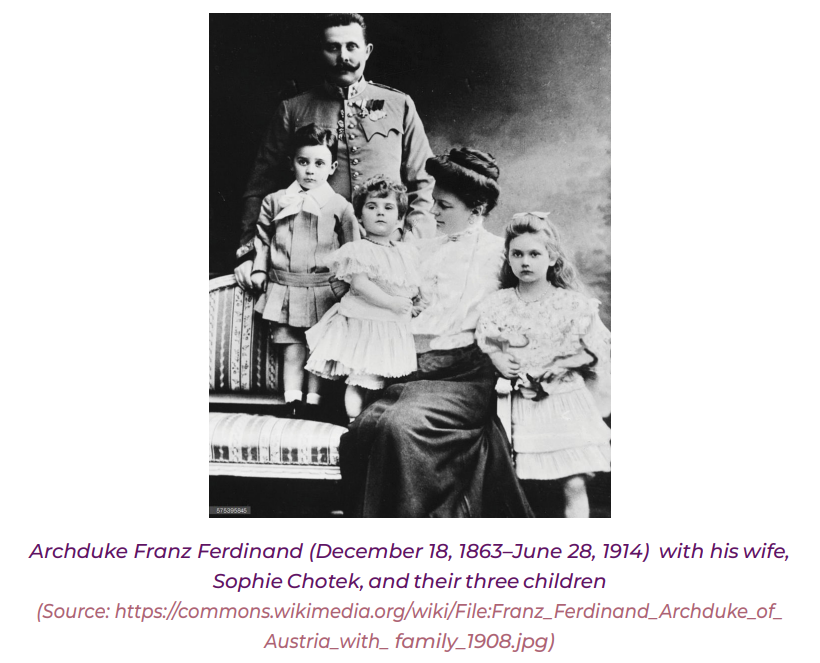
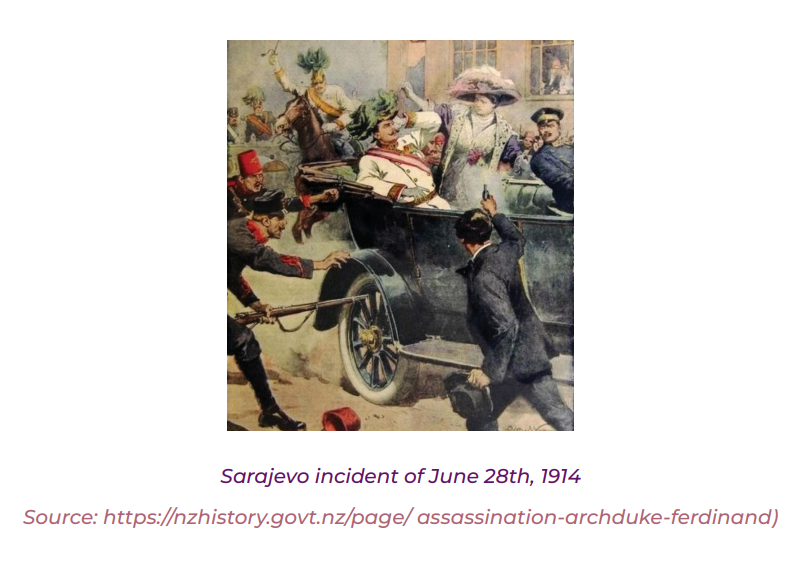
The First World War broke out on July 28th, 1914 after the assassination
of the Archduke of Austria-Hungary, Franz Ferdinand with his wife
Sophia, by a Serb student Gavrilo Princip in an incident known as
“Sarajevo double murder”. The First World War was a global war centered
in Europe. African countries got involved in this war by fighting on
behalf of their colonial masters, while countries in other continents
participated directly or indirectly. It has also been regarded as a WorldWar because its effects were felt world over.
It was predominantly called the World War or the Great War until the
outbreak of a similar World in 1939, when it became known as the
First World War. It involved all the world’s great powers, which were
assembled in two opposing alliances: the Allies (based on the triple
entente: Britain, France and Russia) and the Central Powers (The triple
alliance: Germany, Austria-Hungary and Italy); but, since Austria–
Hungary had taken the offensive against the agreement, Italy didnot join the war.
The war ended in 1918 with the defeat of the triple alliance
member countries by the allies. This war involved people at home as
well as soldiers at the front and for the first time, weapons of mass
destruction were widely used, including the machine gun, tank,airplane and submarine.
3.1. Causes of the First World War
Learning Activity 3.1
1. Explain the two concepts “conflict” and “war”.
2. Examine the causes of the First World War Presentyour results to the class.
• There was lack of an international peace keeping body because
the Congress System, which would have solved a local affair
between Austria and Serbia had collapsed by 1914.
•There was lack of diplomatic statesmen in the World; for
example, Von Bismarck of Germany. Kaiser William II, who
replaced Bismarck, was an aggressive leader.
• The Alliance System which was initiated by Bismarck was
composed of the Triple Alliance and Triple Entente. They were
formed for defensive purposes but later became hostile to each
other.
• Economic competition among European countries mostly
between Germany, France and Britain, led to situations like the
Moroccan Crises in 1906 and 1911 when Germany lost Moroccoto France. This left the spirit of revenge on the side of Germany.
•The arms race which had been characterised by the growth
of militarism between France and Germany. This led to the
manufacture of the most dangerous weapons in preparation for
war.
• There was growth of nationalism in Italy and Germany which
emerged as strong states, and the great Serbian movement
which resulted in the Sarajevo incident.
•The Franco–Prussian war of 1870–1871 resulted in the defeat
of France. The fear of French revenge, made Bismarck start the
alliance system and arms manufacture.
• The Aggressive character of Kaiser William II of Germany
who started the arms race forced Britain to also join the race,
eventually leading to the war.
•Newspapers like The London Times played a big role not only to
publicize the preparation for war but also to dramatize the war
situation.
• The Sarajevo incident of June 28th, 1914 was the immediate
cause of the First World War. The assassination of Franz
Ferdinand, the heir to the Austrian throne, with his wife Sophia
at Sarajevo by a Serbian student, Gravrilo Princip, forced AustriaHungary
to plan an attack on Serbia because it was believed
that Serbia supported the killers. Germany promised support
to Austria-Hungary; as Russia, Belgium, France and Britain
supported Serbia. On July 28th, Austria-Hungary declared waron Serbia and World War I began.
Application Activity 3.1
Discuss the immediate causes of the First World War. Do you
think the Sarajevo incident could have triggered off the FirstWorld War? Present your views to the class.
3.2. Consequences of the First World War
Learning Activity 3.2
Make research on the internet or the library on the
consequences of the World War I and thereafter present yourresults to the class.
•The First World War led to the loss of lives with an estimated 9.7
million combatants dead. About 21 million were wounded while
7.7 million soldiers went missing. An estimated 6 million
civilians died due to direct military action, and famine, or
diseases.
• Women were employed in factories, shops and public offices
replacing men who were fighting in the war. This contributed to
the emancipation of women.
•The war was partly responsible for the first peasant revolution in
Russia, also known as the 1917 Russian revolution.
• The League of Nations was formed as an international peacekeeping body in 1920.
•The war caused changes of governments in Europe. In Italy a
fascist regime under Mussolini emerged. In Germany, Kaiser
William II fled into exile in Holland and was replaced by the
Weimar Republic under president Hinderburg.
• It contributed to the decline of the German and Ottoman empires.
• Dictators like Benito Mussolini in Italy and Adolf Hitler in Germany
came to power.
• Japan and USA emerged as super powers. Some countries like
Canada, Brazil, Mexico and Argentina experienced growth in their
economies.
• New independent states like Poland, Romania, Yugoslavia and
Czechoslovakia were formed.
• There was massive displacement of people in Europe. Over 21
million people were displaced from their homes and became
refugees or internally displaced persons. After the war these
people were resettled in camps, mainly in Western Europe.
• There was territorial re-adjustment whereby France regained her
territories of Alsace-Lorraine and some African states changed
their colonial masters; for example, Rwanda, Burundi, Togo,
Tanganyika and Cameroon among others.
•It led to the calling of the Paris conference and the signing of the
Versailles Peace Treaty which sowed the seeds of world war II.
•It led to the formation of the League of Nations in 1920 as an
international peace keeping organisation. This was supported by
European statesmen who claimed that the absence of a strong
international body made a strong contribution to the outbreak of
the War.
•The war resulted in economic depression in Europe.
Effects of World War I on Africa
The First World War affected all countries that directly or indirectly
participated in it. The war impacted Africa economically, socially and
politically.
Economic consequences
Firstly, Africa experienced economic hardship, due to the exclusion of
Germany from trade. Germany was regarded as a major trading partner
of Africa before the First World War, and when she was completely
excluded from the continent and her merchandise confiscated bythe victors, there was a decline in African exports to Germany.
Secondly, the War had a general negative impact on the trade and
development of Africa. The prices of all commodities increased, the
economies stalled, and the poverty rate increased.The armies needed food supplies and African colonies were tasked toprovide the food. This led to food scarcity, starvation, and death.
Africans were recruited to fight in European armies. Others were
recruited to carry heavy weapons and supplies which exhausted
their bodies.The need to raise troops and carriers and to produce crops for
export reduced the supply for manpower in many areas of Africa. For
example, the recruitment of carriers from Katanga for the campaign
in Eastern Africa led to a decrease in incomes of both the men and womenwho were recruited as carriers and food suppliers.
Social and political consequences
The First World War changed in the relationship between Europe and
Africa. Over two million people from Africa made huge sacrifices for the
European Allies. In East Africa 100,000 men died while 65,000 men
from French North Africa and French West Africa also lost their livesmany others were disabled as a result of war.
Through combat experience and social cohesion with the
Europeans, Africans discovered the realities of European society.
This gave confidence to Africans to play a role in the administration of
colonies. In the territories, which had contributed heavily to the war effort,
the population hoped for social and political reforms. In Senegal, for
example, the reforms promised by France to Blaise Diagne (Mayor
of Dakar) were not fulfilled after the war, which made its people towithdrew their confidence in him.
The First World War marked a clear evolution of the international
opinion with regard to colonialism. Before the war, the colonial
powers did not have to report to anybody. Afterwards, in 1919, the
conference of Versailles examined the colonial past of Germany and
considered it not being in conformity with the new rules of morality,
which were to govern the administration colonies. It is one of thereasons, that made colonialists to withdrew the colonies from Germany.
The First World War also had consequences in Rwanda. These
included the famine “Rumanura”, the end of German rule and the
beginning of Belgian rule. “Rumanura” famine was felt most in
Bugoyi because throughout the First World War, this region was
the principal theatre of military operations in Rwanda. Bananas
were cut down, and cultivation of sorghum was suspended by the
German command in order to deny cover to the enemy. Moreover,
people had fled their homes and left their land for fear of bombs and
to run away ,and were subjected to carrying war materials. There
was also demolition and vandalism of homesteads by soldiers whowere looking for food and people to help carry the war supplies.
Application Activity 3.2
Discuss the consequences of the World War I.
3.3. The 1919 Versailles Peace Treaty
Discuss the reasons why the Versailles Peace Treaty wassigned and make a presentation of your reasons to the class.
At the end of the First World War, the leading statesmen were left with
the task of making peace and creating order out of the chaos.
The postwar peace was made at Versailles near Paris from January to June 1919. The
Versailles Peace Treaty was signed between Germany and the Allied
powers. On June 28th, 1919, exactly five years after the assassination of
Archduke Franz Ferdinand. The other central powers on the Germanside of World War I signed within separate treaties.
The Versailles Peace Treaty was a document that was signed in the
hall of mirrors at Versailles between the victorious powers and defeated
Germany. The terms and conditions of the treaty were manipulated
by the Allied Powers against Germany. This made the aim of the treatyquestionable in making peace.
The conference was dominated from the beginning to the end by: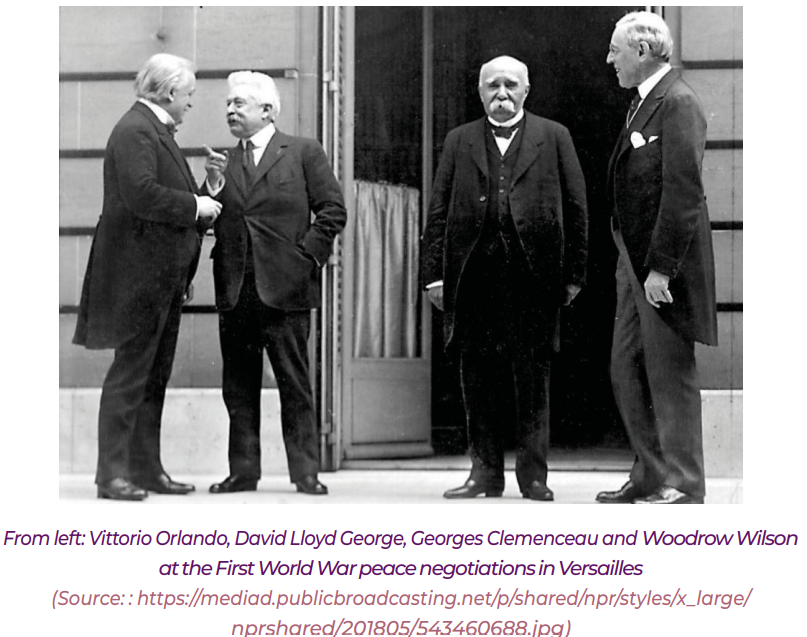
• Georges Clemenceau: “the old tiger,” the Prime Minister of France;
• Lloyd George: Prime Minister of Britain;
• Woodrow Wilson: President of the USA;• Vittorio Orlando: Italian Prime Minister .
Until March 1919, the most important role for negotiating the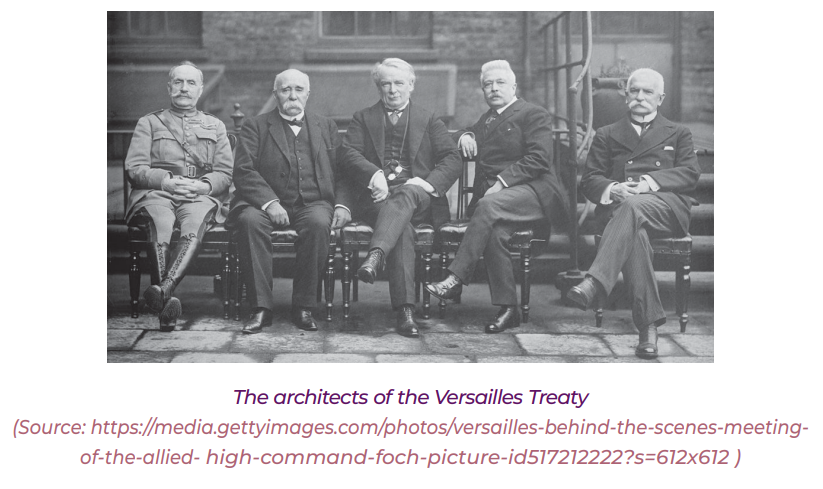
extremely complex and difficult terms of the peace fell to the regular
meetings of the “council of ten”, which comprised the heads of
government and foreign ministers of the five major victors (Britain,
France, the United States, Italy, and Japan). As this unusual body
proved too formal for effective decision-making, Japan and for most of the
remaining conference the foreign ministers left the main meetings,
so that only the “big four” remained. After his territorial claims to Fiume
(today Rijeka) were rejected, Italian Prime Minister, Vittorio Orlando leftthe negotiations and only returned to sign in June.
The final conditions were determined by the leaders of the “big three”
nations: British Prime Minister David Lloyd George, French Prime
Minister Georges Clemenceau, and American President Woodrow
Wilson. Even with this smaller group it was difficult to decide on a
common position because their aims conflicted. The result wascalled the “unhappy compromise”.
Aims of the Versailles Peace Treaty
The aims of the Versailles Peace Treaty included the following:
• Maintain lasting peace in the world;
• Look for ways to punish Germany and her allies;
• Promote the political integrity of independent states;
• Reduce the production of dangerous weapons;
• Redraw the map of Europe;• Set up a body to maintain international peace.
Terms of the Versailles Peace Treaty
The document containing the terms of the Treaty of Versaillesconsisted of15 parts and had about 440 articles.
The parts related to Germany: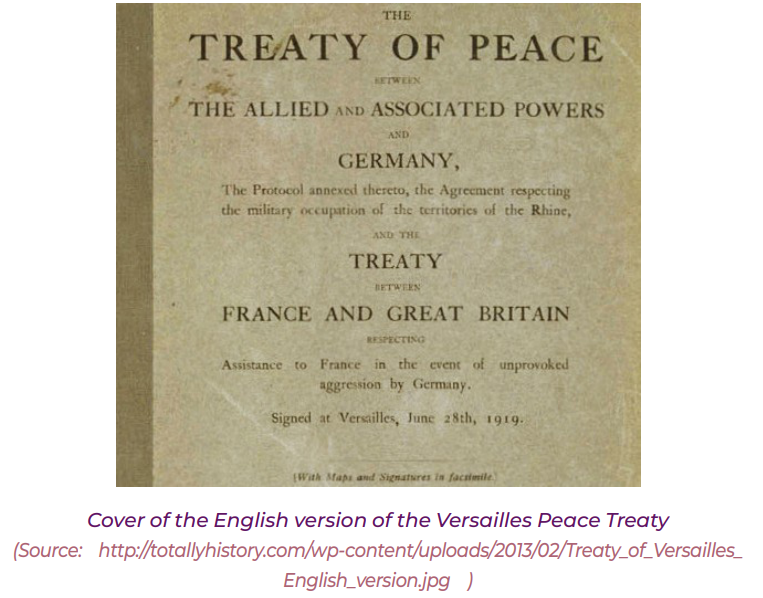
• She was entirely blamed as the sole cause of the First World War.
• She was forced to reduce her soldiers from 4,000,000 to
100,000 soldiers.
• She was stopped from having submarines.
• She was forced to pay war reparations of about 6.5 billion pounds.
• She lost her overseas territories like Rwanda, Burundi, Togo,
Cameroon, Tanganyika and Namibia in Africa.
• She lost Alsace-Lorraine to France.
• She was not allowed to have tanks and was restricted to only 6second-hand battle ships.
Achievements of the Versailles Peace Treaty
The 1919 Versailles Peace Treaty ended the First World War and
created relative peace in Europe during the inter-war period from 1919
up to 1939.
It granted independence to some states like Yugoslavia, Serbia,
Montenegro, Poland, and Czechoslovakia.
It made France to regain her territory of Alsace-Lorraine from
Germany.
It destroyed the German arms and reduced her army to 100,000
soldiers so as to check her military aggression.
It came up with a disarmament policy and although it was only
applied on defeated powers, it helped in maintaining world peace for
sometime.
It declared neutrality on international water bodies which reduced thepossibility of conflicts that would cause another war.
It made arrangements for the exchange of war prisoners between the
defeated, especially Germany and victorious powers.
It reduced the strength of Germany by taking away German overseas
territories such as Togo, Cameroon, Tanganyika, Rwanda, Burundi andNamibia.
Poland, a land locked State, was provided with a corridor of land that
passed through Germany to the part of Danzig on the Baltic Sea.Serbia was also granted access to the Sea.
The Treaty led to the formation of the League of Nations on January 10th,
1920 which registered some success in political, social and economic
aspects the inter-war period.
However, the Versailles peace treaty was very unrealistic in itsattempt to bring lasting peace as defined through its aims.
Failures of the Versailles Peace Treaty
The terms of the 1919 Versailles peace settlement were unrealistic and
unfair to the defeated powers. In implementing the aims of the Versailles
Peace Treaty, there was a lot of injustice which made it unable tomaintain lasting peace in the world.
This settlement had the following weaknesses:
• It was imposed on Germany without consultation because
Germany was only invited to sign without participating in
negotiations.
• It was too harsh on Germany in terms of disarmament which
encouraged Adolf Hitler to rise up and begin an arms race that
led to the Second World War.
• Germany was forced to pay huge sums of war reparations
in form of physical goods like ships, chemicals, cattle and
agricultural products, plus 6, 600, 000, 000 pounds. This led
to unemployment in Germany and economic depression in
Europe.
•The composition of parties to the treaty was also unfair because
the treaty was written by the Triple Entente members only while
the Triple Alliance members were not invited to participate in
negotiations.
• The selfish interests of the leading diplomats (George Clemenceau
desired to humaliate Germany, Lloyd George wanted German
territories and Vittorio Orlando who also desired territorialrewards) rendered the viability of the treaty questionable.
• The distribution of the Germans to different states (3 million
to Czechoslovakia, 2. 5 million to Poland and about 2 million
to Yugoslavia) violated the principle of nationalism and made
future trouble inevitable. Hitler used this problem to invade
Poland which led to the Second World War.
• The blaming of Germany as the sole cause of the First World
War by a guilty clause also made the viability of the Versailles
Peace Treaty questionable from its start.
•The confiscation of German territories in Africa was seen as a
way of making victorious powers rich which made Germany
discontented, leading to Second World War.
•Japan invaded Manchuria in 1933 and Italy under Mussolini
invaded Ethiopia in 1935 mainly because they were not fairly
rewarded by the Versailles treaty.
• The treaty led to a very weak foundation for the League of
Nations as an international peace keeping body. But it did not
provide the League of Nations with an army to fight againstfuture aggressors.
Germany rejected the Versailles peace settlement due to the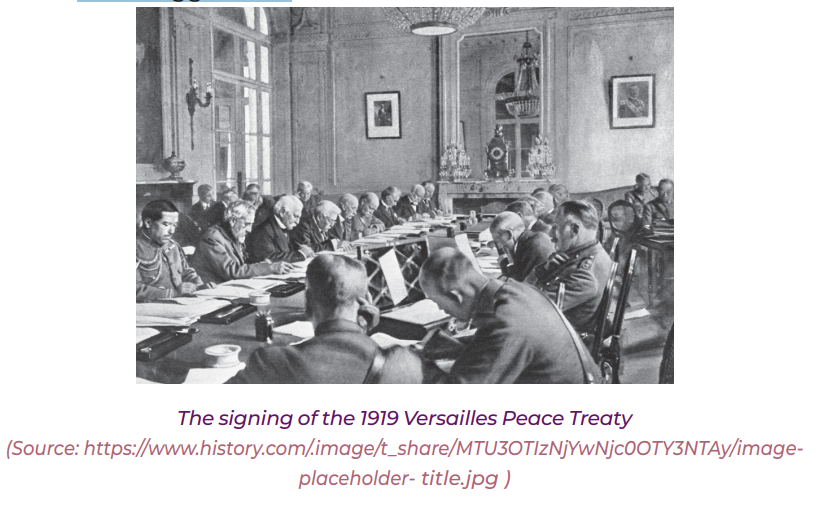
following reasons:
• The treaty was simply dictated on Germany which had no chance
for explanation since she was excluded from peace negotiations.
• The treaty only condemned and blamed Germany for the
outbreak of the First World War.
•The war reparations of 6.6 billion pounds was impossible for
Germany to pay alone with her colonies taken by other countries.
•The disarmament policy was also unfair because it was only
Germany to be disarmed while other European powers were
busy manufacturing weapons.
• The loss of territories in Europe and in Africa was rejected by
the Germans because it was their source of raw materials and
markets, hence leading to their economic decline.
•The Germans rejected the Versailles peace treaty because it
was monopolised by three leaders who had intense hatred for
Germany.
•The Versailles Peace Treaty distributed German nationals to
different states of Poland, Czechoslovakia and Yugoslavia. This
violated the principle of nationalism which later encouraged
Hitler to build the German empire by starting from Austria and
Czechostorakia, Poland which led to the outbreak of the Second
World War.
•The venue where the treaty was signed, in the Hall of mirrors
was where the German empire was proclaimed in 1871. For
this reason, the treaty was considered as the French revenge bymost Germans.
• The treaty was signed under the chairmanship of George
Clemenceau of France who had been Germany’s enemy since
the 1870–1871 Franco-Prussian war.
• The treaty was signed on June 28th, 1919 on the exact
anniversary of the Sarajevo double murder. It was a clear
indication that the Versailles diplomats blamed Germany for theassassination of Archduke Franz Ferdinand and his wife Sophia
3.4. Effects of the 1919 Versailles Peace Treaty on Germany
The 1919 Versailles Peace Treaty signed on June 28th, 1919 in the
Hall of Mirrors at Paris politically, socially and economically affectedGermany in the following ways:
•The 1919 Versailles peace diplomats forced Germany to
denounce the war and accept defeat unconditionally which
made the Weimar Republic unpopular among the Germans.
• Germany was obliged to pay the heavy war indemnity of about
6. 6 billion pounds and this left her economy shattered and
gave rise to severe unemployment, inflation and abject poverty in
Germany.
•The landlocked Poland was granted a corridor to Port Danzig in
the Baltic sea through Germany.
• The Germans who were greatly inspired by Adolf Hitler attacked
and opposed the Weimar Republic leaders for having accepted
the treaty whose terms were unfair and harsh.
• It demilitarized the region of the Rhine lands and all the
fortifications that Germany had already made on the banks of
the Rhine were destroyed beyond repair.
•The treaty forced the defeated Germany to give back Schleswig
to Denmark, and Alsace-Lorraine to France.
•The 1919 Versailles peace treaty forced Germany to cancel the
treaty of Bucharest signed with Romania and the Brest-Litovsk
treaty signed with Russia under which Russia had surrenderedPoland, Latvia, Estonia and Lithuania to Germany.
Application Activity 3.3
1. Write in your exercises book or elsewhere the objectives
of the versailles peace treaty. Present your findings to
the class.
2. With the help of the internet discuss the achievements
of the Versailles Peace Treaty. Make a presentation to
the class
3. Identify the failures/weaknesses of the Versailles Peace
Treaty. Present your findings to the class
4. Discuss the consequences of the 1919 Versailles Peace
Treaty on Germany. Do you think this treaty was fairtowards Germany? Present your discussion to the class
3.4. The League of Nations
Origin of the League of Nations
Learning Activity 3.4
Using internet or library research, identify the origin and
objectives of the League of Nations. Present your findings tothe class.
The League of Nations (LON) was an international peace keeping
body formed after the First World War. It officially came into existenceon January 10, 1920 with its headquarters in Geneva, Switzerland.
It originated from the famous “Fourteen Points” of Woodrow Wilson,
former President of USA, on how the world could achieve national and
international peace after the First World War. According to those points,
the victorious powers formed an international organisation whichcame to be known as the League of Nations (LON).
Objectives of the League of Nations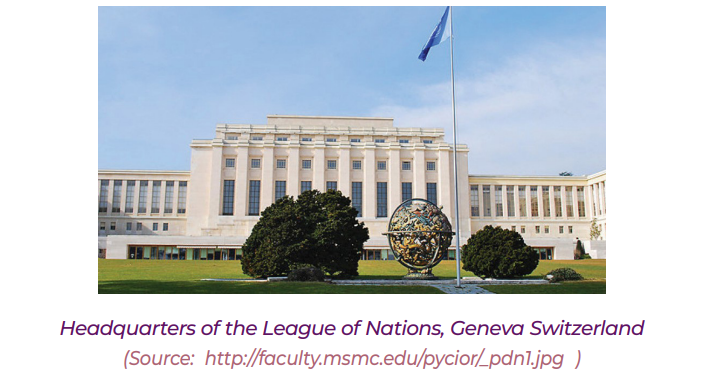
The League of Nations (LON) was formed for the following social,
political and economic objectives:
•To preserve, maintain and promote international peace which
had been destroyed by the 1914–1918 World War by resolving
international conflicts peacefully;
• To prevent aggression;
• To defend and promote territorial integrity and independence
of the League member states against aggression of any kind;
•To enforce disarmament of both victorious and defeatedcountries and limit the production of disastrous weapons;
•To defend and protect the achievements of the 1919 Versailles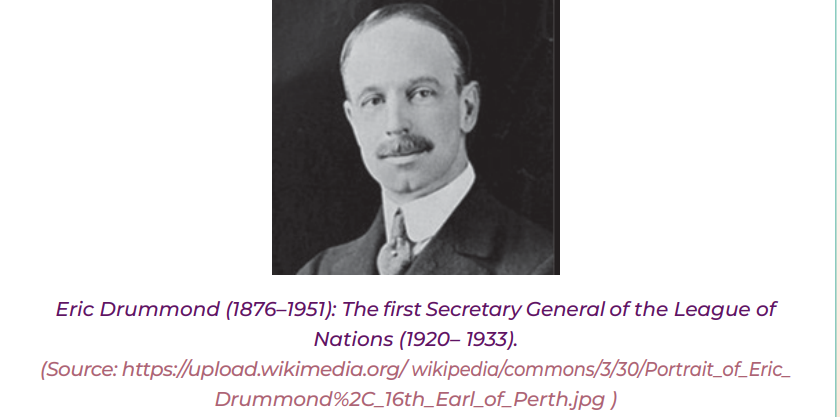
Peace Treaty and put them into practice;
•To resolve the refugee problem by resettling the people displaced
in the First World War;
• To promote the social welfare of member states by solving
problems created by the First World War;
•To ensure efficient administration of the mandate territories like
Rwanda, Burundi, Cameroon, Togo, Tanganyika and Namibia.
Organs of the League of Nations
The LON had 48 member states at the beginning and 55 by 1925. It
was composed of permanent members–France, Britain, Italy, Japan,
and later Germany and the Union of Soviet Socialist Republics (USSR)–
and several non-permanent members elected by the assembly. Itsmain organs were the following:
General Assembly
This was a council of all member states that annually met to
consider political disputes, reduction of armaments and to decide onthe general policy. Each member state had one vote.
Council of the League
This consisted of four permanent members: Britain, France, Italy and
Japan, at the beginning. The USA was to be a permanent member
but refused because of her isolationist policy.
There were four other members elected by the assembly for a
periods of three years, but the number increased from four to nine by
1926. It was the council’s task to deal with specific political disputesas they emerged.
Secretariat
This was in charge of all the paperwork, preparing agendas andwriting resolutions and reports for carrying out the decisions of the League.
Permanent Court of International Justice
This consisted of 15 judges of different nationalities and it was based
at the Hague in Holland. It dealt with legal disputes between states asopposed to political ones.
Commissions and committees
The main commissions handled the mandates, military affairs,
minority groups and disarmament. There were also committees for
international labour, health, economic and financial organisation,child welfare, drug problems and women’s rights.
Achievements of the League of Nations
The League of Nations (LON) registered political, social andeconomic achievements as discussed below.
In 1925 the Larcano conference was held and the Larcano treaty
signed by Germany, Britain, Belgium, Italy and France. By this treaty,
Germany was admitted to the LON in 1926 and this restored world peace.
The international court of justice was set up at the Hague and by
1939 had mediated the signing of about 400 agreements and settled
70 cases of international concern.
The LON succeeded in preparing Iran, Yugoslavia, Turkey, Hungary,
Romania and Czechoslovakia, among others, for independence by
1932.
It established the International Labour Organisation (ILO) which
improved the general living conditions of employees in severalcountries.
In 1926 the LON solved border conflicts between Greece and Bulgaria
by asking the Greeks to withdraw and pay compensation.
The LON settled the First World War refugees and the internally
displaced people by providing various forms of assistance to them.
In 1924 the LON set up a slavery commission that declared slave trade
and slavery illegal and antisocial internationally.
The health organisation of the LON organised for medical assistance and
the distribution of vaccines to combat epidemics like syphilis, cholera,
dysentery, and malaria which had swept Europe.
The LON set up a mandate commission for effective administration of
the former German colonies in Africa.
The League member states set up a committee responsible for
monitoring and discouraging the production, transportation, sellingand consumption of harmful drugs like opium, marijuana and cocaine.
Weaknesses of the LON
After scoring many achievements, the first LON also registered the
following failures:
•It failed to ensure world disarmament when it was unable to
disarm victorious powers like France, Britain, USA and Russia
but only disarmed Germany, a defeated power.
•It failed to form a joint international army that would be used in
checking the activities of dictators and aggressors.
•It failed to prevent the 1931 Manchuria crisis whereby Japan
invaded the Chinese province of Manchuria and went
unpunished.
• It failed to prevent the economic depression of 1929–1935
which had many negative effects like inflation, unemployment,
famine, etc in many countries.
•It failed to win USA membership and the absence of USA in the
LON weakened the organisation economically and militarily.
•It failed to establish a strong organisation with clear membership
principles and thus, a state would join and leave the LON with a
lot of ease i.e. Italy, Japan, Germany and Russia had left by 1936.
• It failed to follow up the payment of the war indemnity imposed
on Germany which Hitler stopped paying immediately after
rising to power in 1933.
• It failed to establish financial sources of its own and depended
on handouts from its member states which sometimes delayed
consequently delaying its activities and interventions.
•It failed to stop Italy’s invasion of Ethiopia in 1935. Italy under
Mussolini invaded and occupied Ethiopia but the LON never
took steps to punish Italy.
•The invasion of Poland by Hitler from Germany that resulted in
the outbreak of 1939–1945 World War was mainly due to the
weakness and the failure of the LON which was not able to stop it
and negotiate peaceful solutions.
Because of its weaknesses, the League of Nations also failed to
preserve peace during the inter-war period of 1920–1939 due to thefollowing reasons:
• It was linked to the unpopular 1919 Versailles Peace Treaty.
• It lacked an international army that would have been used to
fight dictators like Mussolini and Hitler.
•The USA refused to join the LON although its foundation was
proposed and supported by the US president.
• The great economic depression of 1929–1935 made it difficult
for most of the member states to meet their financial obligations to
the League.
•It lacked enough finances of its own which made it hard to
execute its duties properly and impartially.
•It had a weak administrative set up. For example, the secretary
general had limited power.
•It was very slow in decision making.
• It had no mechanism to control the entry and exit of the state
members.
•Its member states promoted national rather than international
interests.
•The appeasement policy of France and Britain from 1935 which
allowed Adolf Hitler to expand German territory undermined the
league’s operations and made it impossible to succeed.
Application Activity 3.4
1. Research on the organs of the League of Nations.
Present them to the class.
2. Identify the achievements of the League of Nations. Compare
your work with that of classmates.
3. In your view, what were the weaknesses of the League
of Nations? Present your findings to the class.
Use the internet to get information about the reasons which
made the League of Nations fail to preserve peace during the
inter-war period of 1920–1939. Make a presentation to the classUnit summary
The First World War started on July 28th,1914 after the assassination
of Archduke Franz Ferdinand, the heir of the Austria throne with his
wife Sophia and ended on November 11th,1918. It started in Europe
and spread afterwards to involve many countries all over the world.
The causes of this World War included lack of an international peace
keeping body, lack of peaceful statesmen, the growth of nationalism,
economic imperialism among European countries. It led to negative
consequences like loss of lives, and destruction of property and
infrastructure.
The African soldiers participated in this war; the Tirailleurs Sénégalais
helped the French and the Kings African Rifles the British. The
Indugaruga helped the Germans to fight against the Belgians in
Rwanda during the First World War. The war also had negative effects
in Africa. For Rwanda, it led to a famine called Rumanurimbaba.Glossary
Armistice: a state of peace agreed to between opponents so they can
discuss peace terms
Belligerent:Someone who fights (or is fighting)
Ceasefire: a state of no fighting agreed to between opponents so
they can discuss peace terms
Drag on: last unnecessarily long or proceed for an extended period
of time
Ultimatum:a final demand or statement of terms, the rejection of
which causes a breakdown in a relationshipEnd of Unit Assessment
1. The First World War (1914–1918) was fought between
two camps (blocs); name them?
2. Examine the main causes of the First World War.
3. What were the economic consequences of the First World
War in Europe?
4. Discuss the objectives of the Versailles Peace Treaty in
Europe.5. Assess the achievements of the League of Nations.