
UNIT: 4 BETWEEN TWO WARS
Key unit competence: To be able to explain the causes and effects
of the 1929 economic crisis and the rise of totalitarian regimes inEurope: Fascism and Nazism
Introductory Activity 4.1
Using internet or library explain the World between the TwoWars
Introduction
Events during the period between two wars led to the Second World
War. During this period, the world witnessed a heavy economic
crisis in 1929, which was a result of the destruction of industries,
communication lines, airports and cities during the First World War.
Measures were taken to overcome the effects of this crisis, the major
one being the “new deal programme” by the new American President
Franklin Delano Roosevelt in 1932. However, the effects were serious
and this led to the rise of totalitarian regimes like Fascism underBenito Mussolini and Nazism under Adolf Hitler.
4.1. World Economic Depression (1929–1935)
Learning Activity 4.1
State the causes and effects of the economic depression orcrisis of 1929. Thereafter, present your results to the class.
The world economic depression was an economic stagnation which
was experienced globally from 1929 to 1935. It was characterised by
total breakdown in the production processes, unemployment, low
incomes, and general lack of effective demand, low prices, low investment
and low economic activities in general.
It began from the Canadian agricultural sector but the most
disastrous period started from the USA after the “Wall Street crash”
or stock market crash, on October 24th, 1929 and spread to Europeand the whole world.
Causes of the great world economic depression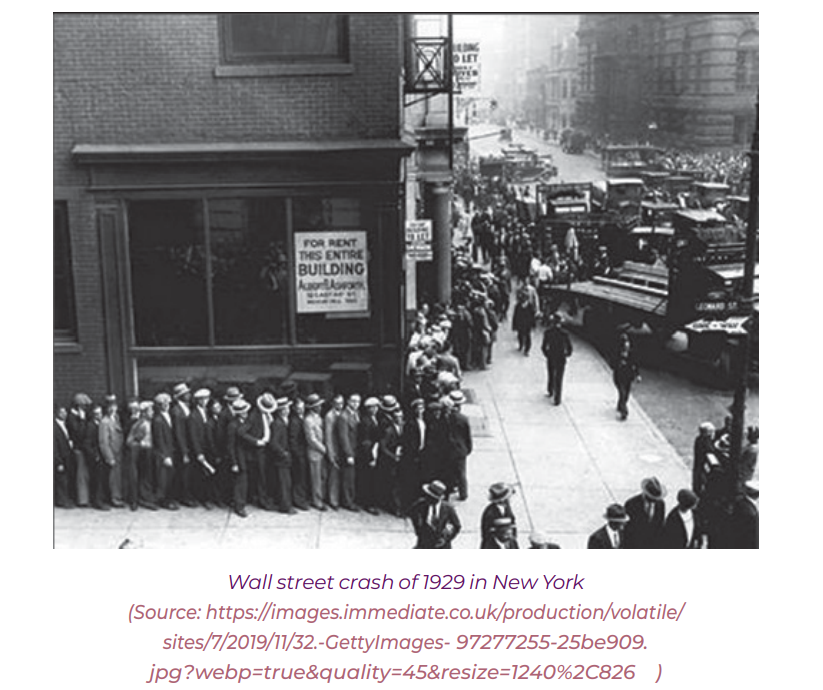
The consequences of the First World War: These include
destruction of industries, communication lines, airports and cities and
loss of lives, which had a negative effect on production and the ability topurchase goods, hence leading to the depression.
The Rise of economic nationalism and isolationist/protectionist
policy led by USA: This policy was used by USA to protect infant
industries at home and it was adopted by other countries mainly in
Europe. This eventually worsened the international trade situation, leading
to the economic depression.
General reduction in the level of international trade during and after
the First World War: The world trade remained low because nations
were unable to import in large quantities. This was due to the low
level of consumption and that was why the depression started inAmerica whose manufactured goods could not be brought.
Payment of the war indemnity by Germany: This was imposed by
the victorious powers during the signing of the 1919 Versailles
Peace Treaty and it greatly affected the German economy; they
printed many bank notes leading to inflation. This contributed to the
outbreak of the economic depression.
Overproduction mainly in the agricultural sector: This was
experienced by various capitalists during the inter-war period in USA,
Britain and Canada. However, when international trade was paralyzed
and there was “no buying and no selling” this resulted in the economicdepression.
System of high taxation in order to escape from “after war
situation”: This policy was adopted by many countries to help their
economy recover from the after effects of the First World War. However,
these heavy taxation policies were too harsh and distracted investment
which also led to the increase of unemployment, low circulation of
money and inflation, leading to economic depression.
Poor trading policy adopted after the First World War: The
defeated powers were not allowed to export to victorious powers and,
worse still, the victorious powers started selective trade as punishmentto defeated ones which led to the economic depression.
Unfair income distribution: This existed especially in USA where
between 1923 and 1926 big companies were owned by a few
capitalists. They provided employment to the few people who
also earned low salary. This led to low purchasing power and lack
of effective demand which contributed to the world economic
depression.
Gold standard system operating in world economies by 1929:
Under this system each economy was supposed to have money in
circulation that was equal to the total value of gold in its reserves. This
system limited money supply for some countries that had small
gold reserves and caused low aggregate demand, leading to theworld economic depression.
The Crash of the world stock exchange in USA, October 24, 1929 (Black
Thursday): This led to the closure of 4,200 banks and people who had
kept their money in these banks suffered great losses. The industries
could no longer secure loans, yet their products could not sell and
eventually they also closed down. This led to huge unemployment,
surplus products, low purchasing power and, consequently to theworld economic depression.
Measures to overcome the world economic depression
After the occurrence of the economic depression, different countries started
to look for various measures to control and fight it.
Germany, on her part, attempted to solve the economic depression by
violating the 1919 Versailles Peace Treaty terms when she stoppedpaying the war indemnity and also started serious industrialization.
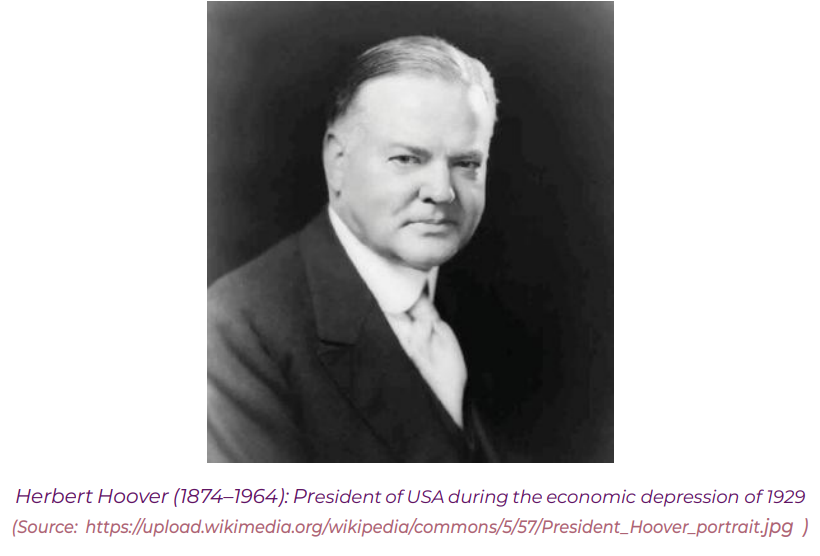
USA fought the economic depression by using the “New Deal”
programme introduced by President Franklin Delano Rooseveltin 1932. By this programme, new laws were made to regulate the
stock market and protect bank depositors’ savings. Other steps
included creation/establishment of programmes which created jobs
for the unemployed like the Tennessee Valley Authority (TVA), and
construction of schools and hospitals. The USA also set up a social
security system and depreciated the value of her dollar so as toincrease the purchasing power of the Americans.
Basically, Roosevelt had three aims:
• Relief: To give direct help to the poverty-stricken millions who
were without food and homes
• Recovery: To reduce unemployment, stimulate the demand for
goods and get the economy moving again
• Reform: To take whatever measures necessary to prevent arepeat of economic disaster
The gold standard system was stopped since this played a role in the
outbreak of the world economic depression.
A world economic conference was held at Geneva in 1933, Switzerland
and was attended by 66 countries that worked out different solutions
to end the economic depression. These solutions included removing
obstacles to free trade, and implementing a uniform tax on importsand exports.
World powers attempted to solve the economic depression by
invading weak states so as to solve the problem of lack of raw
materials and markets for their goods. For example, in 1935 Italy
invaded Ethiopia, in 1936 Germany invaded Czechoslovakia and in1939, Poland.
Different countries formed regional economic integration as a
solution to end the economic depression. The Scandinavians formed
the Oslo Block, USA and South American states also formed aneconomic block.
Unemployment relief schemes were adopted by various countries
such as USA, Britain and France to benefit the unemployed citizens
above 18 years.
Most European countries made efforts to improve on their agricultural and
industrial sectors in order to increase the level of production as a way ofaddressing the problem of low supply and inflation.
Dictatorship was resorted to by most of the European leaders to
suppress demonstrations and strikes.
Some countries restricted borrowing and lending of money on
grounds that the money borrowed for investment ended up beingconsumed. This reduced on the debt burden in various countries.
Effects of the world economic depression Content
• The world economic depression led to human suffering due to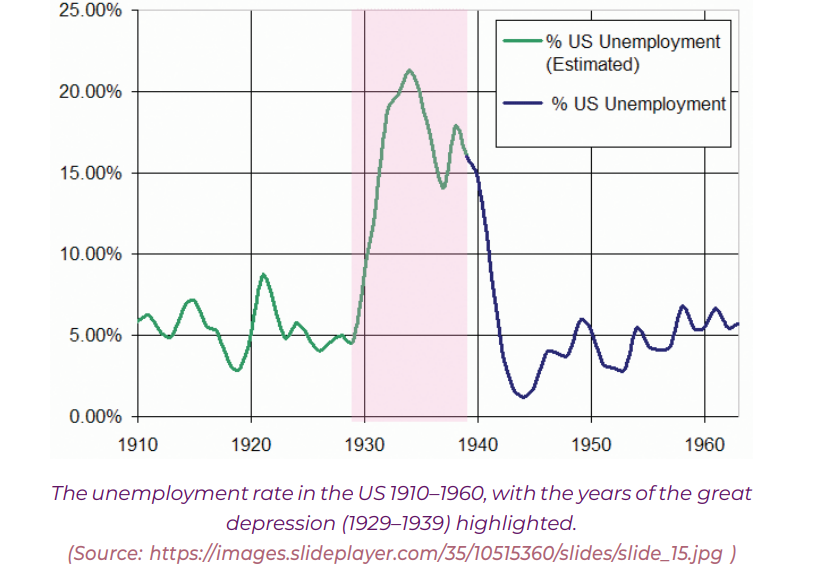
unemployment, low incomes, and lack of basic facilities.
• The economic depression led to the rise of dictators in Europe
such as Adolf Hitler in Germany, Benito Mussolini in Italy and
General Franco in Spain.
• The economic depression contributed to the weakness of the
League of Nations as various member states could not meet the
financial obligations of the League.
• The economic depression led to international aggression by
powerful countries against the weak ones as a way to solve
their economic problems; For example Japan and China, Italy
and Ethiopia and Germany and Austria.
• The economic depression led to the decline in world trade as the
affected countries started trade protectionism; for example, USA.
• The economic depression led to the formation of regional
economic integration as a way of promoting trade among the
different countries.
•The economic depression led to the end of the use of the gold
standard system.
•The economic depression caused a severe fall in the standards of
living of people as the cost of living became higher after the closureof many businesses and this affected production levels.
The economic depression increased the popularity of some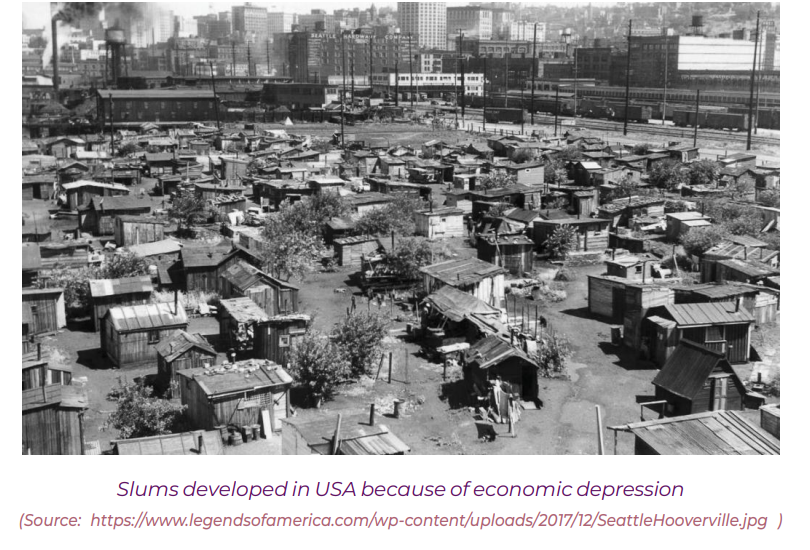
economists such as John Maynard Keynes who introduced
an economic theory popularly known as “Keynesian theory of
unemployment” after analyzing the causes of the economicdepression.
The economic depression led to the outbreak of the Second World
War because of the rise of dictators, and weaknesses of the League of
Nations which failed to check aggression.
Effects of the Economic Depression in Africa Between 1929 and
1932
The Economic Depression of 1929 had greatly impacted African
continent. For example, the world prices for sisal, coffee, maize andhides fell by 70 per cent while cotton prices fell by over 60 per cent.In addition, to some extent the region benefited from efforts elsewhere to
counter the depression. From 1932, the British Empire provided shelter
to the producers of coffee and sisal. The abandonment of the gold
standard by Britain in 1931 and by the USA in 1933 caused the price
of gold to rise by two-thirds between 1931 and 1935. This stimulated
the exploitation of East Africa’s scattered deposits and by 1938 goldwas the second largest export from both Kenya and Tanganyika.
Meanwhile, some imports became cheaper. Despite imperial
preference, East Africa was prevented by the Congo Basin treaties
from discriminating against cheap Japanese manufactured goods,and these became available in large quantities.
In the course of the 1930s, Japan captured much of the East African
market for cotton and silk goods, and for the great mass of consumers
this was clear gain. Government revenues, between 1929 and 1932, fell
on average by 15 per cent but they too had fixed debt charges to pay,
such as pensions. So there were cut-backs in administration and social
services. On reduced incomes, most Africans had to pay as much
tax as before, while most European farmers had large debts to service.
Financial constraints reinforced the political arguments against anycomprehensive scheme for closer union in East Africa.
In East Africa, Tanganyika suffered most from the depression.
Between1929 and 1931 exports slumped from £3.8m to
£1.7111, and government revenue fell by a quarter from 1925 to 1929).
The government already spent one-quarter of its revenue on debt
charges, but it had to borrow heavily in 1932 from the British Treasury,which enforced stringent policies.
At the same time, the railway lost its share of the Katanga copper
traffic (which in 1930 supplied half its freight earnings) to the new
Benguela railway. In 1930 the Tanganyika Sisal Growers Association
was formed, mainly to reduce wages; its president was the unofficial
leader in the legislative council, and in 1937 British settlers dominated
a government commission on labour. In 1932 the government
launched a ‘plant more crops’ campaign, but it was chiefly directed
at those areas in the north and north- west where export crop-
production was already established. The persistent decline in coffeeprices aggravated tensions between chiefs and other farmers.
Application Activity 4.1
1. Explain two causes of the world economic depression
2. How was the economic depression controlled orsolved?
4.2. Totalitarian regimes in EuropeLearning Activity 4.2
In your exercise book do the following activities:
1. Define a totalitarian regime
2. Name the totalitarian regimes in Europe between thetwo World Wars.
Most western countries were governed by elected representatives.
From the 1900s some people began to feel that a government made up
of such a large body of people spent too much time debating and
wondered if was not better to have one strong leader who could
make decisions for them. A single leader could act quickly to solve a
country’s economic problems during world economic depression.
These regimes were known as “totalitarian regimes”. In Italy it
developed under Benito Mussolini and was known as Fascism. InGermany it developed under Adolf Hitler and was known as Nazism.
Totalitarianism (or totalitarian rule) is a political system where the state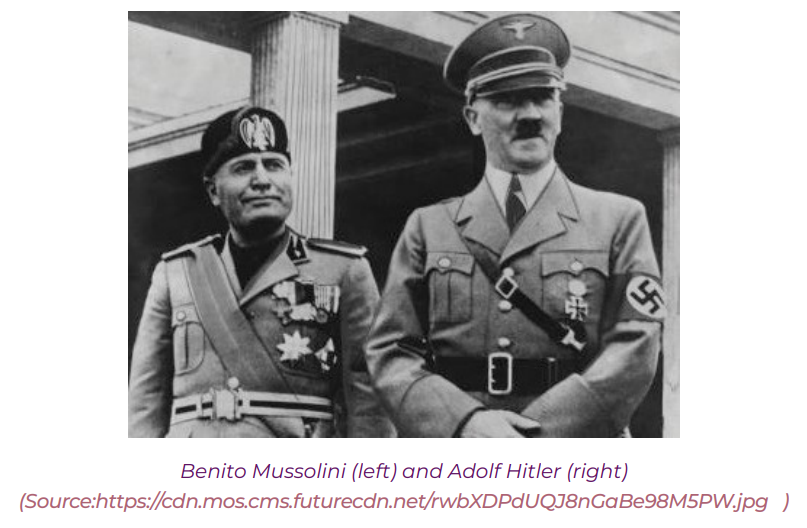
recognises no limits to its authority and strives to regulate every
aspect of public and private life wherever feasible. Totalitarian regimes
stay in political power through an all-encompassing propaganda
campaign, which is disseminated through the state- controlled
mass media, a single party that is often marked by political repression,
personality cultism, control over the economy, regulation and restriction
of speech, mass surveillance, and widespread use of terror. It is not
synonymous with dictatorship, as authoritarian regimes also exhibit
dictatorial features, but do not create an ‘all-controlling, all-politicised’society.
Characteristics of Nazism and Fascism
Two totalitarian regimes, Nazism and Fascism, developed in different
countries and were led by different leaders but had the same and
common characteristics or principles such as:
•Extreme nationalism i.e. emphasis on rebirth of the nation after
a period of decline with an implication that one’s own state is
superior to all.
•Dislike of the importance of Human Rights (abuse of Human
Rights).
• Identification of enemies or scapegoats as a unifying cause in
order to divert the people’s attention from other problems.
•Supremacy of the military or avid militarism because the ruling
elites were always identified closely with the military and the
industrial infrastructure that supported it.
•Rampant / extensive sexism where males dominated and these
regimes inevitably viewed women as second class citizens
•Over-control of mass media through the control of licensing and
access to resources, economic pressure, appeal to patriotism,
and implied threats.
•Obsession with national security, that was under direct control
of the ruling elite. It was usually an instrument of oppression,
operating in secret and beyond any constraints.
•Defence and protection of religion because fascist regimes
attached themselves to the predominant religion of the country
and wanted to be considered as militant defenders of the religion.
•Suppression of intellectuals and artists because intellectual
and academic freedom were considered subversive to national
security and the patriotic ideal. To these regimes, art and
literature should either serve the national interest or they had
no right to exist.
• Fraudulent elections in form of plebiscites or public opinion
polls which were usually bogus. When elections with actual
candidates were held, they would usually be perverted by the
elite to get the desired result.
Rise of Fascism and Mussolini in Italy
The term Fascism is derived from the latin word fasces. The fasces,
were a bundle of rods tied around an axe, as a symbol of a magistrate’s
authority in ancient Rome. They were carried by his agents and could
be used for corporal and capital punishment at his command. The word
fascismo also relates to political organisations in Italy known as fasci,groups similar to guilds or syndicates.
The symbolism of the fasces suggested strength through unity: a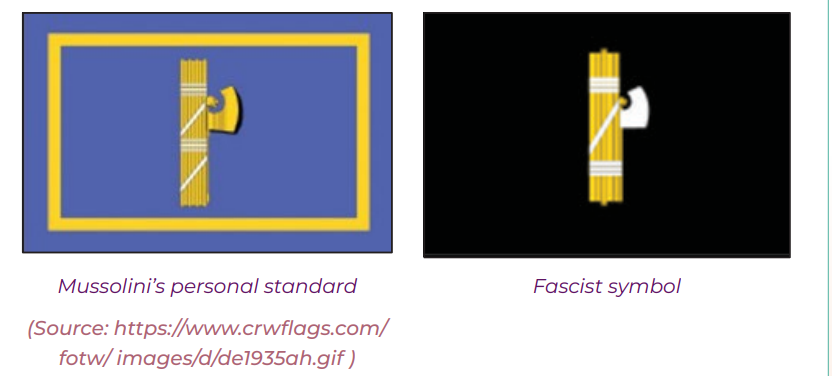
single rod is easily broken, while the bundle is difficult to break.
Background of Mussolini
Benito Mussolini: was an Italian politician who led the national fascist
party, ruling the country from 1922 to his ousting in 1943, and is credited
with being one of the key figures in the creation of Fascism.
Mussolini was born in a small town of Romaginia in Italy on July 29th,
1883. His father was a blacksmith and a socialist, while his mother was
a devout Catholic schoolteacher. Owing to his father’s political leanings,
Mussolini was named Benito after Mexican reformist President Benito
Juárez, while his middle names were from Italian socialists. Mussolini was
the eldest of his parents’ three children.
At the age of 9, Mussolini began his education and graduated as a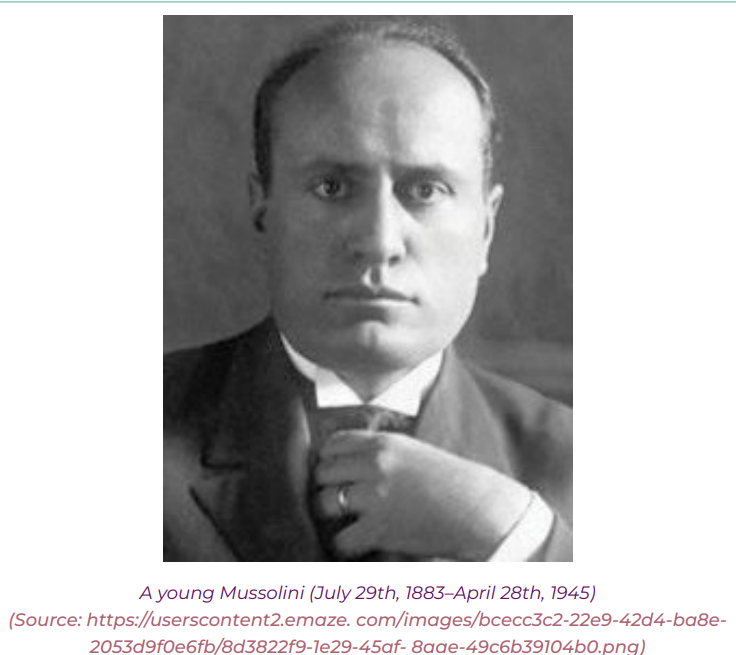
teacher with a diploma in education in 1907. He later abandoned
his education career and joined journalism as a newspaper editor.
Mussolini fought for Italy in the First World War and was wounded.
In March 1919, at Milan city in Italy, he formed a political movement
called the fasci italiani di combattimento (Italian combat leagues
or squad) whose members became known as fascists. It was
composed of frustrated jobless youth, industrial capitalists and themiddle class.
In 1922, Italy witnessed a successful fascist revolution that led to therise of Mussolini supported by the black shirts or army guards.
On October 28th, 1922 he organised a “March to Rome” and when King
Victor Emmanuel III was convinced by the parliament to suppress
the marchers and he refused, the cabinet under Prime Minister LuigiFacta resigned without firing a shot.
King Victor Emmanuel then handed over power to Mussolini by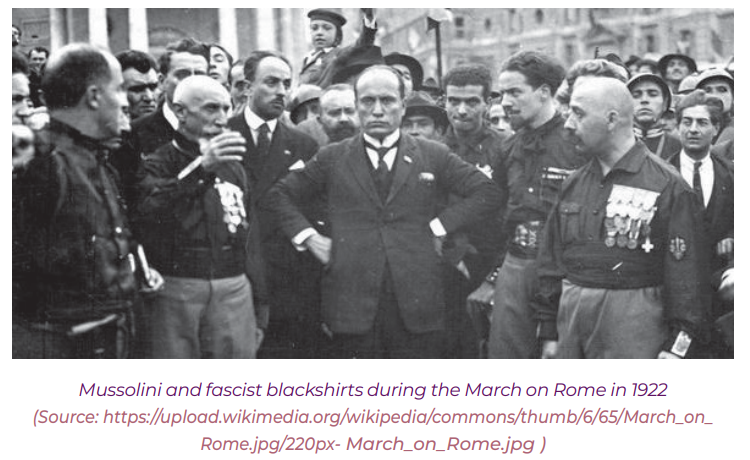
inviting him to form a new government on October 28th, 1922 and
the fascist party took control of Italy. Mussolini was supported by themilitary, the business class, and the liberal right-wing.
Factors for the rise of Mussolini and Fascism in Italy
Mussolini rose to power due to strong support from the Italian
peasants by exploiting the bad social and economic conditions of
the time. Through his speeches to the Italians, he promised them
better conditions and employment for all; and as a result, the majority of
Italians supported him as a promising leader.
Mussolini had a strong personality and it was very instrumental in
his rise to power. He was a good orator who spent most of his time
broadcasting his ideas to the Italians. This made his fascist party
attractive to many sections of the Italians like the middle class, theunemployed, ex-soldiers and industrialist capitalists.
The influence of the communists and socialists in Italy forced the
middle class and industrialist capitalists to support Mussolini who was
anti-communist. With this support, he overthrew the governmentof Victor Emmanuel III.
World War I had weakened the Italian economy and the King failed to
carry out the necessary socio-economic reforms. Mussolini used this
to denounce the government and mobilised a lot of support thathelped him to rise to power.
Corruption and embezzlement of public funds by the officials in the
democratic government of Victor Emmanuel III also paved the way
for Mussolini’s rise to power in 1922 because these officials were notinterested in solving the problems of the time.
King Victor Emmanuel III was very weak in maintaining order in
Italy and this assisted Mussolini to come to power. When he used
violence as a means to end the political chaos he was supported bythe young people.
The formation of a Fascist terrorist group known as “Black Shirts”
helped Mussolini to attain power. This group used a lot of violence
throughout Italy and killed many people who opposed Mussolini and
the king failed to control the situation. To avoid prolonged violence
Italians supported Benito Mussolini to overthrow the government
of Victor Emmanuel III.
The parliamentary elections in May 1921 increased the number of
fascist MPs from 2 to 35. They increased propaganda against theregime of Victor Emmanuel III.
The 1919 Versailles Peace Treaty, which unfairly rewarded Italy made
the democratic government of Victor Emmanuel II unpopular and this
contributed to the rise of Mussolini to power.
The king was politicaly inefficient and refused to use force against
Mussolini. Handed over power to him in 1922.
Mussolini’s internal policy and his methods to consolidate himself in power
After Benito Mussolini rose to power on October 28th, 1922; his regime
from 1922–1943 was built on the principles of Fascism that centred on
extreme nationalism and totalitarianism. Mussolini did not believe in anyform of democracy.
In order to consolidate his power in Italy Mussolini used the followingmethods:
He employed force and violence to get rid of any form of opposition. The
socialist newspaper offices were attacked and closed down. Hundreds
of anti-fascist elements were arrested and killed on his orders and
others were sent exile on Lipali islands in the Mediterranean Sea.
Strict censorship of the press was imposed from 1925 onwards forthe purpose of controlling public opinion.
Mussolini banned all political parties and this left the fascist party
unchallenged. He put an end to free election rights in Italy in order tomaintain the fascist party’s domination in parliament.
He created the fascist army, spies and “ovra” or secret police and
encouraged the Black Shirts to terrorise and control the oppositionleaders.
Mussolini entered an agreement known as Lateran pact in 1929
with Pope Pius XI. His target was to solve the long term problems
between the Catholic church and the state. By this treaty, the
prisoners of the Vatican were set free and Catholicism was recognised
as the state religion. The Vatican became an independent state
within Italy and in return the Papacy recognised the Italian state andthe fascist government of Mussolini.
He abolished intellectual freedom, institutions were to teach
according to fascist ideologies and teachers and university
professors had to swear that they would never teach materials not
in line with the fascist government. Whoever disobeyed his principles
was dismissed automatically. This system of intimidating especially
the university professors ensured minimal opposition to the fascistgovernment.
Mussolini undertook public programmes, which created jobs for
the unemployed. This was propaganda to prove that the fascist
government was providing employment to all, thus capturingmajority support from the Italians.
Mussolini went ahead to form an all-inclusive government by
including members of the opposition in his government. He did
this to make it easy to eliminate them and their influence. This in a way
eased the tension from the opposition and led to the success of BenitoMussolini and his fascist regime.
In 1923 Mussolini acquired the town of Fiume from Yugoslavia with
the signing of the treaty of Rome which made the Italians happyand in turn increased support for Mussolini’s regime.
Mussolini carried out fundamental reforms in the industrial sectorwhereby old industries were rehabilitated and new ones were built.
These included FIAT (Fabrication Italienne Automobile à Turin)
company, oil refineries, and iron and steel industries which increasedMussolini’s fame.
Failures of Benito Mussolini
Mussolini established the fascist state in Italy based on dictatorship and
leadership by decree. This inflicted a lot of suffering on the Italian
masses. He denied Italians their democratic rights. Leadership
through elections came to an end with his coming to power andreferendums were introduced.
He made Fascism the only political system. Political pluralism was
suffocated and in 1925 the party system was abolished. This was
brought about by repressive measures on communist supportersmany of whom were imprisoned.
Mussolini denied Italians all freedom. There was censorship of the
press, no freedom of speech, association and worship, among others.Injustice was widespread and majority of Italians lived like prisoners.
Mussolini failed to control malpractices within the government.
There was rampant corruption and embezzlement of governmentfunds. By 1930, the Italian economy had deteriorated by all standards.
He failed to stabilize the exchange rate and he devalued the Italian currency.
Italian wages and standards of living were the lowest in Europe at thetime.
Discrimination was rampant in all sectors of the society. Even socialservices were not extended to the poor in the rural areas.
He promoted anti-semitism, which was the negative attitude, hatred and
segregation against the Jews. The union between Mussolini and
Hitler and their ideology were hated throughout Europe and this
forced European communities to unite and fight against them anderadicate their ideologies of Nazism and Fascism.
Mussolini followed aggressive policies when he involved Italians in
hostilities and military confrontation with other Europeans, leading
to the outbreak of the Second World War. He was therefore responsiblefor the disastrous war between 1939 and 1945.
Rise of Adolf Hitler and Nazism in GermanyBackground of Adolf Hitler and Nazism
Adolf Hitler (1889–1945) was an Austrian-born German politician
and the leader of the National Socialist German workers party,
commonly referred to as the Nazi Party. He was Chancellor of
Germany from 1933 to 1945 and dictator of Nazi Germany from 1934
to 1945. Hitler was at the centre of the founding of Nazism, the start ofSecond World War, and the holocaust.
Adolf Hitler was born on 20 April 1889 in Austria-Hungary. He was
the fourth of six children. When Hitler was three, the family moved toPassau in Germany.
After his father’s sudden death on 3 January 1903, Hitler’s
performance at school deteriorated. His mother allowed him to quitin autumn 1905.
From 1905, Hitler lived a casual life in Vienna, financed by orphan’s
benefits and support from his mother. He worked as a casuallabourer and eventually as a painter, selling watercolors.
In May 1913, Hitler moved to Munich in Germany and at the outbreak
of the First World War, Hitler was a resident of Munich and volunteeredto serve in the Bavarian army as an Austrian citizen.
After the First World War Hitler returned to Munich. Having no formal
education and career plans or prospects, he tried to remain in the
army for as long as possible. In July 1919, he was appointed intelligence
agent to influence other soldiers and to infiltrate the German workers’
party. While monitoring the activities of the Germany Workers’ Party, Hitler
became attracted to the founder Anton Drexler’s anti-semitic, nationalist,anti-capitalist, and anti-marxist ideas.
To increase its appeal, the Germany Workers’ Party changed its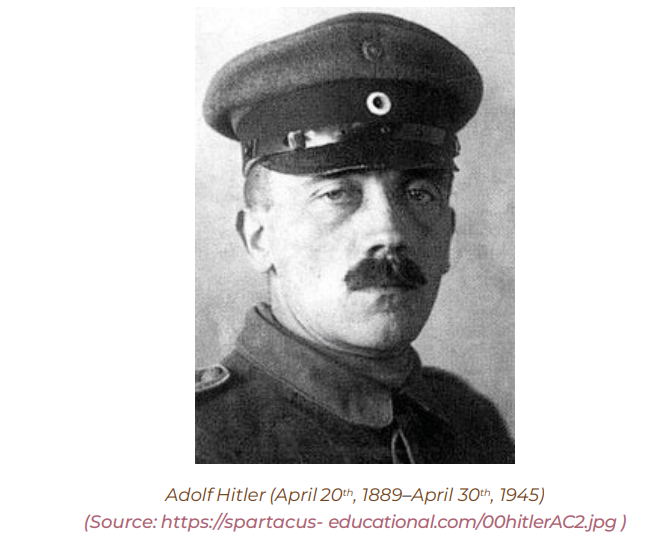
name to the National socialist German workers party, known as
NAZI. Hitler designed the party’s banner of a swastika in a white circlewith a red background.
Like Mussolini, Hitler organised his supporters into fighting squads,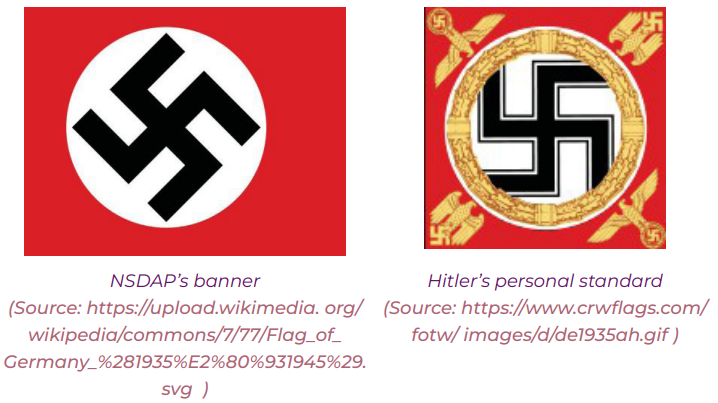
the Nazi storm troopers who battled in the streets against communism
and others they saw as enemies. On November 8th, 1923, Adolf Hitler
attempted a coup d’état against the Bavarian government, but thepolice foiled it.
Hitler was arrested on April 1st, and sentenced to five years’imprisonment.
While in prison, Hitler dictated most of the first volume of Mein Kampf
(My Struggle). The book, was an autobiography and an exposition
of his ideology. The book laid out Hitler’s plans for transformingGerman society into one based on race.
Mein Kampf reflects Hitler’s obsessions, extreme nationalism through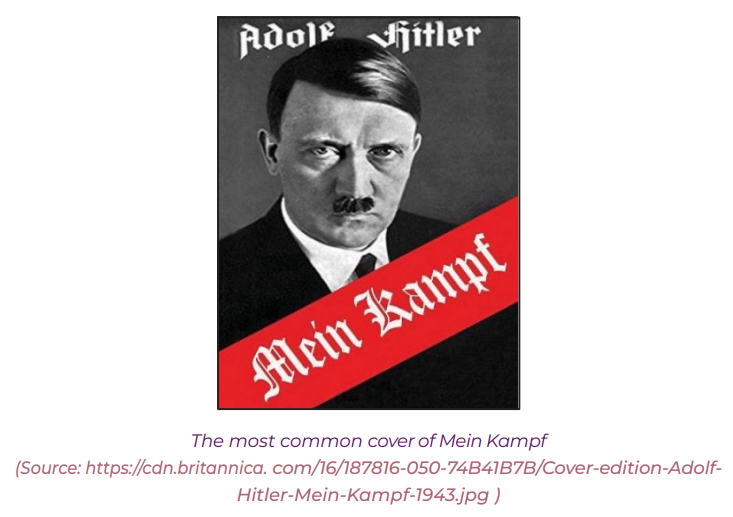
the concept of lebensraum (living space), racism and anti-semitism.
He said that the Germans belonged to a superior “master race” of
Aryans or light-skinned Europeans, whose greatest enemies were theJews.
The Bavarian supreme court issued a pardon and he was released
from jail on December 20th, 1924. Hitler had served just over one year
in prison. Thereafter, he became the “principle leader” of the Nazi
party.
By 1933, the strength and the threat of Hitler’s Nazi party forced
the president to appoint him as a chancellor, which favoured his rise to power.
When President Hindenburg died on August 2th, 1934 Hitler became
führer (leader and chancellor) and supreme commander of the armedforces.
Factors for the rise of Adolf Hitler to power in Germany
In order to achieve his goal of building Germany and uniting all
Germans in one great nation, Hitler realised that Germany needed a
strong and able leader or führer. He was determined to become thatleader. The following factors helped him to rise to power:
Weakness of the Weimar Republic: This republic was unpopular
as it failed to secure better terms from European powers in the 1919
Versailles treaty. It lacked able leadership that could suppress violencewhich Hitler exploited to rise to power.
Effects of World War I and unfair terms of the 1919 Versailles
settlement over Germany: The First World War left Germany
economically weak and the Versailles settlement imposed heavy war
reparations that caused socio-economic problems to the Germans.
Hitler based his ideas on this to blame the government, promising to
liberate the Germans from such misery through Nazi leadership.
This attracted the middle class, the jobless, and industrialists makinghis party strong by 1933.
Effects of the world economic depression of 1929: During this
economic depression the Nazi party became popular with more
followers as Hitler emphasized that problems like unemployment
with 6 000 000 unemployed Germans was due to the Versaillessettlement; and Germans looked at Hitler as their saviour.
Role of the Nazi Storm Troopers: This Nazi terrorist squad was
organised by Hitler’s supporters. In the 1932 parliamentary elections
their presence at polling stations intimidated many voters who
ended up by voting for Nazi representatives. The Storm Troopers also
threatened President Hindenburg that he either appoints Hitler as
a Chancellor or risks countrywide violence. And then Hindenburgresigned in 1933 which helped Hitler to rise to power.
Hitler’s personal talent: Hitler was a gifted demagogue with rare
skills; a propagandist and a man who knew what he wanted and
had the ability to know how to get it. He was a great orator and manypeople supported him.
Hitler’s own writings and the Nazi 25 manifesto: While in prison in 1923,
he wrote his book Mein Kampf in which he set out his ideas about
the future Nazi party, thus convincing the middle class and the jobless
to support the Nazi party. By their 25 point-programmes, the Nazi party
called for German nationalism, elimination of Jews and improving the
social life conditions of the poor, which attracted massive support to theNazi party;
Role of the Nazi party: The Nazi members accused the Jews of
betraying Germany in the First World War. The Nazi also defeated
communism. As a result, the majority of Germans, especially middleclass, industrialists and large landowners, supported Hitler.
Traditions of Germans: The Germans had no respect for
democratically elected governments like the Weimar republic. They had
a strong tradition for authoritarian governments led by powerful army
officers like Otto Von Bismarck, who gave them security and militaryglory more than political freedom and democracy.
Unpopulality of communists and socialist in Germany: This forced the
middle class and industrial capitalists to support Adolf Hitler whowas anti-communism.
Death of President Hindenburg: This created a fertile ground for
Hitler’s rise to president by making the post of president vacantwhich Hitler added to himself as the new German ruler.
Consolidation of Adolf Hitler in power in Germany from 1933 up to 1945
Adolf Hitler became Chancellor of Germany on January 30th, 1933 and
assumed full authority after the death of Hindenburg on August 2nd, 1934.
To retain or consolidate his power, Hitler took a number of steps asdiscussed below.
He imposed a strict ban on all other political parties. He dissolved the
Socialist Democratic party on May 22nd, 1933, the Communist Party
on May 26th, 1933 and the Catholic Democratic and Nationalist
party in June 1933. The last political party to be dissolved was the
People’s Party on July 4th, 1933. Hitler declared those political partiesunconstitutional and only promoted the Nazi party.
On March 23rd, 1933 the Nazi Grand Council passed an “enabling
act” in the German parliament, transferring law-making powers from
the parliament to cabinet, thereby suspending the parliamentaryGovernment.
He centralised all powers and changed the administrative structures in
Germany. He passed the special laws of April, June and July 1934 by
which the Jews and socialists were removed from the civil services.
He created new ministries for propaganda, culture, agriculture and
labour. He rewarded the Nazis with white collar employment anddissolved the trade union movement in June 1933.
He used suppressive policies like Geheime Staatspolizei/ the Secret statepolice (Gestapo) and special spies to eliminate his political enemies.
During the night of the long knives alone, the regime executed atleast 85 people for political reasons.
He suppressed the press, broadcasting, literature, drama, music,
painting, public films and only publications reflecting Hitler’s tastes were
allowed in Germany. This was intended to keep the masses ignorant
of his failures. All books which had anti-Nazi ideas were collected andburnt in a huge fire in Berlin in 1935.
The clergy and professional teachers had to sign an oath promising
never to teach materials that were against the Nazi Party. He
controlled the Catholic Church through the concordat of 1933 with thePope.
He built a strong army that was used against internal and external
enemies. He transformed the Storm Troopers into a highlydisciplined and equipped army.
Hitler overcame the pre-1933 economic problems, which earned
him more support from Germans and no one would think of fighting oropposing him.
He created a system of the youth movements of boys and girls of
14 years called the “Hitler youth” and “league of German maids”
respectively who were taught that Hitler was ever right and were also toldto report their parents if they were anti-Nazi to the secret police.
He violated the Versailles Treaty and used an aggressive foreign and
revenge policy, re-armed Germany, withdrew Germany from the
League of Nations ,and expanded Germany by attacking Austria,
Czechoslovakia and Poland. This earned Hitler more support from theGermans, although it contributed to his downfall in 1945.
Factors for the downfall of Adolf Hitler and Nazism in 1945
Adolf Hitler eventually met his downfall largely because of World War
II which we will study in Unit 7. In addition he had other problemsas discussed on the next page:
Dictatorship coupled with excessive oppression like the banning
of political parties, and harassing and killing of his political opponents,caused Germans to turn against him.
The size and heterogeneous nature of the German Empire
which by 1942 included Germans, Austrians, Poles, Dutch and
Czechoslovakians, became too big and diverse for Adolf Hitler tocontrol.
Hitler had a poor political agenda and weak principles. He allowed the
radical ex-service men of the First World War who were not politicallyinformed to dominate the Nazi Party.
Hitler’s withdrawal of Germany from the League of Nations isolated himfrom global affairs, making him unpopular.
The aggressive foreign policy of Hitler especially in Austria,
Czechoslovakia and Poland contributed to the outbreak of theSecond World War that eventually led to his downfall.
The decline of the Germany economy due to the bombardment of
factories and industries by the allied forces of Britain, France and USAduring the Second World War harmed Hitler’s popularity.
As we will see later, the Germans were eventually defeated in Second
World War and Hitler committed suicide in Berlin as his enemies
advanced on him. It is necessary to note that before Hitler committedsuicide, senior army officers had made several attempts on his life
Application Activity 4.2
1. Determine the common characteristics of Nazism and
Fascism in European affairs
2. Discuss the factors for the rise of Benito Mussolini inItaly in 1929
Unit summary
The period between the two wars was marked by; the 1929 economic
depression and the rise of totalitarian regimes like Fascism of Benito
Mussolini and Nazism of Adolf Hitler. The rise of Fascism in Italy and
Nazism in Germany compromised peace in Europe due to the effects
the 1929 economic crisis. This situation led to the outbreak of theSecond World War which lasted for five years.
Glossary
Banner: Symbol or emblem of an organisation.
Censorship: the suppression or prohibition of any parts of books,
films, news that are considered a threat to security or unacceptable.
Demagogue: a political leader who seeks support by appealing to
popular passions and prejudices
Disdain: lack of respect accompanied by a feeling of intense dislike
Fraudulent: intended to deceive
Indemnity: a sum of money paid in compensation for loss or injury
Inflict: cause of something unpleasant or painful to be suffered by
someone
Ousting: the act of ejecting someone or forcing them out
Pervert: distortion or corruption of what was first intended
Plebiscite: a vote by the electorate determining public opinion on
a question of national importance
Rampant: unrestrained or unchecked
Subversive: a radical supporter of political or social revolution or in
opposition to a civil authority or governmentSuicide: the act of killing oneself
End of Unit Assessment
1. What does “world economic depression” mean?
2. Explain the causes of the world economic depression of
1929
3. Identify the consequences of the economic crash on
USA and world economies?
4. Examine the factors for the rise of Benito Mussolini in Italy.
5. Account for the rise and fall of Adolf Hitler and Nazism inGermany.