Lesson 2: Bloom’s Taxonomy
Page 4
Affective
Goals: Developing Attitudes & Values The affective domain of Bloom’s Taxonomy
includes how people relate emotionally. It helps us understand the development
of attitudes and values. Attitudes and values are an important part of the
competence-based curriculum, and therefore teachers must consider how they use
classroom time to encourage the development of learners’ positive attitudes and
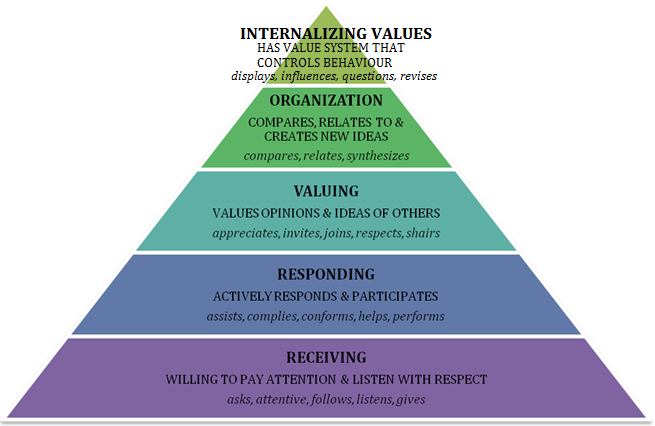
values. Figure 17 Affective Domain of
Bloom’s Taxonomy Following are more detailed descriptions of each
affective level as well as examples of outcomes a teacher can see in the
classroom to evaluate learners’ progress along the taxonomy. Table 9 Affective Level and
Examples of Outcomes Level of Expertise Description of Level Example of Measurable Outcome Receiving Demonstrates a willingness to participate. Gives
attention by choice. In class, the learner is attentive and takes
notes. Responding Shows
interest in the content or activity by seeking it out or pursuing it for
pleasure. Volunteers and is ready to respond. The learner completes assignments and participates
in class discussions. Valuing Appreciates
or values the content or activity. Motivated to participate. Chooses to behave well.
Begins to identify with a value and commit. The learner looks for additional information outside
of class (on internet, news, etc.). Organization Can compare and contrast values and choices. Begins
to order and prioritize values. Chooses to commit to certain values and
behaviors. When confronted with ideas and values that differ
from their own, the learner listens and relates them to their own. Internalizing
Values Adopts a long-term value system that is consistent
and predictable. Can talk about their own beliefs and live by a personal code
of ethics. The learner is interested to meet people with other
values and ideas.
This is the end of Lesson 2.